How much to raise in a seed round comes down to one calculation: the monthly burn needed to hit your next milestone, multiplied by the months it takes to get there, plus a buffer of six months for the raise after that. Most UAE seed rounds land between about USD 1 million and 3 million, but your number should come from your plan, not the average.
- 1
Why getting the seed round size right matters
Raise too little and you are back in front of investors in 12 months, with half the progress you promised. Raise too much and you give away more of the company than you needed to, or you scare off investors who think the number does not match your stage.
The bar for the next round is also high. Only 7.3% of early-stage startups in MENA go on to raise a Series A (10.9% in the UAE). The founders who make it usually raised enough to hit a clear milestone with time to spare.
That is why the round size question sits at the centre of our startup CFO work. Everything else in the raise, from valuation to the use of funds slide, follows from it.
- 2
What drives how much a seed startup should raise
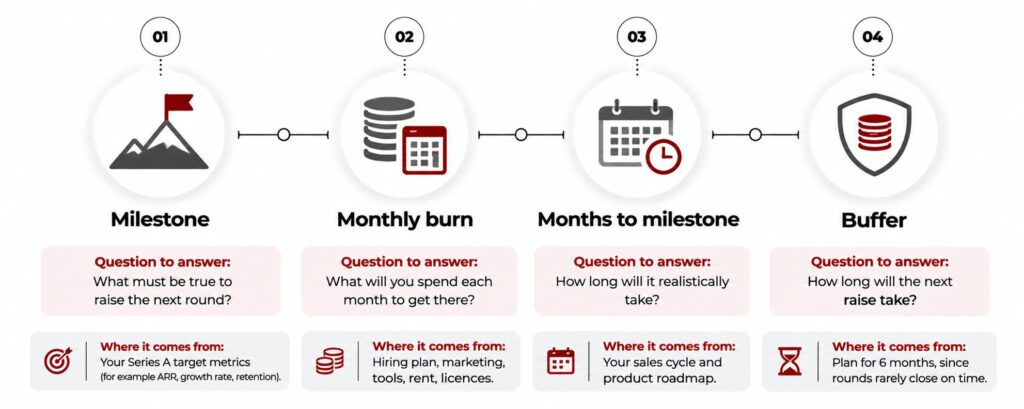
Four inputs decide the number:
| Input | Question to answer | Where it comes from |
|---|---|---|
| Milestone | What must be true to raise the next round? | Your Series A target metrics (for example ARR, growth rate, retention) |
| Monthly burn | What will you spend each month to get there? | Hiring plan, marketing, tools, rent, licences |
| Months to milestone | How long will it realistically take? | Your sales cycle and product roadmap |
| Buffer | How long will the next raise take? | Plan for 6 months, since rounds rarely close on time |
Runway expectations have moved. Investors increasingly look for 24 to 30 months of runway after a raise, up from the old 18-month rule. If your plan gives less than 18 months, expect pushback.
- 3
How to calculate how much to raise, step by step
- Set the milestone. Write down what the next investor needs to see. For a B2B SaaS company, that might be AED 3.5 to 4 million ARR with net revenue retention above 100%.
- Build the hiring plan. List every hire, the month they start and their full cost, including visa, Emirates ID, medical insurance and end-of-service gratuity.
- Add the non-people costs. Licence renewal, office or flexi desk, software, marketing, legal and accounting.
- Calculate monthly net burn. Total monthly costs minus monthly revenue. Burn usually rises over the period as the team grows, so use the month-by-month figure, not one average.
- Count the months to the milestone. Be honest about sales cycles. Enterprise deals in the GCC can take three to six months to close.
- Add the buffer. Six months of burn at the end-of-period rate, to cover the next raise.
- Sense-check the dilution. Seed rounds commonly sell somewhere around 10% to 25% of the company. If your number only works by selling 35%, revisit the plan or the milestone.
Our runway calculator does steps 4 to 6 for you. If you are trying to stretch the cash you already have instead, read our guide on how to extend startup runway.
✅ Action to Take
Write your milestone first and keep it to two or three numbers. A round sized for a vague milestone is a round sized by guesswork.
- 4
A worked example for a Dubai startup
A Dubai B2B SaaS company has AED 40,000 of monthly revenue and a team of 6. Its plan to reach Series A readiness looks like this (example assumptions):
| Line | Months 1 to 12 | Months 13 to 24 |
|---|---|---|
| Team (average headcount) | 10 | 14 |
| Salaries and people costs | AED 330,000 a month | AED 470,000 a month |
| Office, licence, visas and admin | AED 35,000 a month | AED 45,000 a month |
| Software and hosting | AED 25,000 a month | AED 35,000 a month |
| Marketing | AED 60,000 a month | AED 90,000 a month |
| Revenue | AED 90,000 a month (average) | AED 260,000 a month (average) |
| Net burn | AED 360,000 a month | AED 380,000 a month |
The maths:
- 12 months at AED 360,000 = AED 4.32 million
- 12 months at AED 380,000 = AED 4.56 million
- 6-month buffer at AED 380,000 = AED 2.28 million
- Total: AED 11.16 million, or about USD 3 million
If USD 3 million at the founder’s expected valuation means selling 30% of the company, the plan needs work. Options include a slower second-year hiring plan, a smaller marketing budget, or a nearer milestone. Cutting second-year marketing to AED 60,000 a month brings the raise to about AED 10.6 million (USD 2.9 million), which barely moves dilution. Delaying four hires does more.
- 5
How to show use of funds in your pitch deck
Use of funds is the round size, broken down by where the money goes. Investors check that it matches the plan above and that most of it goes into the things that reach the milestone.
A typical seed split looks like this:
- Product and engineering: 35% to 50%
- Sales and marketing: 25% to 40%
- Operations and admin: 10% to 15%
- Buffer: 5% to 10%
Show it as percentages on one chart, with the milestone written underneath. Our guide to the pitch deck financials slide shows where it fits in the deck.
- 6
Mistakes founders make when sizing a seed round
- Picking a number because another startup raised it.
- Using today’s burn instead of the burn after hiring.
- Forgetting visa, gratuity and licence costs, which add up fast in the UAE.
- No buffer, so the company starts fundraising again almost as soon as the round closes.
- A use of funds chart that does not add up to the round size.
- Raising in AED or USD without stating the exchange rate in the model (USD 1 = AED 3.6725).
- 7
Work it out yourself or with a CFO?
The method above works on a spreadsheet, and many founders size their own round. Where a CFO helps is in testing the assumptions (hiring timing, sales cycle, burn) and defending the number in investor meetings.
A fundraising project with a startup CFO typically costs about AED 30,000 to 80,000, depending on scope. The exact cost depends on how much support you need through the raise, so book a free consultation for a quote.
Check your round size before investors do
The free JaZaa Startup Pitch Review is a one-hour, one-on-one session for founders raising pre-seed, seed or Series A. We go through your deck and forecast line by line, test your round size against your plan, and send a ranked action list and recording within 24 hours. No cost and no equity ask.
Apply for a review or talk to a startup CFO about your raise.
Common Questions
Raise enough to reach your next milestone plus about six months for the following raise. In practice, many UAE seed rounds fall between about USD 1 million and 3 million, but the right number comes from your burn and timeline, not the market average.
Aim for 24 months or more. Investors in 2026 increasingly look for 24 to 30 months of runway after a raise. Less than 18 months usually means you will be raising again before you have hit the milestone.
Seed rounds commonly sell around 10% to 25% of the company. If your round size only works by selling much more, look again at your milestone, your hiring plan or your valuation expectations.
It shows how the money you raise will be spent, usually as percentages across product, sales and marketing, operations and a buffer. Investors use it to check that the round funds the work needed to reach the milestone.
A buffer of about six months is sensible, because raises take longer than planned. Raising far beyond the plan increases dilution and can make investors question your discipline, so tie any extra to a clear use.
JaZaa CFO Advisory Team
JaZaa is a Dubai-based management consultancy that gives startups and SMEs senior finance support through fractional, virtual, part-time and interim CFO services. The team works with firm owners on billing controls, cash flow, reporting and tax readiness across the UAE.