

Your pitch deck financials slide should show, on one screen, how much revenue you expect, how much cash you will burn to get there, how much you are raising and what milestone that money buys. Seed investors spend under a minute on it. If the four numbers agree with each other, they keep reading. If they do not, the deck goes on the pile.
- 1
Why the financials slide decides more meetings than you think
Most investors read a deck in a few minutes, and the financials slide is where they test whether the story on the earlier slides holds up in numbers. A big market slide followed by a timid revenue line, or an aggressive revenue line with no hiring to support it, raises the same question: does this founder know the business?
It matters more in the current market. UAE startups raised USD 895 million in the first half of 2026, 66% of all MENA funding, but across only 79 deals. Investors are writing fewer, larger cheques and screening harder at the first read.
The slide is also where your startup CFO work shows. Founders with a clean model behind the slide answer follow-up questions in the same meeting. Founders without one promise to “send the numbers later”.
- 2
What seed investors expect to see on the slide
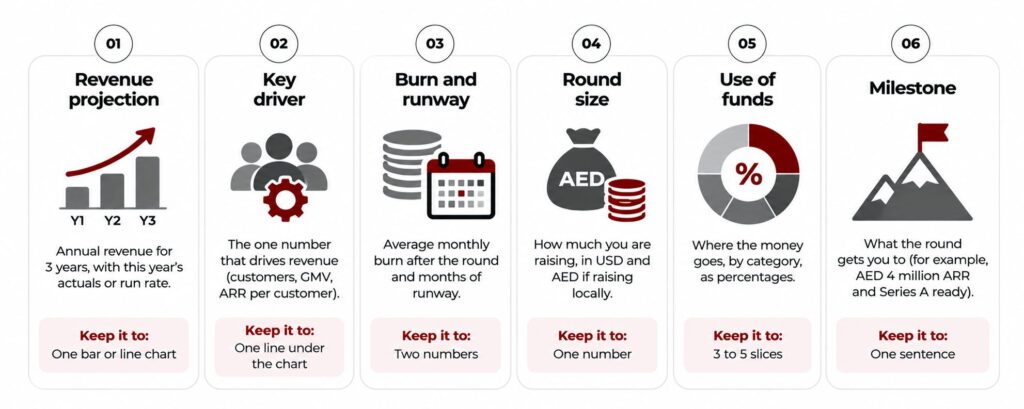
Keep it to the numbers that support a decision. For a pre-seed or seed round, that is:
| Element | What to show | Keep it to |
|---|---|---|
| Revenue projection | Annual revenue for 3 years, with this year’s actuals or run rate | One bar or line chart |
| Key driver | The one number that drives revenue (customers, GMV, ARR per customer) | One line under the chart |
| Burn and runway | Average monthly burn after the round and months of runway | Two numbers |
| Round size | How much you are raising, in USD and AED if raising locally | One number |
| Use of funds | Where the money goes, by category, as percentages | 3 to 5 slices |
| Milestone | What the round gets you to (for example, AED 4 million ARR and Series A ready) | One sentence |
Some founders split this into two slides: one for projections and unit economics, one for the raise and use of funds. Both work. What does not work is a slide that pastes in the full profit and loss.
- 3
How many years of projections to put in a pitch deck
Three years is the right answer for most seed decks. Year one should be grounded in your current pipeline or traction. Years two and three show the shape of growth once the round is deployed.
Five-year projections are fine in the model behind the slide, but on the slide itself they invite investors to argue about year five instead of your plan for the next 18 months. If an investor asks for five years, send the model.
✅ Action to Take
Put actuals for the last 6 to 12 months on the slide, even if they are small. Real numbers next to projections build more trust than a perfect forecast with no history.
- 4
How to build the financials slide, step by step
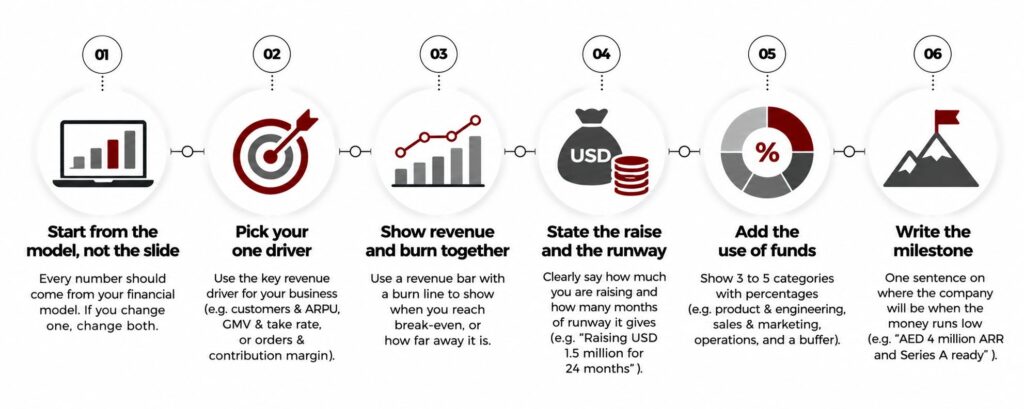
- Start from the model, not the slide. Every number on the slide should be pulled from your financial model. If you change one, change both. Our checklist covers what to fix in the model first.
- Pick your one driver. For SaaS, it is usually customers and average revenue per account. For marketplaces, GMV and take rate. For e-commerce, orders and contribution margin per order.
- Show revenue and burn on the same chart. A revenue bar with a burn line below it tells investors when you reach break-even, or how far away it is.
- State the raise and the runway. “Raising USD 1.5 million for 24 months of runway” is clearer than any chart.
- Add the use of funds. Three to five categories, as percentages. Product and engineering, sales and marketing, operations, and a buffer are enough for most seed rounds. Our guide on how much to raise in a seed round explains how to size it.
- Write the milestone. One sentence on where the company will be when the money runs low. This is what the next investor will price.
- 5
An example financials slide for a UAE seed round
Here is how a Dubai B2B SaaS startup might lay out its slide:
- Revenue: AED 0.6 million (2026 actual run rate), AED 2.2 million (2027), AED 5.5 million (2028)
- Key driver: 45 customers today at an average AED 13,000 a year, growing to 380 by end of 2028
- Burn:average AED 210,000 a month after the round
- Raise:USD 1.5 million (about AED 5.5 million)
- Runway:26 months
- Use of funds: 45% product and engineering, 35% sales and marketing, 12% operations, 8% buffer
- Milestone:AED 4 million ARR and Series A ready by Q2 2028
Check the maths before an investor does. AED 5.5 million divided by AED 210,000 a month is about 26 months. An AED 5.5 million run rate with 380 customers works out at roughly AED 14,500 each, so the model assumes a small price rise. That is fine, as long as the model says so.
- 6
Mistakes that weaken a pitch deck financials slide
- Projections that start at zero and turn into a hockey stick in year three with no change in team size.
- A slide that shows profit but no cash, so investors cannot see burn.
- Round size and use of funds that do not add up to the same total.
- Numbers that differ between the slide, the appendix and the model.
- Gross margin on the slide that ignores hosting, payment fees or delivery costs.
- No milestone, so the investor cannot tell what their money buys.
The numbers are only half of it. The narrative around them, covered in our guide to telling a clear financial story for investors, is what makes the slide memorable.
- 7
Should a CFO check your financials slide?
If you are raising in the next three months, yes. A second pair of eyes catches mismatches between the slide and the model that founders read past. For a one-off check, the free Pitch Review below is enough for most seed founders. For ongoing work through the raise (model, data room, investor questions), a fundraising project with a startup CFO typically runs about AED 30,000 to 80,000, depending on scope. Book a free consultation for an exact quote.
Get a free review of your deck and forecast
The JaZaa Startup Pitch Review is a free, one-hour, one-on-one session for founders raising pre-seed, seed or Series A. We review your deck and forecast line by line, ask the questions investors will ask, and send a ranked action list and recording within 24 hours. No cost and no equity ask.
Apply for a review or talk to a startup CFO about the full raise.
Common Questions
Three years of revenue projections, the main revenue driver, monthly burn, runway, the round size, use of funds and the milestone the round buys. Keep the full profit and loss in the model or appendix, not on the slide.
Three years is standard for seed. Show actuals for the last 6 to 12 months where you have them, then projections. Keep five-year projections in the model, where investors can find them if they ask.
Show both revenue and burn. Seed-stage investors care most about how much cash you will spend and how long it lasts, so monthly burn and runway matter more than a profit line that may be years away.
Yes, if it stays readable. Many seed decks combine revenue, burn and the raise on one slide. If it gets crowded, split it into a projections slide and a "the ask" slide with round size, use of funds and milestone.
Use USD for the round size, because most regional and international investors think in dollars, and add AED where you raise locally or report UAE revenue. Keep one currency per chart and state the exchange rate (USD 1 = AED 3.6725).
JaZaa CFO Advisory Team
JaZaa is a Dubai-based management consultancy that gives startups and SMEs senior finance support through fractional, virtual, part-time and interim CFO services. The team works with firm owners on billing controls, cash flow, reporting and tax readiness across the UAE.