


🔔 Why this matters now
Two UAE changes in 2026 raised the stakes for your finance setup. Salaries now fall due on the 1st of each month, and e-invoicing has firm go-live dates for every business that issues B2B invoices.
Q: Does a good bookkeeper still matter once I bring in a CFO?
Yes. Someone has to record every transaction. A CFO reads those records and plans ahead, so the two roles work as a pair.
Q: Is there a revenue figure where the switch becomes urgent?
AED 3 million is the clearest UAE line. Above it, cash-basis accounts and Small Business Relief both fall away.
| 📊 Bookkeeper, Accountant and CFO at a Glance | |||
|---|---|---|---|
| ROLE | WHAT THEY OWN | TIME FOCUS | USUAL TRIGGER TO ADD |
| Bookkeeper | Recording sales, bills, payments and bank lines | Past (this week) | From day one |
| Accountant | Month-end close, adjustments, financial statements, tax schedules | Past (this month and year) | VAT registration or accrual accounts |
| Fractional CFO | Forecasts, cash planning, board and investor reporting, pricing calls | Future (next 3 to 18 months) | Fundraising, fast hiring, or several entities |
| Full-time CFO | All of the above, plus team leadership | Future | Scale where finance needs a daily senior owner |
- Sign 1
Your numbers arrive after the decision
If that opening sounds familiar, look at what your bookkeeper is actually hired to do. A bookkeeper records what happened. When the business moves faster than the record, the founder ends up deciding on gut feel.
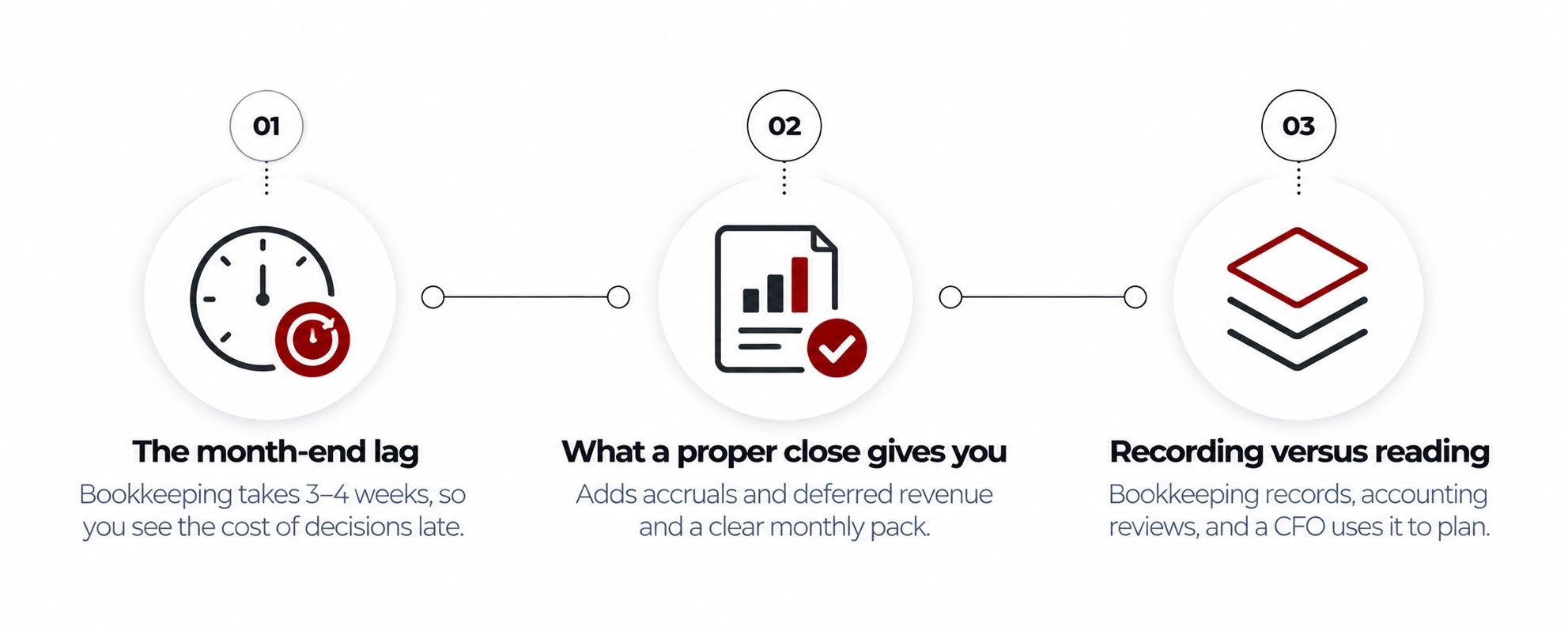
The month-end lag
A typical small-firm bookkeeping cycle is simple. Receipts come in, bank lines get matched, and the month is “done” when the last invoice is found. That can take three or four weeks.
A lag like that hurts when you hire every month or spend heavily on ads. You see the cost of a decision long after you can change it.
What a proper close gives you
A monthly close adds accruals, prepayments and deferred revenue to the ledger, so each month’s profit lands in the right month. It also produces a short pack that a founder can read in ten minutes.
Read it and you should know whether the month made money, and where the cash went.
Recording versus reading
JaZaa’s own service pages draw the line this way. Bookkeeping records and organises daily activity. Accounting reviews, adjusts and summarises those records into statements. A CFO then uses the statements to plan.
If nobody in your setup does the second and third steps, the lag will not fix itself.
✅ Action to Take
Set a fixed close date, such as the 10th working day of each month. If your setup cannot meet it, a team offering accounting services with a set month-end close can take it over. Your bookkeeper stays on daily entries.
- Sign 2
Revenue just crossed AED 3 million
AED 3 million is where UAE rules start to treat your business differently. Two reliefs that small firms rely on both stop at that figure.
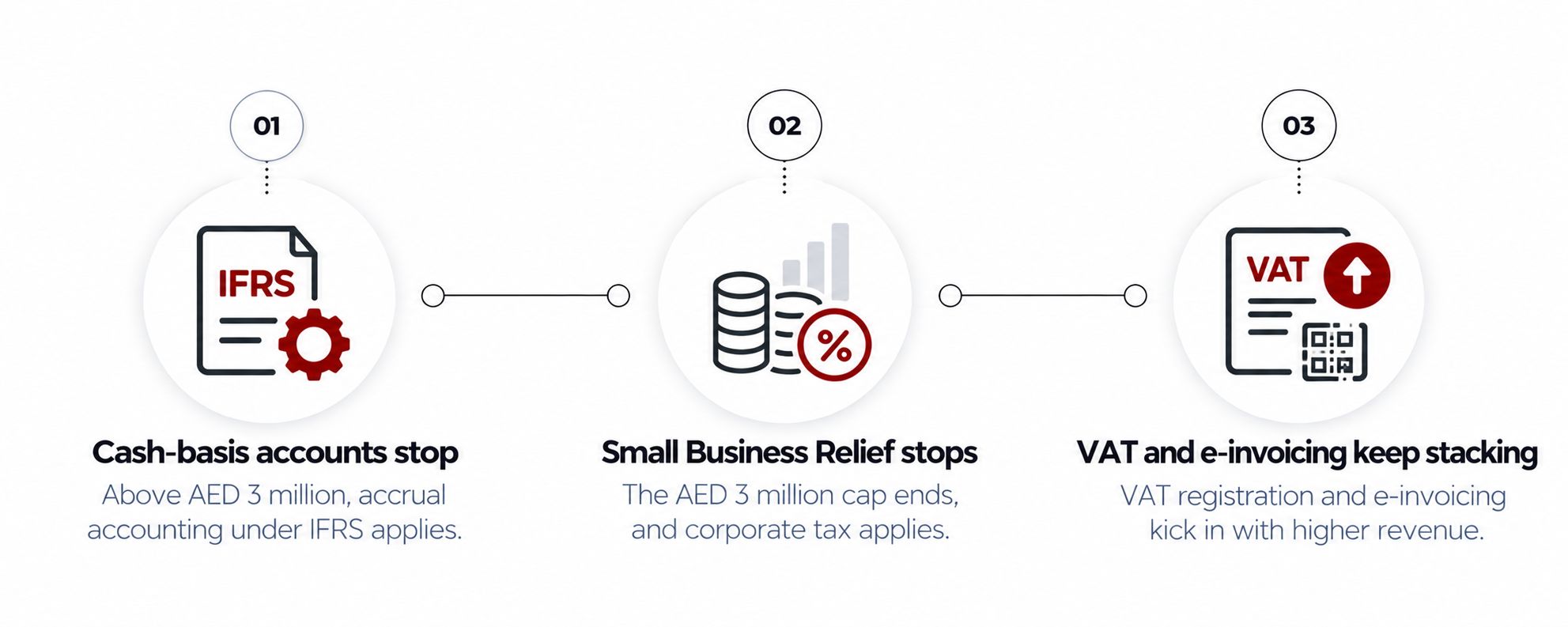
Cash-basis accounts stop
Ministerial Decision 114 of 2023 allows cash-basis financial statements only while revenue stays at or below AED 3 million. Above that, accrual accounting under IFRS applies. Firms with revenue up to AED 50 million may use IFRS for SMEs.
Accrual accounts need judgement. Someone has to decide when revenue is earned, what to accrue, and how to treat a customer who prepaid for a year. A bookkeeper trained to log bank lines is rarely set up for those calls.
Small Business Relief stops too
The Ministry of Finance extended Small Business Relief through Ministerial Decision 131 of 2026. It now covers tax periods ending on or before 31 December 2029. The AED 3 million revenue cap did not change, and the relief has to be elected in the return.
Here is what crossing the line can mean. Say revenue reaches AED 3.4 million and taxable profit is AED 600,000. The first AED 375,000 is taxed at 0%. The remaining AED 225,000 is taxed at 9%, which comes to AED 20,250. A year earlier, under the cap, the same firm could have elected relief and paid nothing.
That bill is due within nine months of the year end. Unpaid corporate tax then picks up a late payment penalty of 14% a year, worked out monthly.
VAT and e-invoicing keep stacking
VAT registration is mandatory once taxable supplies pass AED 375,000. E-invoicing comes next. Firms below AED 50 million in revenue must appoint an Accredited Service Provider by 31 March 2027. They go live on 1 July 2027. Larger firms had their appointment date moved to 30 October 2026 under Ministerial Decision 66 of 2026.
E-invoicing changes how invoices leave your system, so your chart of accounts and customer records need to be right well before go-live.
✅ Action to Take
Map your revenue against the AED 3 million and AED 50 million lines for this year and next. Then plan the accrual switch with our corporate tax consulting team for UAE startups before your next year end.
- Sign 3
Cash surprises you every month
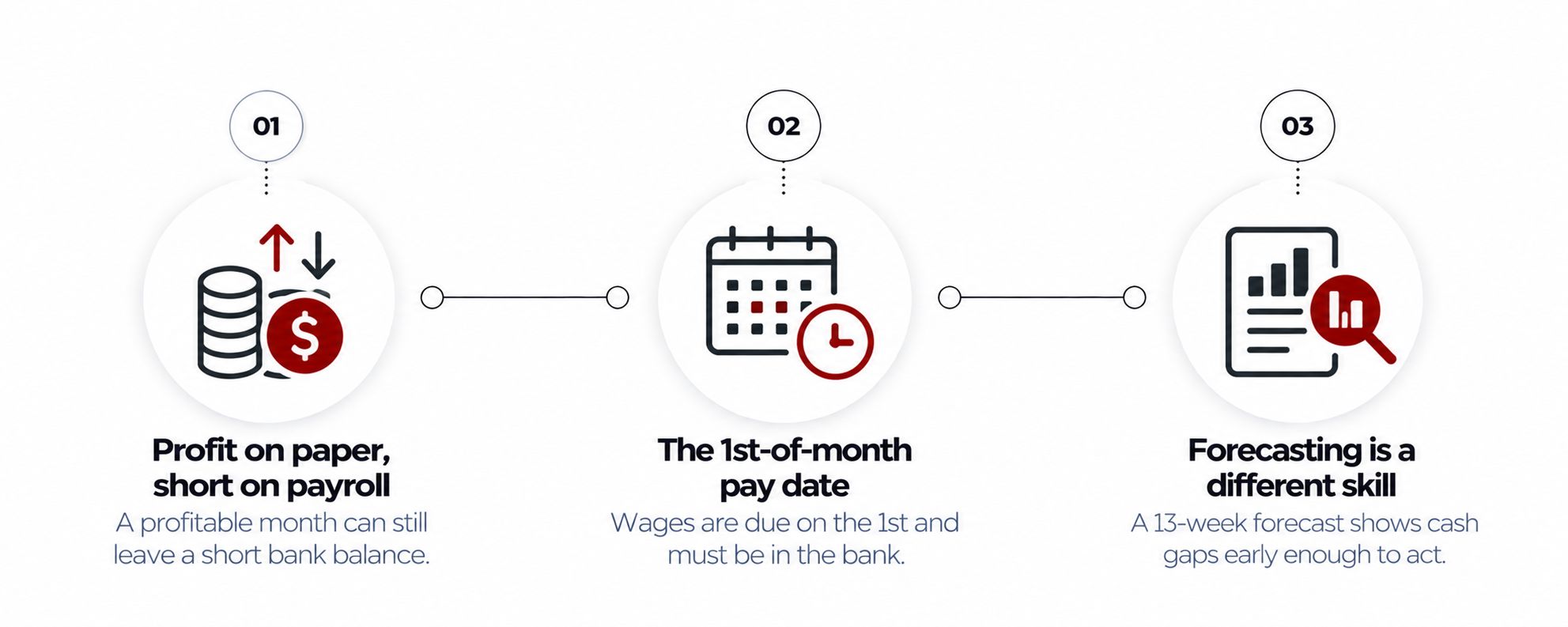
A profitable month and a short bank balance can happen at the same time. Customers pay late, stock gets bought early, and a quarterly VAT payment lands in the same week as payroll.
Profit on paper, short on payroll
Bookkeeping tells you what you were owed and what you paid. It does not tell you what will be in the bank on the 28th. That needs a forecast built week by week from known receipts, known bills and planned spend.
A 13-week cash forecast is the usual tool. It shows the gaps early enough to chase a debtor, delay a purchase or draw on a facility.
The new 1st-of-month pay date
Ministerial Resolution 340 of 2026 took effect on 1 June 2026. Wages for each month now fall due on the 1st of the next Gregorian month. The Ministry of Human Resources and Emiratisation tracks payment through the Wage Protection System. The old grace period is gone.
In Baker McKenzie’s reading, a firm counts as compliant if at least 85% of total wages reach staff by the 1st. Enforcement starts soon after.
Payroll cash now has to be in place on a fixed day every month, and a founder who learns of a shortfall on the 30th has few options left.
Forecasting is a different skill
A forecast runs on assumptions about when sales close, how long customers take to pay and when new hires start. It also needs someone to compare last month’s forecast with what actually happened, and adjust.
That review loop is where most of the value sits. A forecast nobody checks drifts away from reality within a quarter.
✅ Action to Take
Build a 13-week cash forecast and update it every Monday. JaZaa’s startup financial planning team can build the forecast with you and set up the weekly review.
- Sign 4
Investors ask questions the ledger cannot answer
A seed investor asks for revenue by customer cohort, gross margin by product line, and cash runway under two hiring plans. Your bookkeeper sends a trial balance.
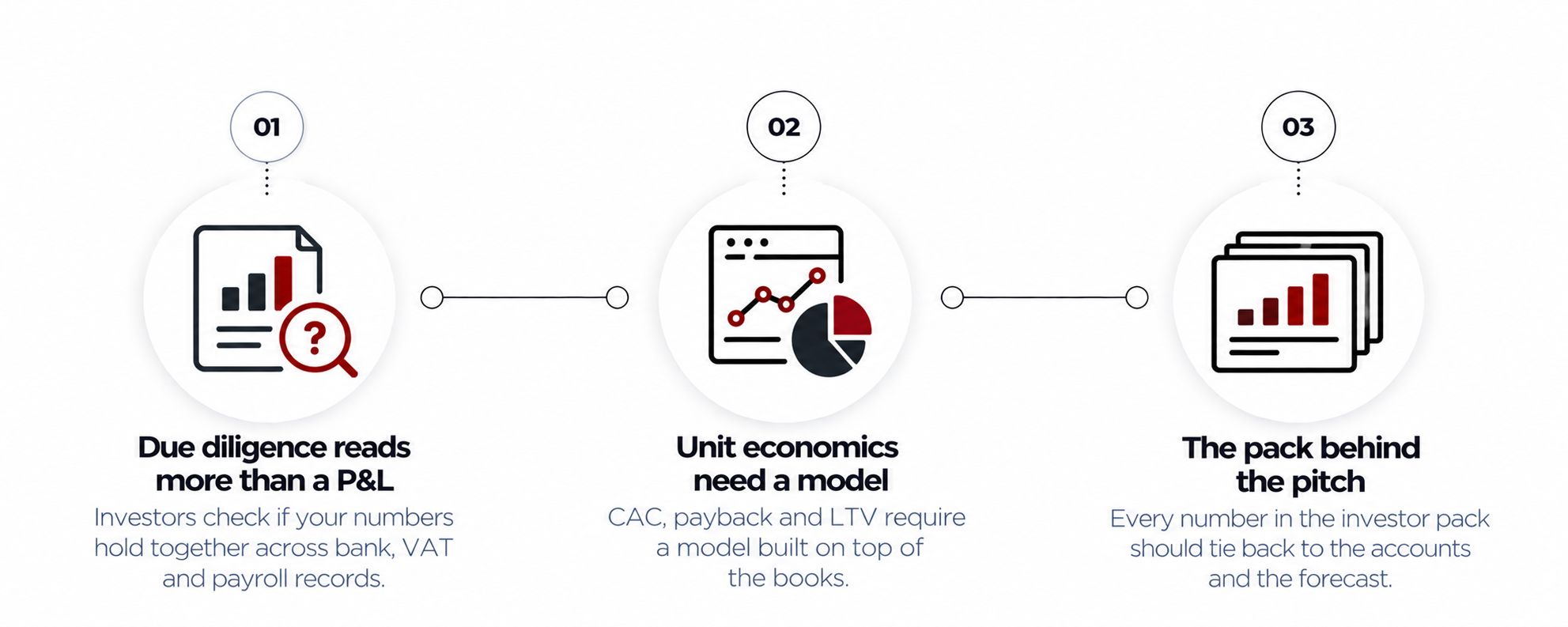
Due diligence reads more than a P&L
Investors check whether your numbers hold together. They match revenue to bank deposits, VAT returns to sales, and payroll to WPS records. Gaps in any of these slow the deal down.
Under the Corporate Tax Law, businesses must also keep records for seven years. An investor who finds missing support for older years will ask why.
Unit economics need a model
Questions about customer acquisition cost, payback and lifetime value need a model built on top of the books. The ledger holds the raw inputs. Someone still has to split marketing spend by channel, track customers by start month, and keep the logic consistent from one month to the next.
The pack behind the pitch
Good investor packs tie every slide number back to the accounts. A forecast that starts from a different revenue figure than the management accounts loses the investor’s trust in the first meeting.
✅ Action to Take
Before your next raise, run the books against an investor checklist. JaZaa’s free due diligence checklist for UAE startups lists 105 items across five areas. Fix the gaps it shows before you build the model.
Not sure which of these signs applies to you?
A 30-minute call is usually enough to see where your finance setup is thin.
- Sign 5
You run more than one entity
A free zone company for international clients and a mainland LLC for local trade is a common UAE setup. It also doubles the finance work, and adds rules that apply only when the two deal with each other.
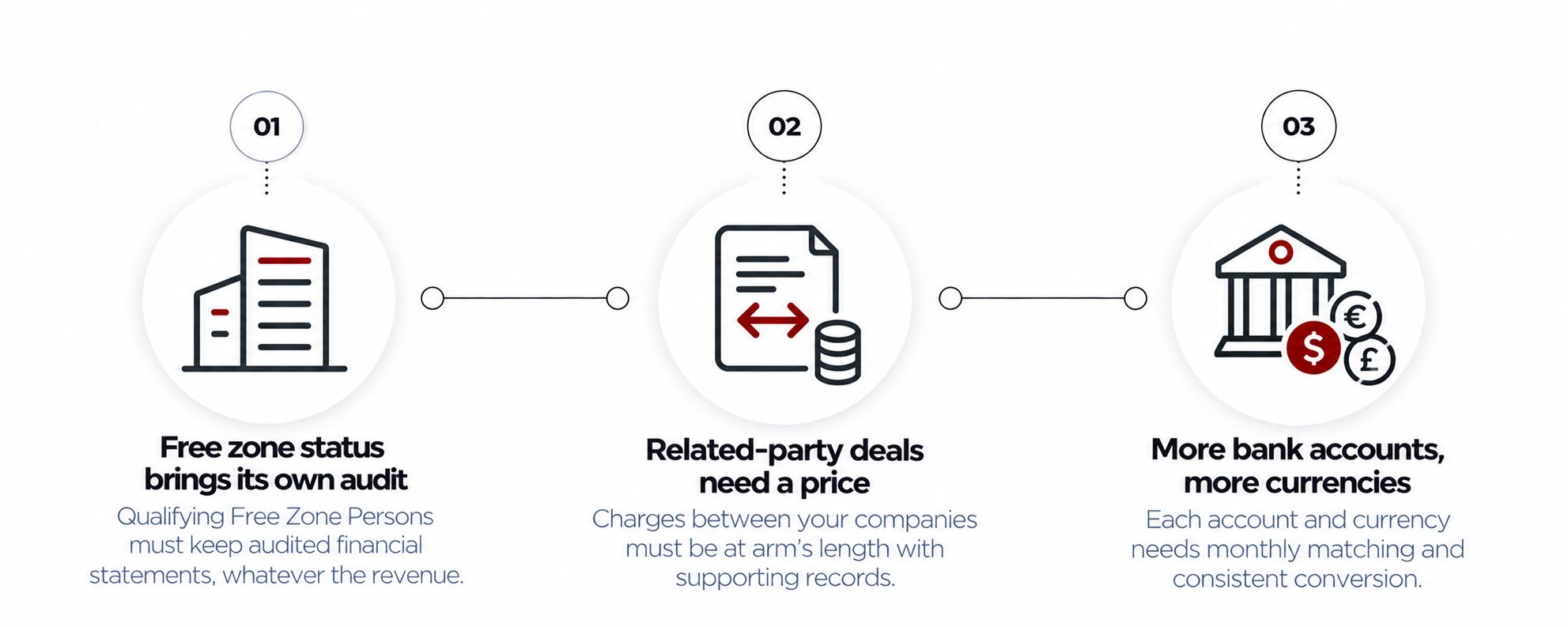
Free zone status brings its own audit
Ministerial Decision 84 of 2025 requires every Qualifying Free Zone Person to prepare and keep audited financial statements, whatever its revenue. Other firms need audited statements once revenue passes AED 50 million, and every tax group needs them too.
Audits run on the ledger. Missing reconciliations and unexplained balances can turn a short audit into a long, expensive one.
Related-party deals need a price
When your two companies charge each other for staff, rent or services, the Corporate Tax Law expects those charges at arm’s length. That means the price two unrelated firms would agree between themselves. The paperwork behind each charge has to exist before anyone asks for it.
More bank accounts, more currencies
Several entities usually mean several bank accounts, payment gateways and currencies, and each one needs matching against the books every month. Tax figures are reported in AED, so foreign-currency balances also need a consistent conversion method.
✅ Action to Take
List every entity, bank account and inter-company charge on one page. Then ask a team offering audit support for UAE free zone and mainland firms to review the gaps before your auditor does.
- Sign 6
The founder is still the finance team
Many UAE founders approve every payment, chase every overdue invoice, and rebuild the forecast at midnight before a board call. That works for a while. It stops working once the business needs those hours for sales and hiring.
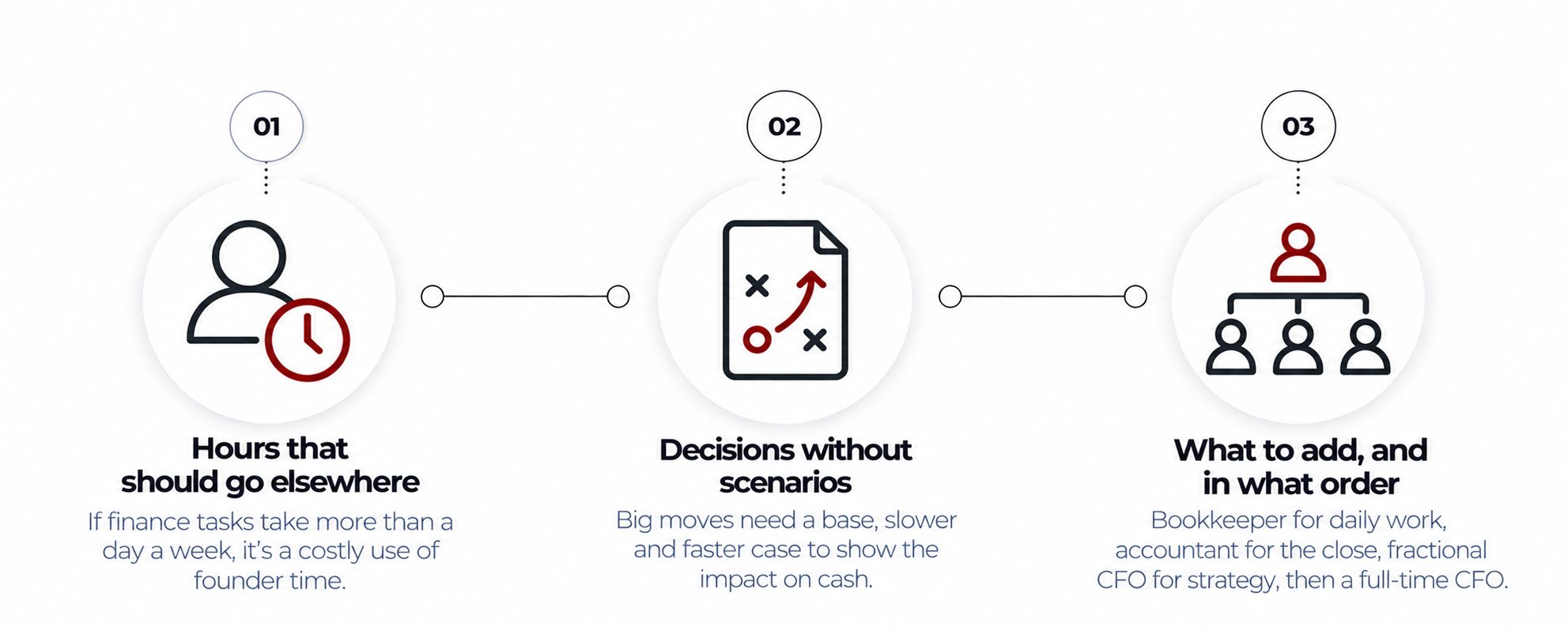
Hours that should go elsewhere
Track your own time for two weeks, and if finance tasks take more than a day a week, the business is paying a senior salary for junior work.
Decisions without scenarios
Pricing changes, a new market, or a second office all deserve a scenario model. Without one, the founder picks a number that feels safe and hopes. A CFO tests the base case, a slower case and a faster case, then shows what each does to cash.
What to add, and in what order
You rarely need to replace anyone. A practical sequence for a UAE startup looks like this.
- Keep the bookkeeper on daily entries and bank matching.
- Add an accountant or accounting service for the monthly close and statements.
- Add a fractional CFO for forecasts, board packs, fundraising and tax planning.
- Move to a full-time CFO only when finance needs a senior owner every day.
Cost shapes the order. JaZaa’s published fractional CFO retainers in Dubai run from AED 15,000 to AED 35,000 a month. The same page puts a full-time CFO salary at AED 400,000 to AED 900,000 a year, before gratuity and benefits.
✅ Action to Take
Write down the five finance decisions you expect to make in the next six months. If most need forecasts or investor input, a fractional CFO working set days each month is usually the next hire.
Common Questions
Short answers to what UAE founders ask most about moving past a bookkeeper.
When decisions need forward-looking numbers the books cannot give. In the UAE, the usual triggers are revenue above AED 3 million, a fundraise, several entities, or cash gaps around the 1st-of-month pay date.
Usually not. A CFO depends on accurate daily records. Most startups keep the bookkeeper and add senior finance time above them.
An accountant reviews and adjusts the records, closes each month, and prepares statements and tax schedules. Behind those statements sit the daily entries that a bookkeeping service keeps current every week.
Not at most early stages. A fractional or part-time CFO covers forecasting, reporting and fundraising at a share of the cost. A daily senior hire comes later.
JaZaa's published range is AED 15,000 to AED 35,000 a month, depending on scope and days. The final figure depends on entities, transaction volume and how much investor work is involved.
Only while revenue stays at or below AED 3 million, under Ministerial Decision 114 of 2023. Above that, accrual accounts under IFRS or IFRS for SMEs apply.
Yes, for tax periods ending on or before 31 December 2029, following Ministerial Decision 131 of 2026. Revenue must stay within AED 3 million, and you must elect it in the return.
Under Ministerial Decision 84 of 2025, you need them once revenue exceeds AED 50 million or if you are a Qualifying Free Zone Person. Every tax group needs them too.
Below AED 50 million in revenue, appoint an Accredited Service Provider by 31 March 2027. Go-live is 1 July 2027.
Under Ministerial Resolution 340 of 2026, any payment after the 1st counts as delayed. Enforcement steps escalate with each day and with repeat delays.
Rarely. JaZaa's teams work with platforms such as QuickBooks, Xero, Zoho Books and Wafeq. A virtual CFO working inside your current software can start from the system you already run.
The next 18 months bring more fixed dates for UAE startups. E-invoicing goes live for smaller firms in July 2027. Payroll now runs on a hard monthly deadline, and Small Business Relief ends in 2029. Each of these rewards a business that can see its numbers before the deadline arrives. The founders who add forward-looking finance support now will spend those months planning, while others spend them catching up.
JaZaa CFO Advisory Team
JaZaa is a Dubai-based management consultancy that gives startups and SMEs senior finance support through fractional, virtual, part-time and interim CFO services. The team works with founders on cash planning, reporting, tax readiness and fundraising across the UAE.
Legal disclaimer
This article provides general information about finance roles and UAE accounting, tax and payroll rules for startups and SMEs in the UAE. It does not constitute professional financial, tax, accounting, or legal advice specific to your business. JaZaa provides professional business services including accounting, bookkeeping support, and management consulting. We are not a registered audit firm, tax agent, CPA, or Chartered Accounting firm. Thresholds, deadlines and penalties here reflect UAE rules as of October 2026. Confirm your position with a registered tax agent before filing. Reading this article does not create an advisor-client relationship with JaZaa. For advice specific to your situation, arrange a consultation.