
🔔 What changed in 2026
What’s new in 2026
The Central Bank of the UAE brought a new rulebook into force on 13 September 2026. It is called the Small to Medium Sized Enterprises Customer Protection Regulation. It replaces the 2021 SME Market Conduct Regulation. SMEs are now treated as a distinct, protected customer segment, not a scaled-down version of retail banking. Banks must open basic accounts for low-risk SMEs within three business days of receiving complete paperwork. They must also issue a Key Facts Statement that spells out fees and lending terms in plain language. A founder applying for a loan today has more disclosure rights than one who applied a year ago.
Q: Does this regulation make it easier to get approved?
Not directly. It governs how banks disclose terms and handle SME accounts, not their credit criteria. A weak application still gets declined under the new rules.
Q: Does it apply to free zone banking through DIFC or ADGM?
No. The regulation binds banks and finance companies licensed by the Central Bank of the UAE. Institutions regulated by the DFSA or FSRA in the financial free zones sit outside its scope.
| 📋 Bank Loan Prep at a Glance | ||
|---|---|---|
| STEP | TYPICAL REQUIREMENT | WHY IT MATTERS |
| Trading history | 12 to 24 months of operations | Banks rarely lend to companies under a year old |
| Turnover | Around AED 1 million a year for standard bank loans | Sets the baseline for most mainstream lenders |
| Financials | 1 to 3 years of audited statements | Required above roughly AED 500,000 borrowed |
| Credit score | AECB score, ideally above 700 | Checked for the business and for major shareholders |
| Documentation | Trade license, MOA, VAT returns, bank statements | Confirms the business is what it claims to be |
A virtual CFO builds this file over several weeks. The work happens well before the application reaches a bank, whether that is one of the UAE’s large commercial banks or a government-backed lender. That way, nothing gets discovered mid-review.
- Signal 1
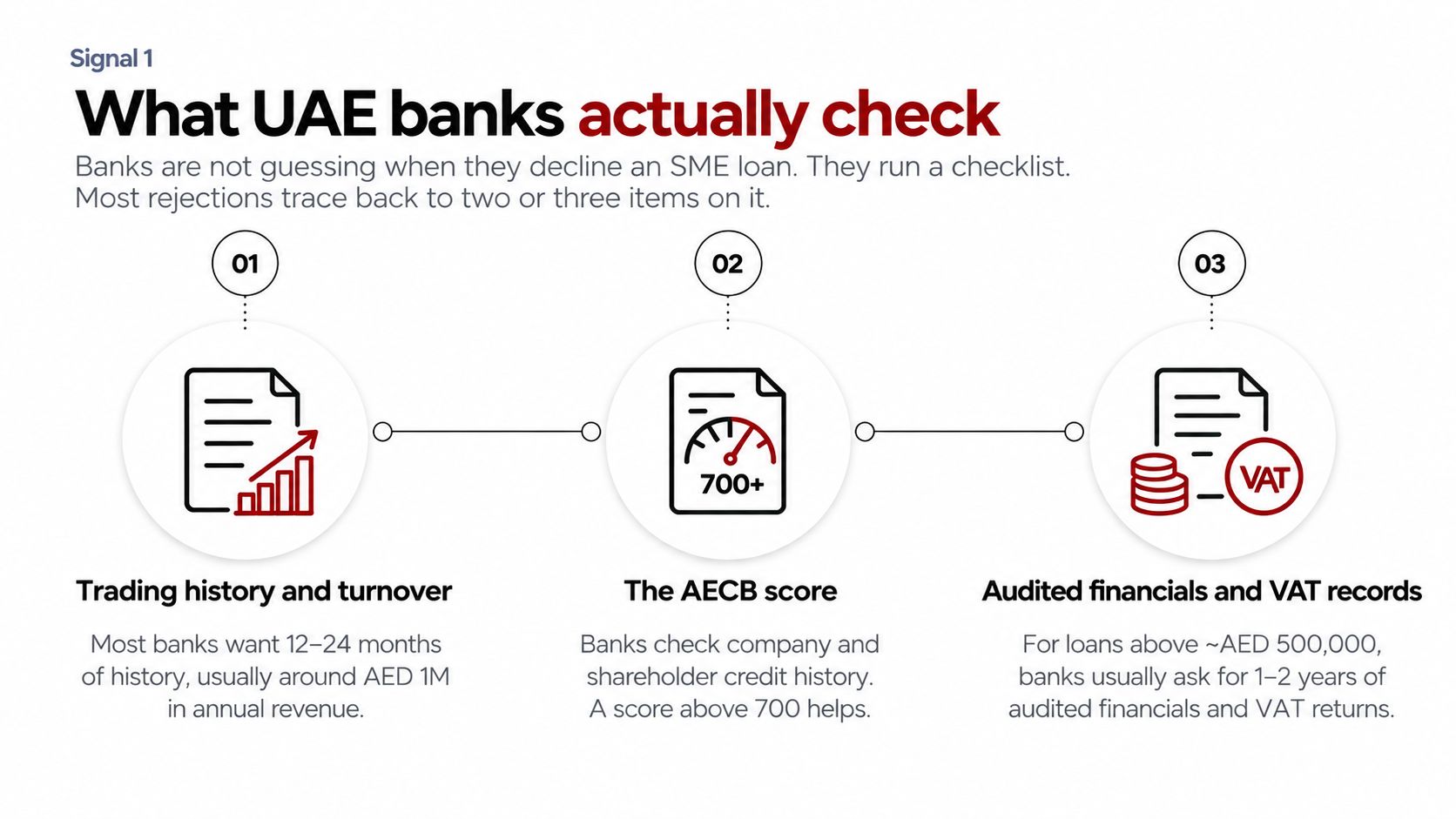
What UAE banks actually check
Banks are not guessing when they decline an SME loan. They run a checklist. Most rejections trace back to two or three items on it.
Trading history and turnover
Most banks want 12 to 24 months of operating history before they consider a term loan. Startups under a year old usually get pushed toward unsecured fintech lenders instead. Founder-backed financing is another common fallback. On turnover, mainstream banks typically look for annual revenue of around AED 1 million. Some digital lenders work with smaller businesses, generating AED 25,000 a month. A CFO checks these numbers against a bank’s stated criteria before an application goes anywhere.
The AECB score
Every UAE bank pulls a credit report from the Al Etihad Credit Bureau. This applies to the company and to the personal history of major shareholders and guarantors. A score above 700 strengthens an application. A poor personal score on one shareholder can sink an otherwise healthy company’s chances. That surprises founders who assume only the business gets assessed. Fixing what can be fixed early, a late utility bill, an unpaid credit card, is one of the fastest wins in loan prep.
Audited financials and VAT records
For loans above roughly AED 500,000, banks generally ask for one to two years of audited financial statements. Some want up to three. They also want VAT returns that tie out to the numbers in those statements. A mismatch between the VAT filings and the financials is one of the most common reasons a loan file stalls in underwriting.
✅ Action to Take
Ask a virtual CFO to pull your AECB report early. Reconcile your VAT filings against your management accounts before you approach any bank. Fixing a mismatch takes days. Discovering it during underwriting can cost you weeks.
- Signal 2
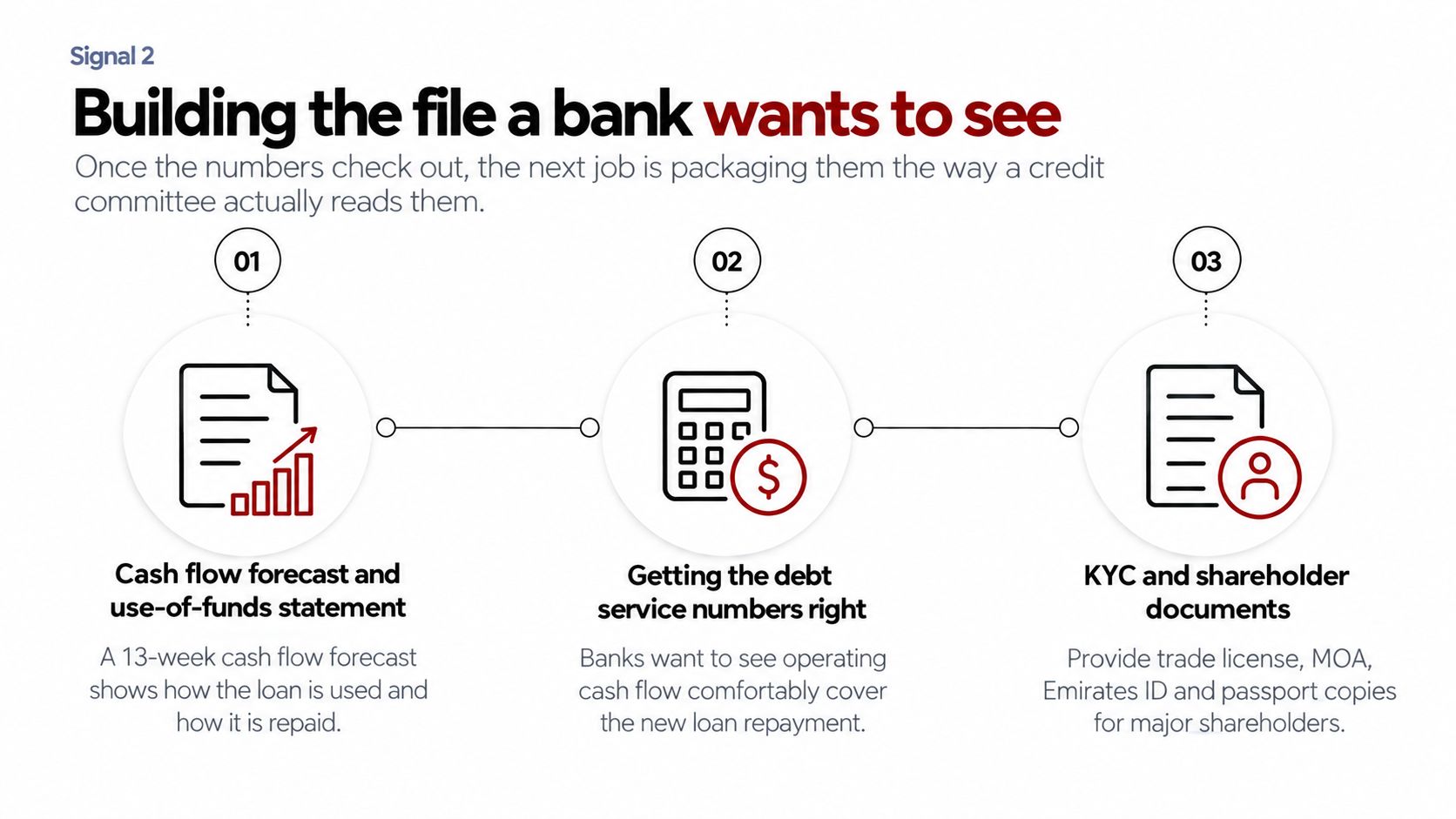
Building the file a bank wants to see
Once the numbers check out, the next job is packaging them the way a credit committee actually reads them.
The cash flow forecast and use-of-funds statement
A rolling 13-week cash flow forecast shows a bank how the loan gets used. It also shows how it gets repaid. Vague language like working capital rarely satisfies a credit officer. A specific statement reads far better, AED 300,000 for equipment financed over five years, or AED 150,000 to bridge a 60-day payment gap with a named client. It signals a business that knows its own numbers. CB Insights reviewed 431 startup shutdowns since 2023. Running out of cash was the final cause in 70% of them. Banks read that same pattern in every declined file. A clear forecast is the strongest signal against it.
Getting the debt service numbers right
Banks want to see operating cash flow comfortably cover the new loan repayment, on top of existing obligations. A CFO builds this calculation before the bank does. That way there are no surprises when the credit team runs their own version. If the coverage is thin, this is also the point where a CFO can restructure the ask. That might mean a smaller amount, a longer tenor, or a different product entirely.
KYC and shareholder documents
Expect to provide a trade license and Memorandum of Association. Add Emirates ID and passport copies for every major shareholder. Include an Ejari or tenancy contract for the business premises too. Banks have tightened Know Your Customer checks in recent years. An incomplete shareholder file is a common reason applications sit unprocessed for weeks, rather than getting a clean decline or approval.
✅ Action to Take
Have your CFO draft the use-of-funds statement and the 13-week cash flow model as one package before submission. A JaZaa accounting review at the same time catches VAT inconsistencies that would otherwise surface during the bank’s own diligence
- Signal 3
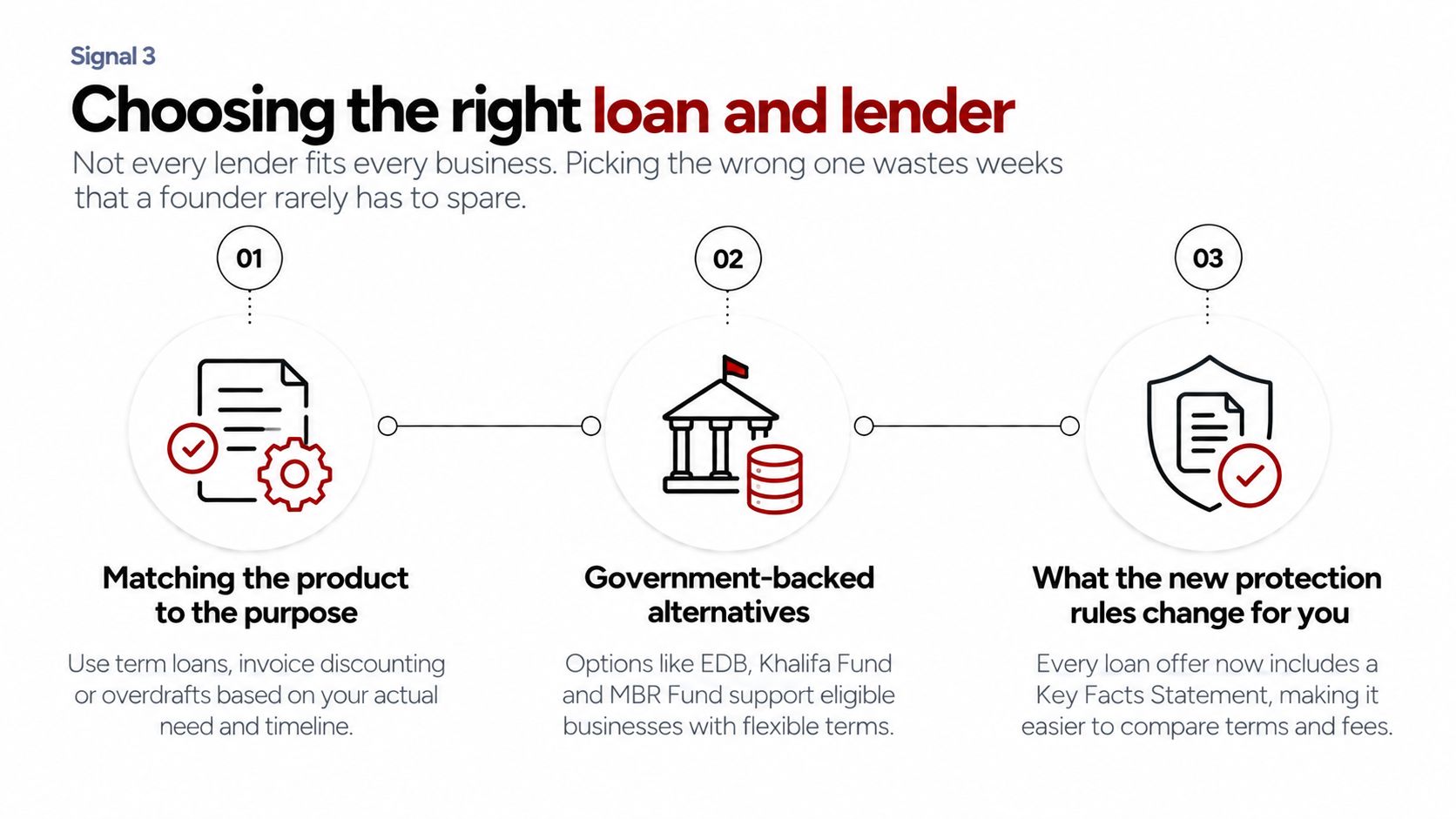
Choosing the right loan and lender
Not every lender fits every business. Picking the wrong one wastes weeks that a founder rarely has to spare.
Matching the product to the purpose
Term loans suit long-term investments such as equipment or office space. Tenors commonly run 12 to 48 months. Invoice discounting suits a business waiting 30, 60, or 90 days on client payments, advancing up to roughly 90% of an invoice’s value. An overdraft facility suits short, recurring cash gaps rather than a single large purchase. Matching the product to the actual need changes both the approval odds and the eventual cost. Taking whatever a relationship manager offers first rarely gets the best terms. Islamic structures such as Murabaha and Ijara cover the same needs under Sharia-compliant terms, and most major UAE banks offer both conventional and Islamic versions of each product.
Government-backed alternatives
For businesses that do not yet fit a traditional bank’s criteria, the UAE runs several government-backed routes. Emirates Development Bank offers financing for priority sectors, including technology, healthcare, and food security. Tenors and grace periods here often run longer than commercial banks provide. The Khalifa Fund for Enterprise Development supports Emirati entrepreneurs in Abu Dhabi, with financing, training, and mentorship. The Mohammed Bin Rashid Fund for SMEs offers subsidised loans and guarantees, with more flexible eligibility than commercial lenders. These programmes typically restrict business type or fund use. A CFO checks eligibility before a founder spends weeks on an application that was never going to qualify.
What the new protection rules change for you
Under the SME Customer Protection Regulation, every offer now needs a Key Facts Statement. It lays out fees, rates, and terms in a standard format. This makes it far easier to compare two competing offers side by side, since both must disclose the same categories in the same structure.
✅ Action to Take
Before signing any offer, ask your CFO to compare the Key Facts Statements across at least two lenders. Book a free consultation if you want a second set of eyes on the terms before you commit.
Not sure which lender fits your business?
Every lender weighs trading history, turnover, and collateral differently. Book a free consultation and we will map your options against what you actually have on hand.
- Signal 4
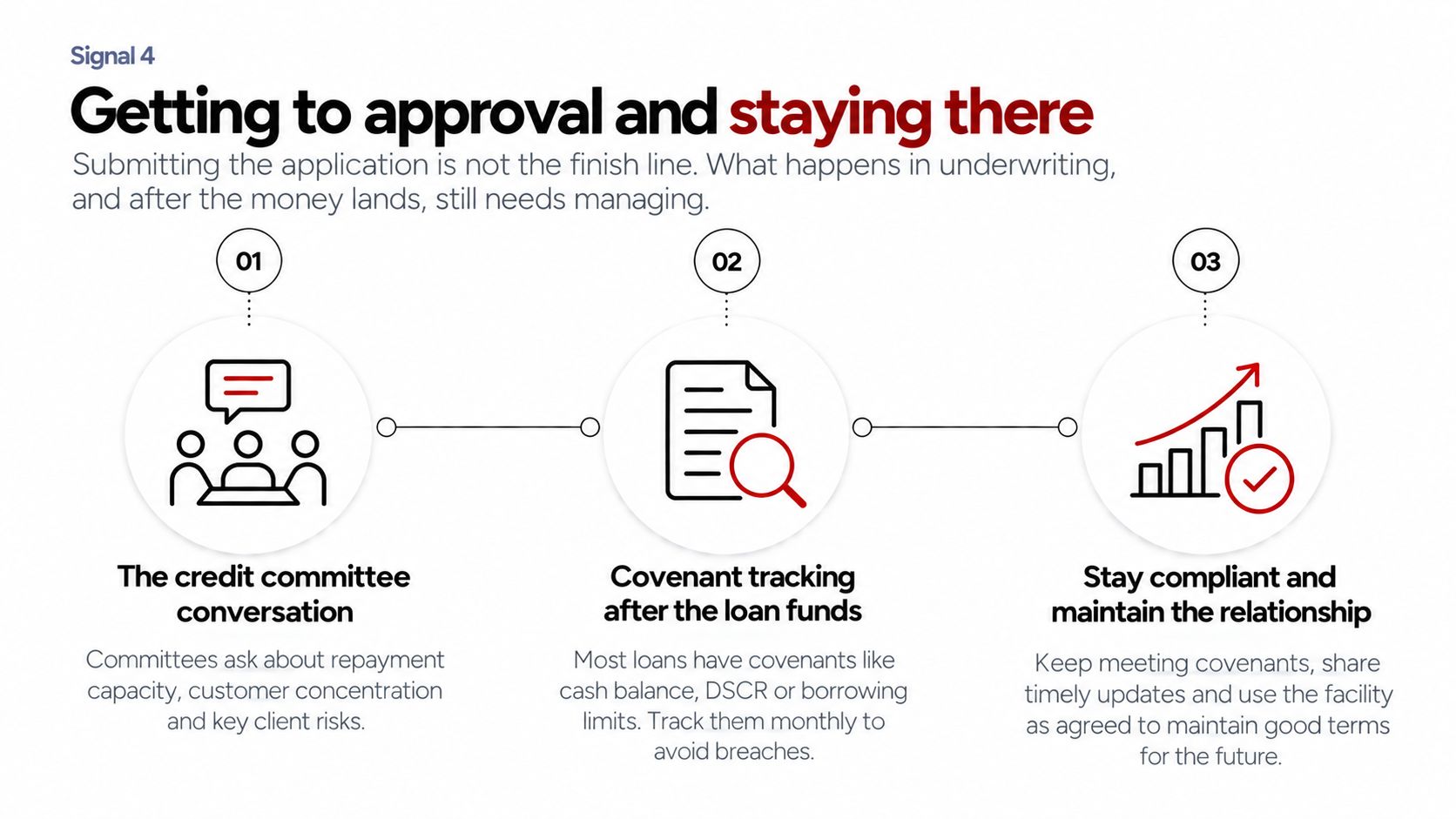
Getting to approval and staying there
Submitting the application is not the finish line. What happens in underwriting, and after the money lands, still needs managing.
The credit committee conversation
Most SME loans above a modest threshold go through a credit committee, not a single relationship manager’s sign-off. Committees ask pointed questions about repayment capacity and customer concentration. They also ask what happens if a major client leaves. A CFO who has already modelled these scenarios can answer on the spot. Promising to follow up later reads to a committee as a lack of preparation.
Covenant tracking after the loan funds
Most term loans carry covenants, a minimum cash balance, a debt service coverage ratio, or a limit on further borrowing. Breaching a covenant, even briefly, can trigger a review of the whole facility. A CFO builds covenant tracking into the same monthly reporting cycle used for everything else. That way, a breach gets caught internally, weeks before the bank ever notices.
✅ Action to Take
Ask your CFO to add loan covenants to your monthly management reporting from the day funds land. Catching a covenant issue in your own numbers beats hearing about it from the bank.
Common Questions
Straight answers to what founders usually ask before applying for a UAE business loan.
Yes. The main value of a virtual CFO here is preparation, a clean AECB score, accurate audited financials, a specific use-of-funds statement, and a realistic debt service calculation. All of it gets built before the bank ever sees the file.
Most banks want 12 to 24 months of operating history. Businesses younger than that usually look at fintech lenders, invoice discounting, or founder-backed financing instead of a traditional term loan.
There is no single pass or fail number. An AECB score above 700, for both the business and its major shareholders, meaningfully strengthens an application.
Yes. Banks check the personal credit history of major shareholders and guarantors alongside the company's own record. A weak personal score can affect an otherwise strong business.
Mainstream banks typically look for annual turnover of around AED 1 million. Some fintech and digital lenders work with businesses generating as little as AED 25,000 a month.
Unsecured SME facilities in the UAE commonly run 8% to 18% per annum. The exact rate depends on the lender, the loan size, and the strength of the application.
Not necessarily easier, but often more flexible on eligibility, with longer tenors and grace periods. Programmes such as Emirates Development Bank, Khalifa Fund, and the Mohammed Bin Rashid Fund for SMEs each carry their own restrictions.
It is a rulebook that came into force on 13 September 2026. It requires banks to disclose fees and terms clearly through a Key Facts Statement, and to open low-risk SME accounts within three business days.
Not always. Smaller facilities may accept management accounts and bank statements. Most banks require audited statements once the loan amount passes roughly AED 500,000.
Preparation with a CFO typically takes two to four weeks. Bank processing after a complete submission commonly runs another two to eight weeks, depending on the lender and loan size
decline is often a fixable gap, not a fundamental problem. A CFO reviews the reason, then rebuilds the file before reapplying. Sometimes that means a different lender. Sometimes it means a different loan structure entirely. Talk to a virtual CFO advisory team before resubmitting the same file to a second bank unchanged.
Yes, though multiple hard credit checks in a short window can affect your AECB score. A CFO usually recommends applying to one or two well-matched lenders first, rather than shotgunning applications across every bank in the market.
Yes. Fintech and digital lenders often move faster and accept a shorter trading history, though usually at a higher interest rate than a traditional bank. A CFO weighs speed and cost against your actual timeline before recommending one over the other.
No. Waiting for perfection usually costs more time than it saves. A CFO can often get a file bank-ready within a few weeks by fixing the two or three issues that actually matter to a lender, rather than trying to polish every line item first.
Banks in the UAE are not looking for a perfect business. They are looking for a business that understands its own numbers well enough to explain how a loan gets repaid. The founders who get approved on the first attempt are rarely the ones with the strongest revenue alone. They are the ones who walked in with a file that answered every question before a credit officer had to ask it.
JaZaa CFO Advisory Team
JaZaa works with startups and SMEs across the UAE on virtual and fractional CFO engagements, including loan readiness, cash flow forecasting, and lender comparisons. The team has taken founders from a first AECB pull through to a signed facility agreement, across banks, fintech lenders, and government-backed programmes. Learn more about JaZaa
Legal disclaimer
This article provides general information about bank loan preparation for startups and SMEs in the UAE. It does not constitute professional financial, tax, or accounting advice, and it is not a guarantee of loan approval from any lender. JaZaa provides professional business services including accounting, bookkeeping support, and management consulting. We are not a registered audit firm, tax agent, CPA, Chartered Accounting firm, or licensed credit broker. Lending decisions rest entirely with the relevant bank or finance company under its own credit criteria. Reading this article does not create an advisor-client relationship with JaZaa. For advice specific to your situation, arrange a consultation.