


🔔 Why this matters now
Q: What are unit economics in plain terms?
The profit or loss on one customer, one order or one subscription. Take what that customer pays you, strip out what it costs to serve them, then strip out what it cost to win them. What remains is the unit. If the unit loses money, more customers make the problem bigger.
Q: When should a founder start measuring them?
Once the same sale can be repeated by someone other than the founder. David Skok, whose work popularised these metrics, argues that ratios like LTV to CAC mean little until the go-to-market motion is repeatable. Before then, founder-closed deals flatter the numbers. Track the inputs early, and start trusting the ratios once the process is real.
| 📊 The Five Numbers at a Glance | ||
|---|---|---|
| METRIC | FORMULA | HEALTHY SIGNAL |
| Contribution margin | Revenue less variable cost to serve | Positive and stable by cohort |
| CAC | All sales and marketing cost divided by new customers | Falling or flat as volume grows |
| LTV | Gross margin per customer over their life | Built on real retention data |
| LTV to CAC | LTV divided by CAC | Around 3 to 1 or better |
| CAC payback | Months of gross margin to recover CAC | Under 12 months |
| Burn multiple | Net burn divided by net new ARR | Below 1.5 |
- Metric 1
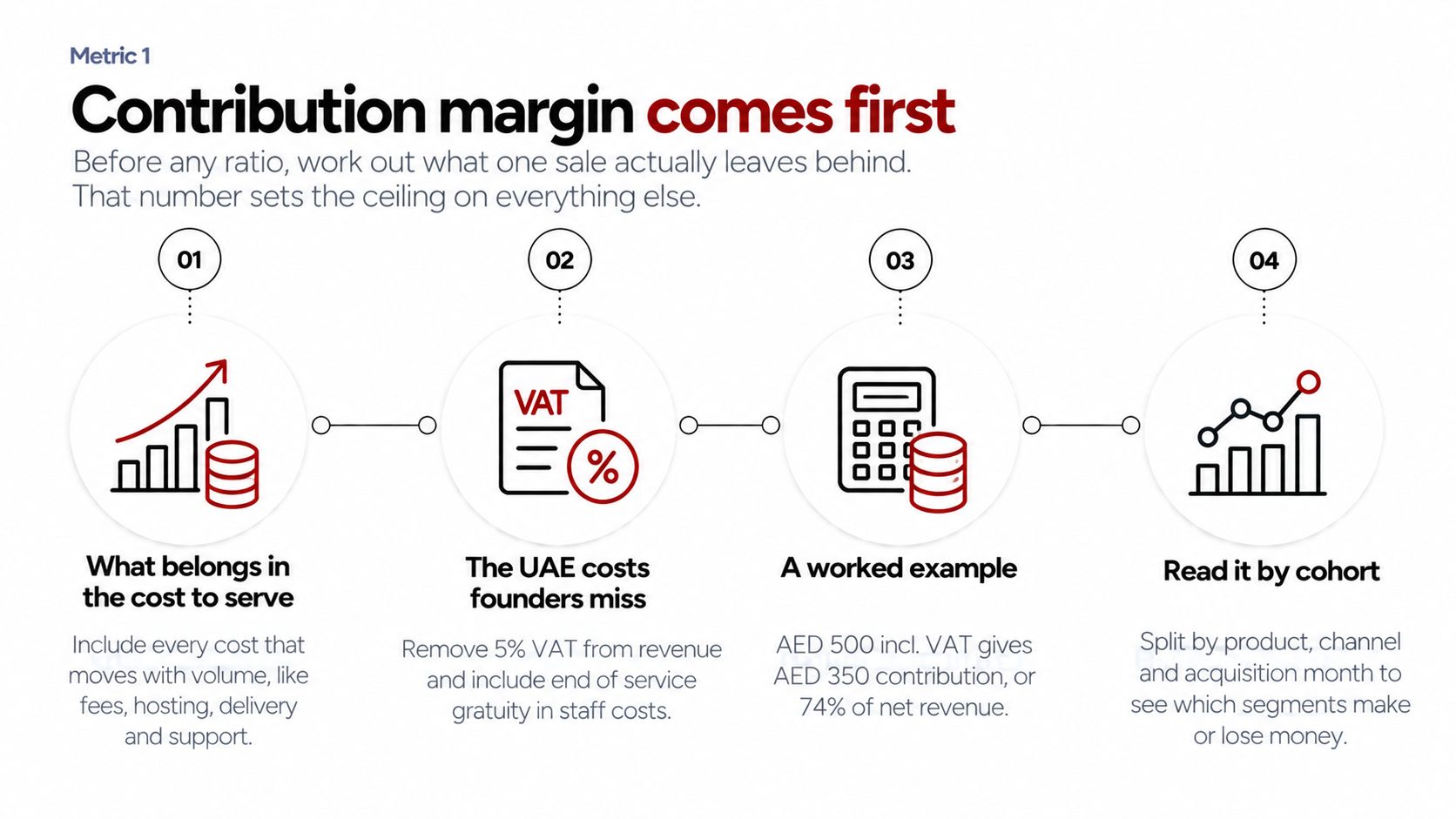
Contribution margin comes first
Before any ratio, work out what one sale actually leaves behind. That number sets the ceiling on everything else.
What belongs in the cost to serve
Every cost that moves with volume. Payment gateway fees, hosting, delivery, support time, third-party licences and any commission paid on the sale. Fixed costs like rent and the founder’s salary stay out. This is the cost of one more customer, not the cost of the company.
The UAE costs founders miss
Two local items skew the number. First, VAT. Prices shown to UAE consumers include 5% VAT, so revenue in the model must be the amount net of it. Second, staff cost. Anyone in a delivery or support role accrues end of service gratuity, at 21 days of basic wage a year for the first five years and 30 days after that. A fully loaded hourly cost includes that accrual.
A worked example
A plan sells at AED 500 a month including VAT, so net revenue is AED 476. Hosting and support cost AED 90 per account, payment fees AED 12, and a third-party data licence AED 24. Contribution margin is AED 350, or 74% of net revenue. Cut the price to AED 400 including VAT and contribution falls to AED 255. A 20% cut in revenue removes 27% of the contribution. Price moves hit the unit harder than they look on a revenue line.
Read it by cohort
One blended margin hides the story. Split it by product, by channel and by month of acquisition. Most companies find one segment carrying the average while another quietly loses money on every sale.
✅ Action to Take
Rebuild your cost to serve from the ledger, line by line, before trusting any ratio built on top of it. Clean cost coding through structured accounting services is what makes cohort margin possible at all.
- Metric 2
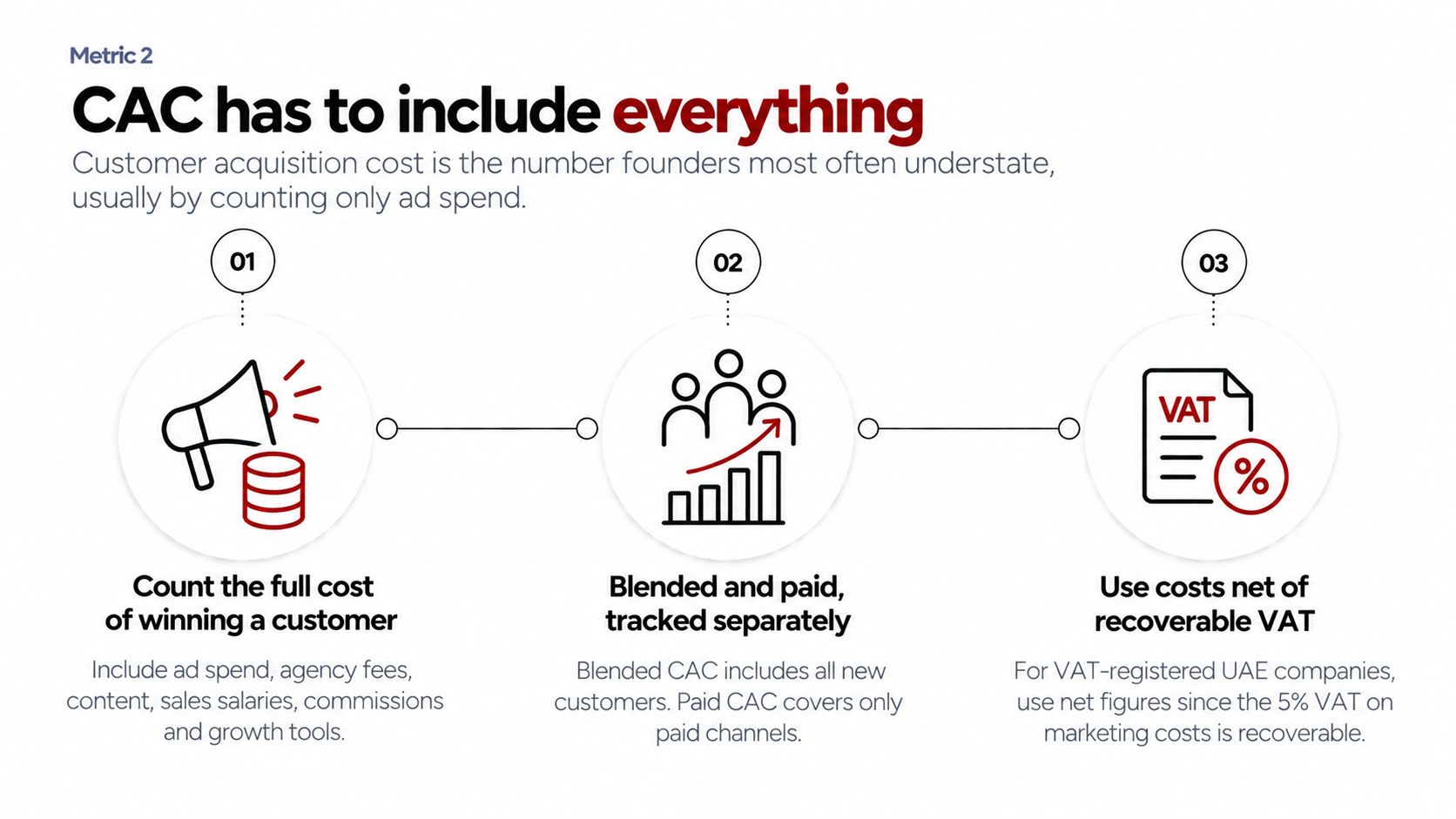
CAC has to include everything
Customer acquisition cost is the number founders most often understate, usually by counting only ad spend.
Count the full cost of winning a customer
Ad spend, agency fees, content production, sales salaries, commissions, event costs and the software your growth team uses. Divide the total by the customers acquired in the same period. Media spend alone is only part of that number.
Blended and paid, tracked separately
Blended CAC divides all acquisition cost by all new customers, including the ones who arrived free. Paid CAC looks only at customers won through paid channels. Investors ask for both, because the gap between them shows how much of your growth is actually bought. Report the blended figure to the board and the paid figure to the growth team, since each answers a different question.
Use costs net of recoverable VAT
A VAT-registered UAE company recovers the input VAT on agency invoices, software and most marketing services. That 5% is not a cost to the business, so a CAC built on gross invoice values overstates itself. Use the net figures, the same ones that sit in your VAT return.
✅ Action to Take
Agree one written CAC definition and apply it every month, so the trend line stays comparable. Founders who want that discipline held between board meetings keep it inside monthly reporting with virtual CFO support.
- Metric 3
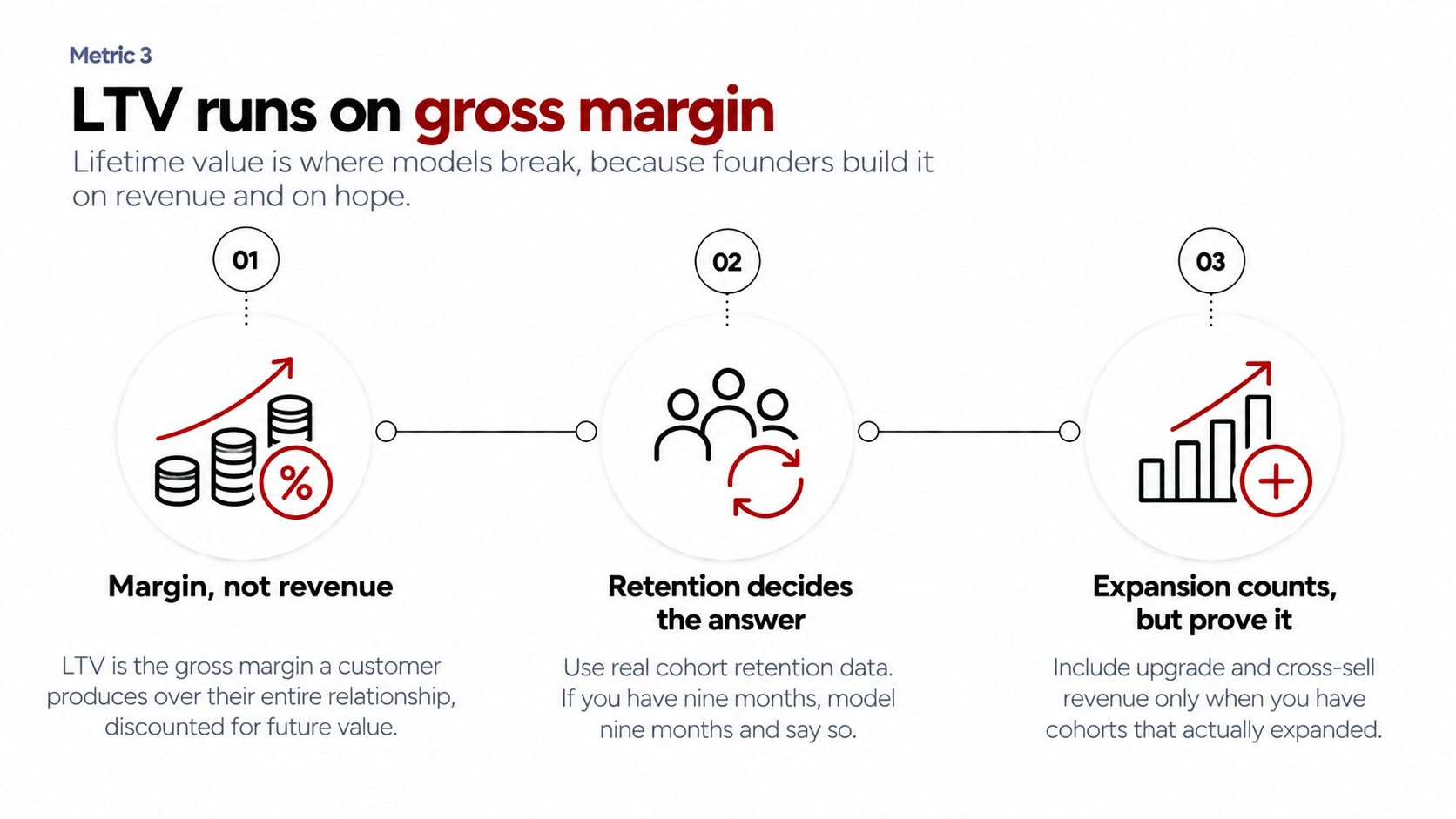
LTV runs on gross margin
Lifetime value is where models break, because founders build it on revenue and on hope.
Margin, not revenue
LTV is the gross margin a customer produces across their whole relationship, discounted for the fact that money arriving in year three is worth less today. A revenue-based LTV can overstate customer profitability badly, and the gap widens as margins thin.
Retention decides the answer
LTV is only as good as the churn number inside it. Use observed retention from real cohorts. If you have nine months of data, model nine months and say so. An assumed churn rate applied to a young company produces a confident figure with nothing behind it.
Expansion counts, but prove it
Upgrades and cross-sells lift LTV, and they are the easiest place to be optimistic. Include expansion revenue only where you can point to cohorts that actually expanded.
✅ Action to Take
Rebuild LTV from cohort data and mark clearly which parts are observed and which are assumed. Early companies setting this up for the first time usually do it alongside startup CFO support so the model survives investor questions.
- Metric 4
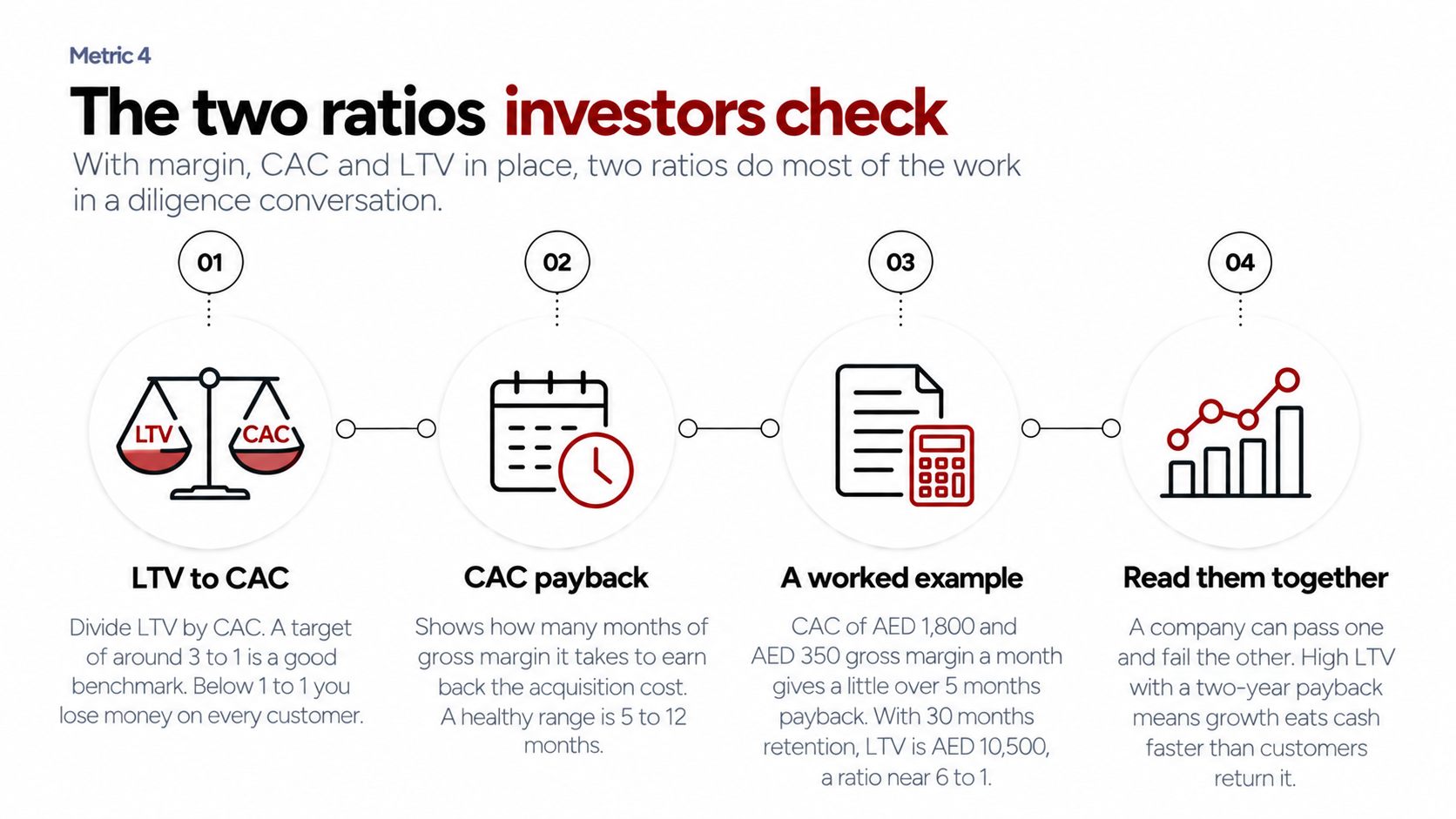
The two ratios investors check
With margin, CAC and LTV in place, two ratios do most of the work in a diligence conversation.
LTV to CAC
Divide LTV by CAC. The target of roughly 3 to 1 comes from David Skok’s work on SaaS metrics. Below 1 to 1 you lose money on every customer. Far above 5 to 1 usually means you are underspending on growth. The ratio travels less well outside subscription businesses, so a transactional company should run it on contribution margin over a fixed window such as twelve months.
CAC payback
Payback measures how many months of gross margin it takes to earn back the acquisition cost. Skok’s guidance puts a healthy range at five to twelve months. Payback matters more than the ratio in the early years, because it sets how much cash you need to grow. A strong ratio with a long payback still drains the bank.
A worked example
Say CAC is AED 1,800 and a customer produces AED 350 of gross margin a month. Payback lands a little past five months. If that customer stays 30 months, LTV is AED 10,500 and the ratio sits near 6 to 1. A ratio that high usually means there is room to spend more on acquisition.
Read them together
A company can pass one and fail the other. High LTV with a two-year payback means growth eats cash faster than customers return it. Present both, every time.
✅ Action to Take
Put both ratios in the monthly pack with the assumptions written underneath them. Founders heading into a raise usually pressure-test them alongside a defensible business valuation before investors do it for them.
- Metric 5
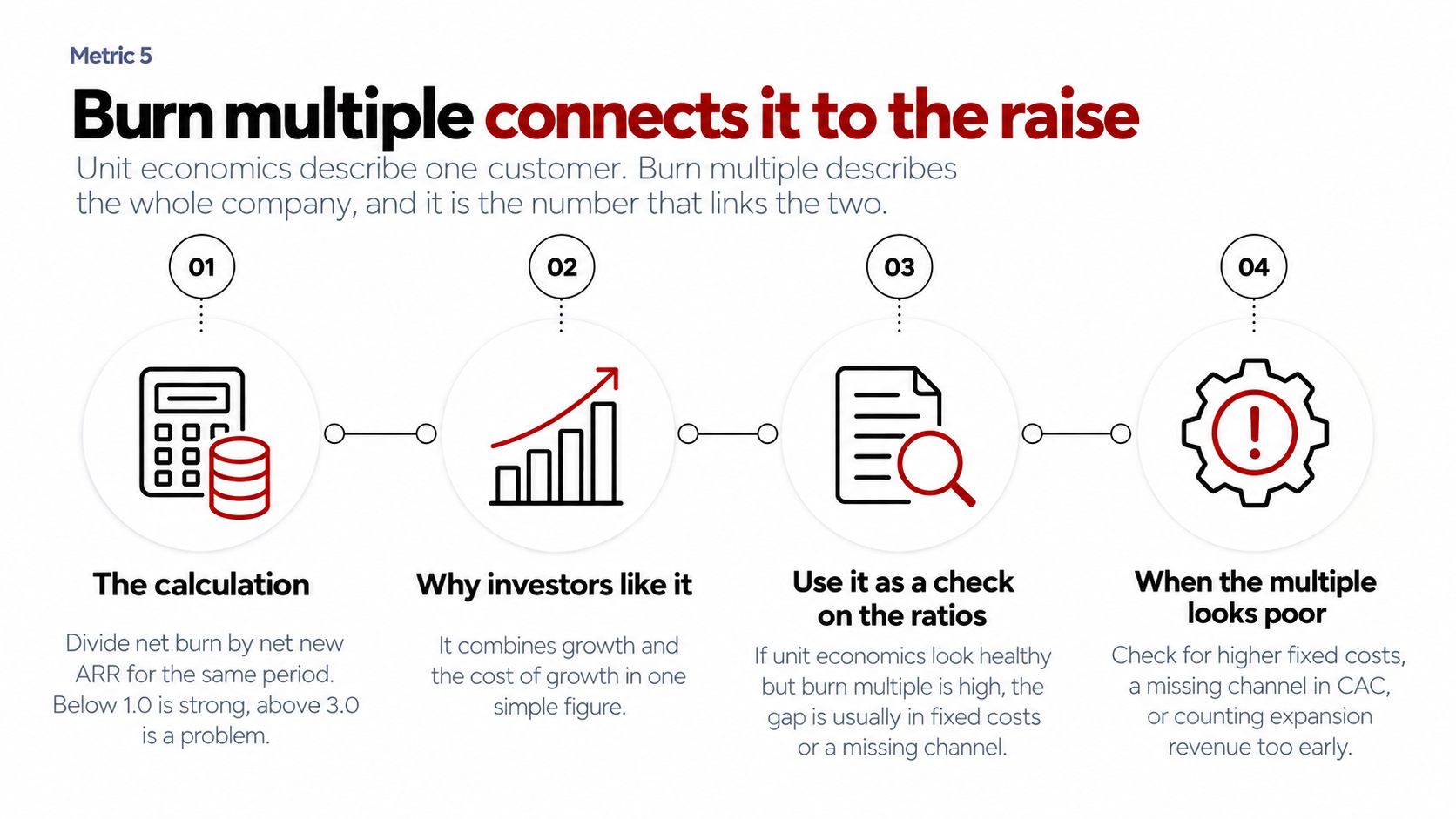
Burn multiple connects it to the raise
Unit economics describe one customer. Burn multiple describes the whole company, and it is the number that links the two.
The calculation
Divide net burn by net new annual recurring revenue for the same period. David Sacks, who popularised the measure, rates anything below 1.0 as amazing and 1.0 to 1.5 as great. Above 2.0 starts to look inefficient, and above 3.0 reads as a problem.
Why investors like it
It is hard to dress up. Growth rate alone says nothing about what the growth cost. Burn multiple puts the two together in one figure, which is why it shows up in almost every efficiency conversation now.
Use it as a check on the ratios
If unit economics look healthy and burn multiple looks poor, the gap usually sits in fixed cost or in a channel that is not in the CAC calculation. That gap is worth finding before an investor finds it.
When the multiple looks poor
Three causes explain most of it. Fixed costs have grown ahead of revenue. A channel that produces customers is missing from the CAC calculation. Or expansion revenue is being counted before it is contracted. Work through those three before concluding the product is the problem.
✅ Action to Take
Track burn multiple quarterly alongside runway so the two move together in the same report. Companies that want senior eyes on that trend without a full-time hire add a fractional CFO to the monthly cycle.
Not sure which of these numbers your company can actually produce?
A short call about your current reporting will show what is measurable today.
- Metric 6
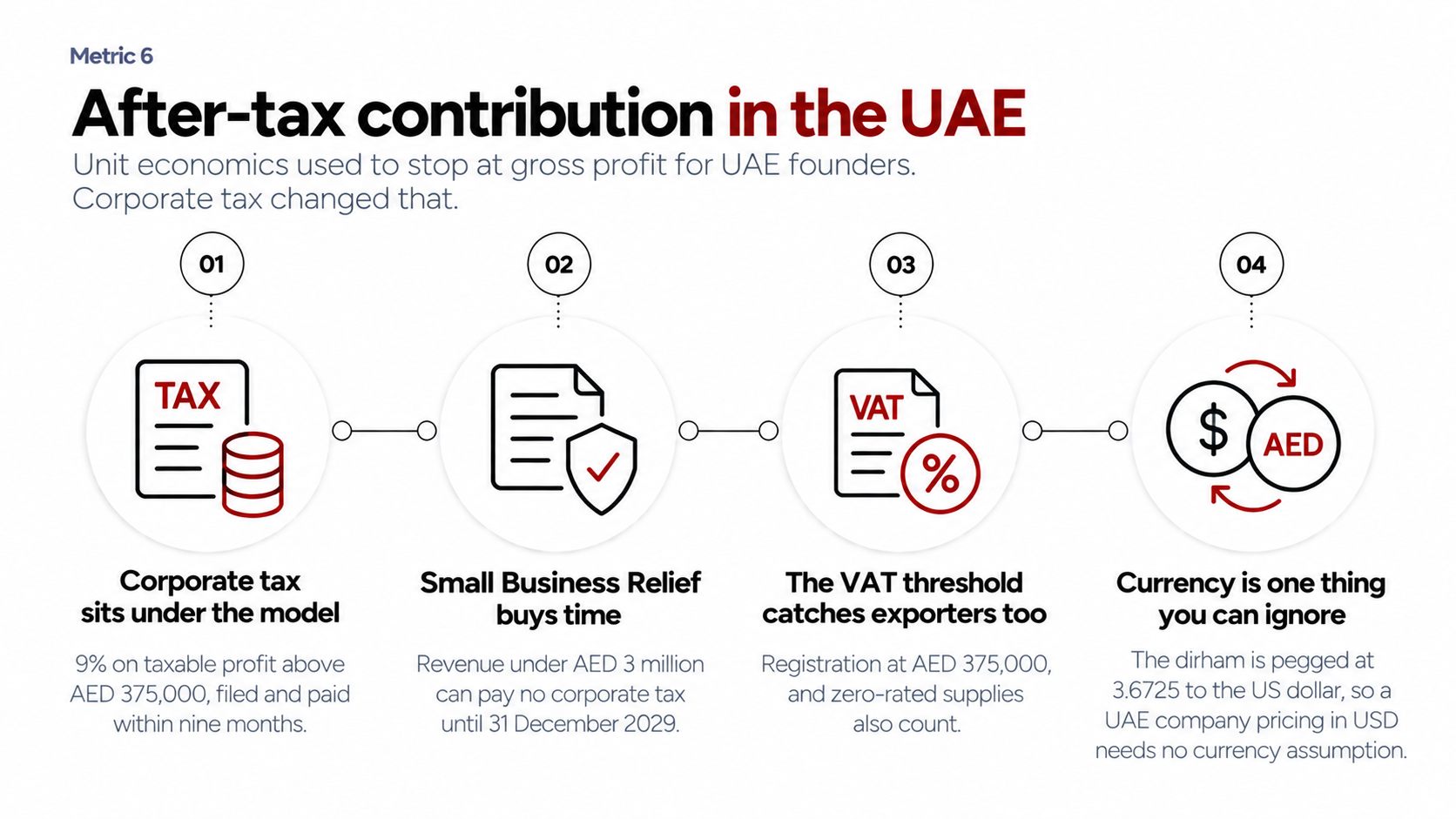
After-tax contribution in the UAE
Unit economics used to stop at gross profit for UAE founders. Corporate tax changed that.
Corporate tax sits under the model
Corporate tax is 9% on taxable profit above AED 375,000, filed and paid within nine months of the tax period end. The FTA corporate tax guide covers the mechanics. Once the company is profitable, contribution margin and after-tax contribution are different numbers, and pricing decisions should use the second one.
Small Business Relief buys time
Ministerial Decision 131 of 2026 extended Small Business Relief to tax periods ending on or before 31 December 2029, for revenue under AED 3 million. Companies using it pay no corporate tax for the period. It also means no tax loss arises to carry forward, so a loss-making year deserves a comparison before the election is made.
The VAT threshold catches exporters too
Registration becomes mandatory once taxable supplies pass AED 375,000, and zero-rated supplies count towards that figure. A company selling entirely to customers abroad can cross the threshold without charging a dirham of VAT. Registration also opens input VAT recovery on costs, which is what keeps the net CAC figures accurate.
Currency is one thing you can ignore
The dirham has been pegged at 3.6725 to the US dollar since 1997. A UAE company pricing in dollars carries no currency assumption inside its unit economics. Revenue in other currencies does need one, so a price list in euros or pounds needs a stated rate and a review date.
✅ Action to Take
Add an after-tax contribution line to the model and use it for pricing and channel decisions. Founders with free zone entities or several licences confirm the position with specialist corporate tax advice before changing prices.
Common Questions
Short answers to what UAE founders ask when they start tracking unit economics.
The profit or loss on a single unit of business, usually one customer or one order. They show whether growth builds value or burns it.
Contribution margin. Every other metric is built on it, and a wrong cost base makes every ratio above it wrong too.
Around 3 to 1 for a subscription business, following David Skok's guidance. Much higher usually means you are underspending on growth.
Five to twelve months on Skok's guidance. Under a year keeps the cash need manageable while you scale.
Yes. Sales and marketing salaries, commissions and tools all belong in it. A CAC built on ad spend alone understates the true cost.
Yes, on both sides. Revenue from UAE consumers should be net of the 5%, and acquisition costs should be net of recoverable input VAT.
Yes, for staff whose time scales with customers. Gratuity accrues at 21 days of basic wage a year for the first five years and 30 days after that, so a loaded cost includes it.
Below 1.5 on David Sacks' scale, with below 1.0 the strongest reading. Above 2.0 signals that growth is costing more than it returns.
The logic holds, the benchmarks shift. Transactional businesses should run the ratio on contribution margin over a set window such as twelve months.
Early customers usually come from the cheapest channels. As those saturate, each new cohort costs more to reach. A rising CAC with a stable payback period is normal growth, while a rising CAC with lengthening payback is a warning.
Monthly for the inputs, quarterly for the ratios. Cohort data moves slowly, and monthly ratio swings usually reflect noise.
Most early companies start with clean bookkeeping and a monthly model, then add senior review as the numbers start driving decisions. Scheduled part-time CFO time covers the review layer without a permanent hire.
Unit economics get more useful as the data gets older. A model built this quarter on three months of retention is a guess with a spreadsheet around it. The same model in a year, fed by real cohorts, tells you which channel to fund and which product to reprice. Start collecting the inputs now, even while the ratios are still too young to trust.
JaZaa CFO Advisory Team
The JaZaa CFO Advisory Team works with startups and SMEs across the UAE on financial modelling, cash planning and management reporting. Members hold US CMA, MBA and capital market qualifications, with backgrounds in capital structuring and investor reporting.
Legal disclaimer
This article provides general information about unit economics and financial metrics for startups and SMEs in the UAE. It does not constitute professional financial, tax, or accounting advice specific to your business. JaZaa provides professional business services including accounting, bookkeeping support, and management consulting. We are not a registered audit firm, tax agent, CPA, or Chartered Accounting firm. Benchmark figures are general guidance and vary by business model and stage. Reading this article does not create an advisor-client relationship with JaZaa. For advice specific to your situation, arrange a consultation.