


🔔 Why this matters now
MAGNiTT’s H1 2026 review shows fewer deals and more selective money. MENA startups raised USD 1.35 billion across 214 deals, with funding down 22% and deal count down 41% on the year. The UAE took USD 895 million, or 66% of all MENA funding, even as its own deal count fell 37%.
Q: Who is writing the cheques right now?
Mostly regional investors. MAGNiTT puts MENA-based investors at about 81% of capital deployed in H1 2026, their highest share in more than five years.
Q: What does a smaller pool of deals mean for my pitch?
Fewer deals means more founders competing for each cheque. Numbers that do not tie back to the books end the call early.
| 📊 The Investor Story at a Glance | ||
|---|---|---|
| STORY PART | WHAT INVESTORS TEST | WHERE THE PROOF SITS |
| History | Do the reported numbers match the bank, VAT returns and payroll? | Management accounts, reconciliations, audited statements where required |
| Engine | Does each customer earn back what it cost to win? | Cohort model, LTV to CAC, payback months |
| Fuel | How much growth does each dirham of burn buy? | Burn multiple, cash forecast, runway |
| Plan | What will this round deliver, and by when? | Driver-based forecast, use of funds, milestones |
| Structure | Who owns what after the round? | Cap table, share classes, valuation file |
- Chapter 1
Start with history investors can check
An investor story begins with the past, because the past is the only part an investor can verify. If last year’s revenue in the deck differs from the figure in your VAT returns, nobody will trust next year’s forecast.
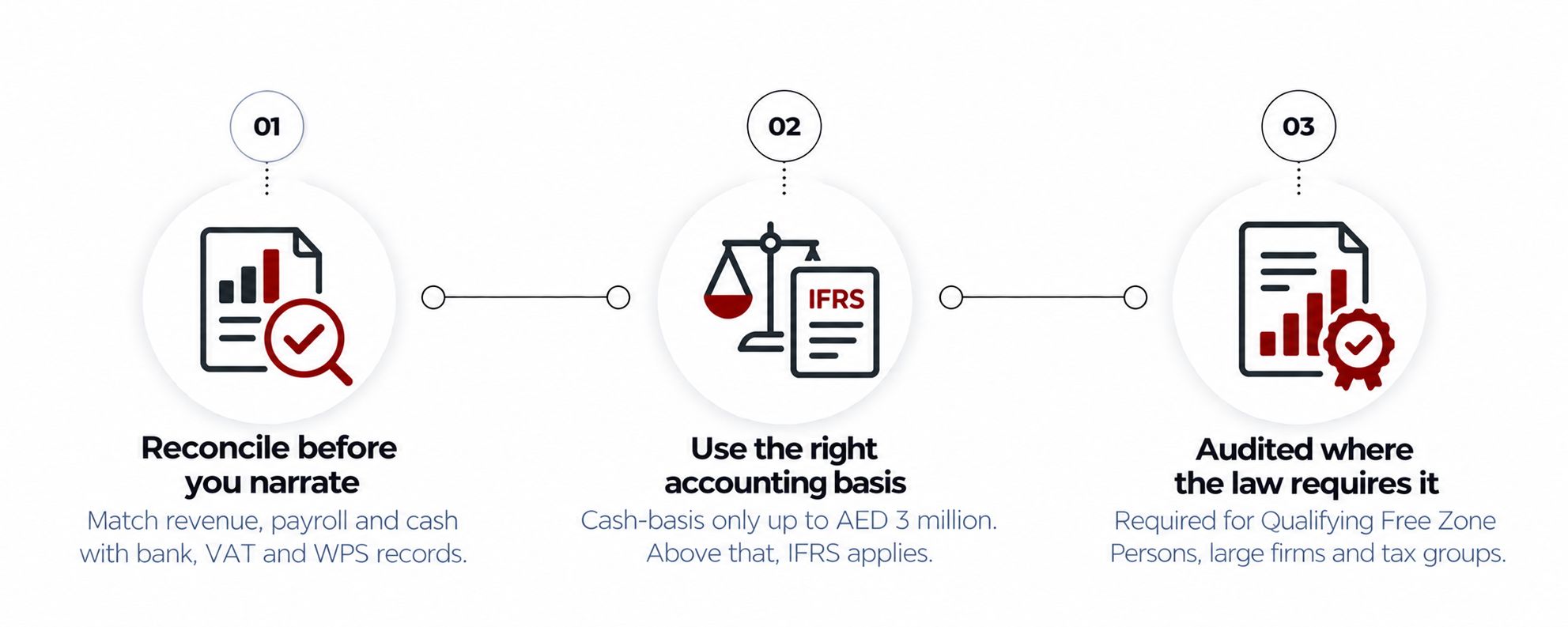
Reconcile before you narrate
Before you write a single slide, match three things. Revenue should agree with bank deposits and VAT returns. Payroll should agree with Wage Protection System records. Cash in the accounts should agree with the bank statement on the last day of each month. A team offering accounting services that close the books each month can run these checks for you.
Expect investors to ask for your tax filings. Corporate tax returns are due within nine months of the year end. A startup with two years of trading will usually have one on file, and the deck must agree with it.
Use the right accounting basis
Ministerial Decision 114 of 2023 allows cash-basis statements only while revenue stays at or below AED 3 million. Above that, IFRS applies, and firms with revenue up to AED 50 million may use IFRS for SMEs.
Even below AED 3 million, accrual accounts tell investors more. They show revenue in the month it was earned, which makes growth and margins far easier to read.
Audited where the law requires it
Ministerial Decision 84 of 2025 requires audited financial statements for every Qualifying Free Zone Person, whatever its revenue. It also covers firms with revenue above AED 50 million and every tax group. If your startup sits in one of these groups, the audited figures are the history. The deck has to start from them.
✅ Action to Take
Pull 24 months of revenue from the ledger, the bank and the VAT returns, and list every gap. JaZaa’s audit support team can clean up those gaps before an investor finds them.
- Chapter 2
Name the number your story turns on
Every good investor story has one number at its centre. For a subscription business it might be net new ARR. A marketplace might lead with gross merchandise value and take rate. Every slide after it should explain why it will grow.
Choose the metric that matches the model
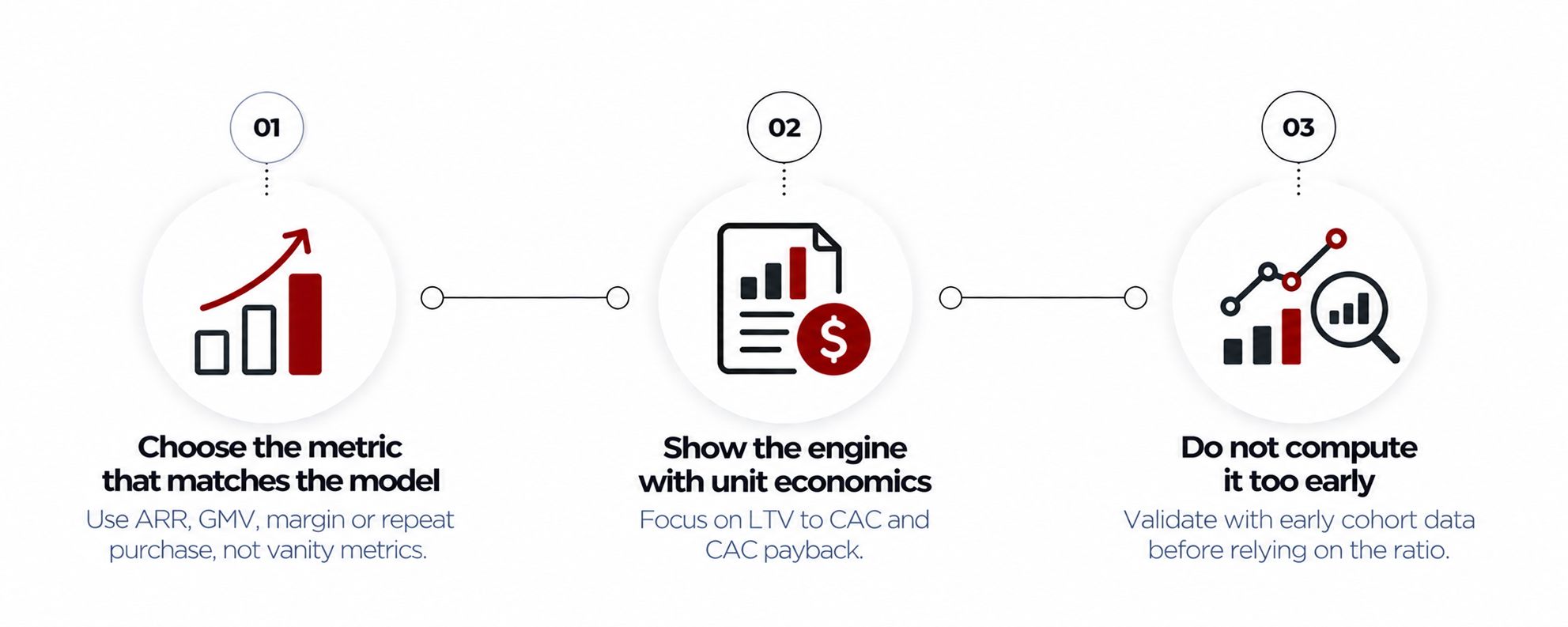
Investors judge a SaaS startup on recurring revenue and retention. They judge an e-commerce brand on contribution margin per order and repeat purchase. A founder who leads with total downloads or social followers asks the investor to do the maths for them.
Show the engine with unit economics
David Skok, who writes the For Entrepreneurs blog on SaaS metrics, sets a working target of about 3 to 1 for lifetime value against customer acquisition cost. He also suggests a CAC payback of 5 to 12 months, and he calculates lifetime value on gross margin, not revenue.
Here is a worked example in AED. A customer pays AED 2,000 a month at a 75% gross margin, so each one adds AED 1,500 a month in margin. Monthly churn of 2.5% means the average customer stays 40 months. Lifetime value is AED 1,500 times 40, or AED 60,000. If it costs AED 18,000 to win that customer, the ratio is 3.3 to 1, and payback takes 12 months.
That story works, but only just. Payback sits at the top of Skok’s range, so an investor will ask how you plan to bring it down.
Do not compute it too early
Skok warns against reading too much into this ratio before sales and marketing become repeatable. With five customers from the founder’s own network, say so plainly. Show the early cohort data and the plan to prove the engine, and leave the ratio for later.
✅ Action to Take
Write your central number at the top of a blank page. Under it, list the three inputs that move it most. A startup CFO who builds early-stage models can turn those inputs into a cohort model the deck can quote.
- Chapter 3
Show what each dirham of burn buys
Investors fund growth, but they price efficiency. Burning AED 3 million to add AED 1 million of new revenue tells one story. Burning AED 1 million for the same result tells a far better one.
The burn multiple
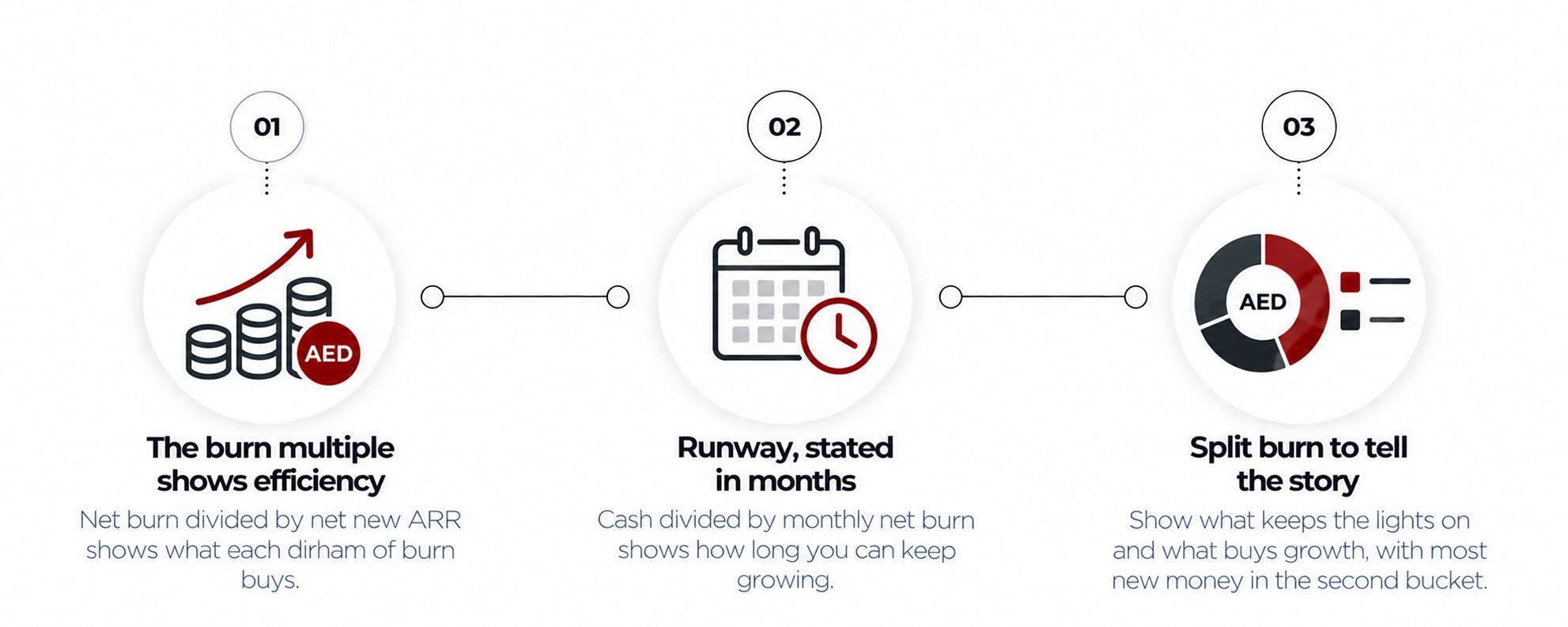
David Sacks, the investor and Craft Ventures co-founder, defines the burn multiple as net burn divided by net new ARR. He grades it on a simple scale. Below 1.0 is amazing, 1.0 to 1.5 is great, 1.5 to 2.0 is good, 2.0 to 3.0 is suspect, and above 3.0 is bad.
Say your startup burned AED 1,080,000 last quarter and added AED 600,000 of net new ARR. The burn multiple is 1.8, which lands in the good band. The story then needs to show how the next round moves it lower.
Runway, stated in months
Runway is cash divided by monthly net burn. With AED 4.2 million in the bank and net burn of AED 350,000 a month, runway is 12 months. Put that figure in the deck, and show the month the cash runs out under the plan.
Under Ministerial Resolution 340 of 2026, salaries for each month fall due on the 1st of the next month, with no grace period. The cash forecast has to hold payroll on that date every month, even in a slow sales quarter.
Burn that tells a story
Split burn into what keeps the lights on and what buys growth. Investors want to see that most new money goes to the second bucket.
✅ Action to Take
Calculate your burn multiple for each of the last four quarters and plot the trend. A fractional CFO who reviews burn every month can keep the figure current through the raise.
- Chapter 4
Build the forecast from drivers you can defend
A forecast that shows revenue tripling every year with no reason attached is a wish. Investors look for the drivers underneath, such as leads per month, conversion rate, average deal size and churn. Each driver needs a source, usually your own history.
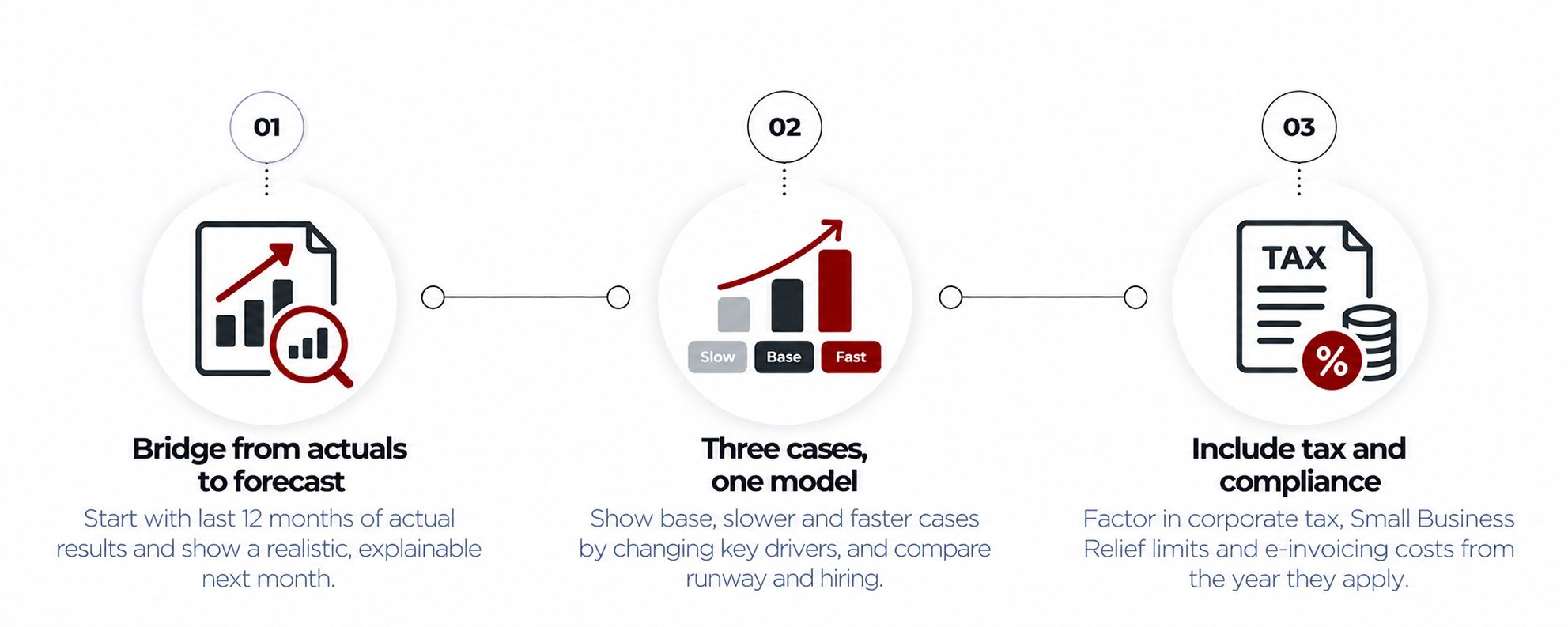
Bridge from actuals to forecast
Start the forecast from the last 12 months of actual results. The first forecast month should look like the last actual month, plus a change you can explain. A jump in month one is the fastest way to lose an investor’s trust.
Three cases, one model
Build a base case, a slower case and a faster case in the same model. Change only the drivers between them. Then show runway and hiring under each case. An investor learns more from how you plan for a slow year than from the best case.
Put tax and compliance in the model
Corporate tax is 9% on taxable profit above AED 375,000. Small Business Relief now runs to tax periods ending on or before 31 December 2029 under Ministerial Decision 131 of 2026. It applies only while revenue stays within AED 3 million. A forecast that crosses that line should show the tax cost from the year it applies.
E-invoicing belongs in the plan too. Firms below AED 50 million in revenue must appoint an Accredited Service Provider by 31 March 2027 and go live on 1 July 2027. Budget for it.
✅ Action to Take
Rebuild the forecast so every revenue line traces back to a driver and a source. JaZaa’s startup financial planning team builds driver-based models with base, slow and fast cases in one file.
Not sure your numbers tell a story yet?
A short call can show which chapter is missing.
- Chapter 5
Turn use of funds into milestones
The use of funds slide often lists percentages by department and stops there. Investors read it as a plan only when each block of spend ties to a result and a date.
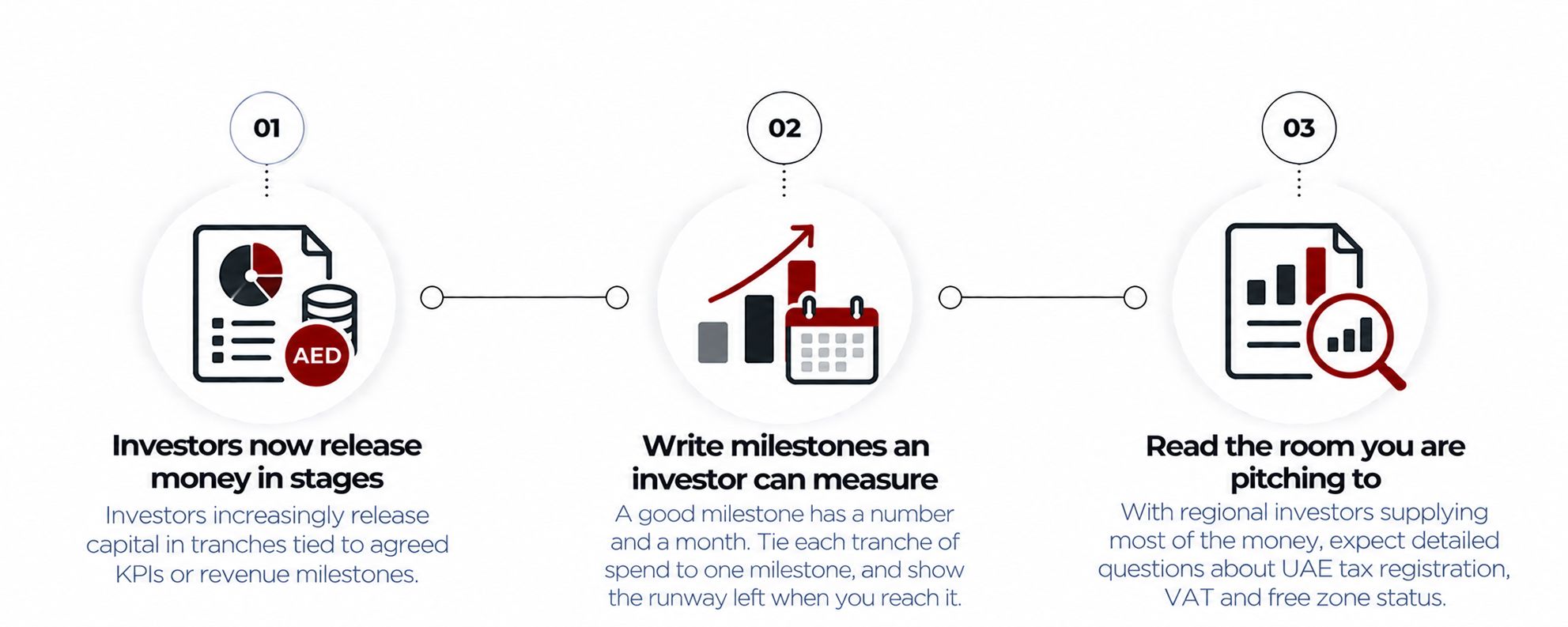
Investors now release money in stages
The UAE chapter of the Chambers Venture Capital 2026 guide, updated in May 2026, reports more bridge rounds and convertible instruments. It also notes that investors increasingly release capital in tranches tied to agreed KPIs or revenue milestones. Your story should name those milestones before the investor does.
Write milestones an investor can measure
A good milestone has a number and a month. For example, “AED 250,000 of monthly recurring revenue by September 2027” can be checked. “Expand into Saudi Arabia” cannot. Tie each tranche of spend to one milestone, and show the runway left when you reach it.
Read the room you are pitching to
MAGNiTT found that the ten largest deals took 58% of all H1 2026 capital. The other 204 deals shared the remaining 42%. With regional investors supplying most of the money, expect detailed questions about UAE tax registration, VAT and free zone status. Have the answers in the data room.
✅ Action to Take
Redraw the use of funds slide as a timeline with three to five milestones. Our fundraising support team prepares the model, deck and data room around those milestones.
- Chapter 6
Make the cap table and data room match
The last chapter of the story is ownership. Investors check that the cap table, the valuation and the legal documents all agree with the deck.
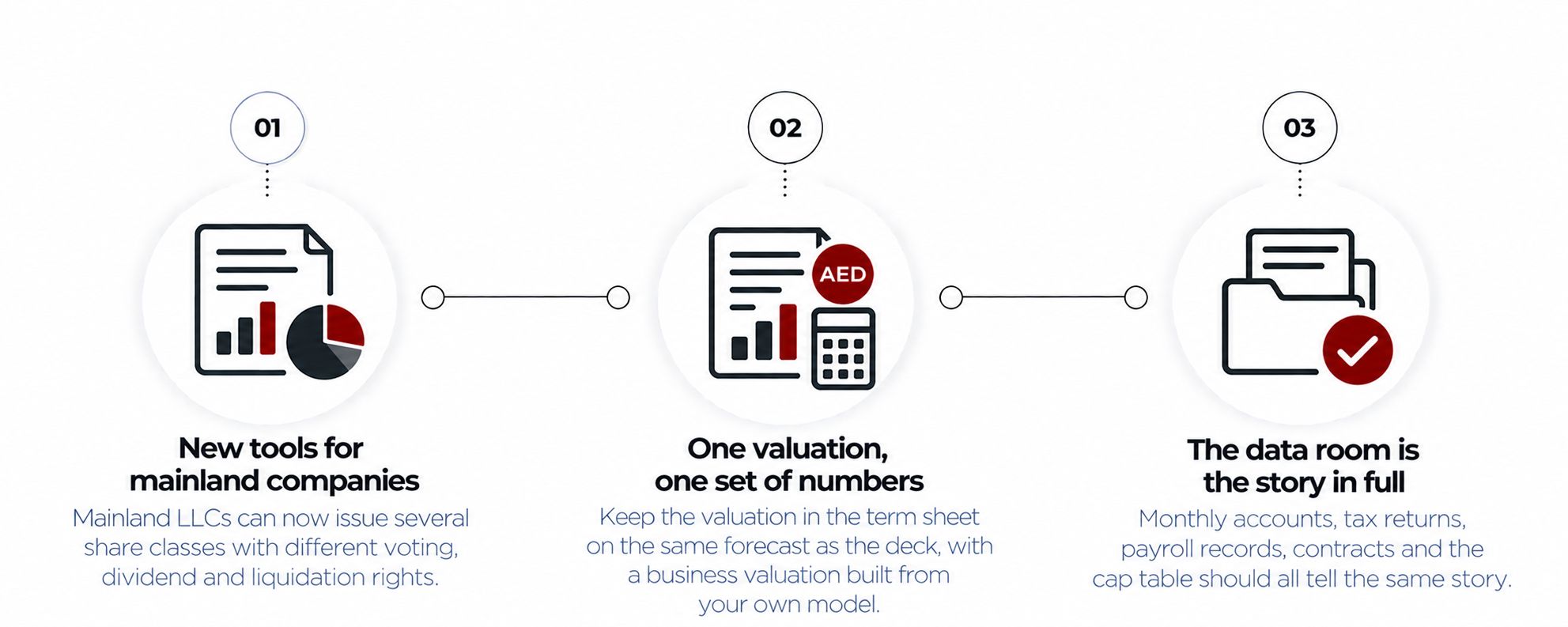
New tools for mainland companies
Federal Decree-Law 20 of 2025 amended the Commercial Companies Law. Mainland LLCs can now issue several share classes with different voting, dividend and liquidation rights. They can also put drag-along and tag-along rights into their constitutional documents.
Gowling WLG notes that putting share classes into practice depends on further Cabinet decisions and updates to the commercial register. Check what your licensing authority accepts today before you promise an investor a preference share.
One valuation, one set of numbers
The valuation in your term sheet should rest on the same forecast as the deck. A separate business valuation built from your own model keeps those figures in step. It also gives you a file to defend in negotiation.
The data room is the story in full
Investors open the data room to confirm what the deck claimed. Monthly accounts, tax returns, payroll records, contracts and the cap table should all tell the same story. If one document disagrees, the investor will trust that document over the slide.
✅ Action to Take
Before you send the deck, check it against the data room line by line, and fix any figure that differs.
Common Questions
Quick answers to what UAE founders ask about building an investor financial story.
Start with reconciled history, name the one number the business turns on, and show unit economics and burn efficiency. Then build a driver-based forecast and tie use of funds to dated milestones.
Every month since launch, reconciled to the bank and tax filings. For older startups, 24 to 36 months of monthly accounts gives investors enough to judge trends. JaZaa's free due diligence checklist for UAE startups lists 105 items to have ready.
The one that best explains your business model. Recurring revenue suits SaaS. Contribution margin per order suits e-commerce. Gross merchandise value and take rate suit marketplaces.
David Skok uses about 3 to 1 as a working target, with CAC payback of 5 to 12 months. Use gross margin, not revenue, when you calculate lifetime value.
Net burn divided by net new ARR, as defined by David Sacks. Under 1.0 is amazing, and above 3.0 is bad.
The law requires them only in set cases. Under Ministerial Decision 84 of 2025, these are Qualifying Free Zone Persons, firms with revenue above AED 50 million and tax groups. Many investors still ask for audited statements before a priced round.
Yes. Corporate tax is 9% on taxable profit above AED 375,000. Small Business Relief applies to tax periods ending by 31 December 2029, and only while revenue stays within AED 3 million.
MAGNiTT's H1 2026 review shows UAE funding up 53% to USD 895 million, while UAE deal count fell 37%. Fewer startups are raising larger sums.
Federal Decree-Law 20 of 2025 allows several share classes in mainland LLCs. Practical rollout depends on Cabinet decisions and register updates, so check with your licensing authority first.
Each block of spend, the milestone it buys, and the month you expect to hit it. Show the runway left at each milestone.
Yes. JaZaa runs a free startup pitch review with a mock investor session for two founders every two weeks.
MAGNiTT’s H2 2026 figures will show whether the drop in deal count holds. Either way, regional investors now supply most of the capital, so expect them to check UAE filings, payroll and free zone status as closely as growth. Mainland share classes may also bring new term sheet structures once the register catches up. Founders who keep their numbers investor-ready every month can open a round within weeks when the right investor appears.
JaZaa CFO Advisory Team
JaZaa is a Dubai-based management consultancy that gives startups and SMEs senior finance support through fractional, virtual, part-time and interim CFO services. The team works with founders on financial models, valuations, investor materials and due diligence across the UAE.
Legal disclaimer
This article provides general information about preparing financial information for investors for startups and SMEs in the UAE. It does not constitute professional financial, tax, accounting, or legal advice specific to your business. JaZaa provides professional business services including accounting, bookkeeping support, and management consulting. We are not a registered audit firm, tax agent, CPA, or Chartered Accounting firm. Nothing here is investment advice or an offer of securities, and share class and company law questions need a UAE-licensed lawyer. Reading this article does not create an advisor-client relationship with JaZaa. For advice specific to your situation, arrange a consultation.