

🔔 Why this matters now
Two things changed the maths for UAE startups this year. Funding got harder to close, and payroll moved to a fixed date with no slack. MAGNiTT counted 214 MENA deals in the first half of 2026, down 41% on a year earlier.
Q: Why does the payroll date matter for scenarios?
Since 1 June 2026, wages fall due on the 1st of each month under Ministerial Resolution 340 of 2026. Every case in your model has to show that cash exists on that date.
Q: Is one careful forecast enough?
Rarely. A single forecast shows the year you hope for, while three cases show what you will do if the year goes another way.
| 📊 The Three Cases at a Glance | |||
|---|---|---|---|
| CASE | REVENUE VIEW | FUNDING VIEW | WHAT IT IS FOR |
| Base | What you expect, built from the last 12 months | Round closes on your planned date | Budgets, hiring plan, targets |
| Worst | Slower sales, later collections | Round slips by six months or more | Protecting payroll and runway |
| Best | Faster growth you could still deliver | Round closes early or larger | Planning the cash that growth eats |
| Triggers | Leading indicators you track weekly | Investor pipeline status | Telling you which case you are in |
- Step 1
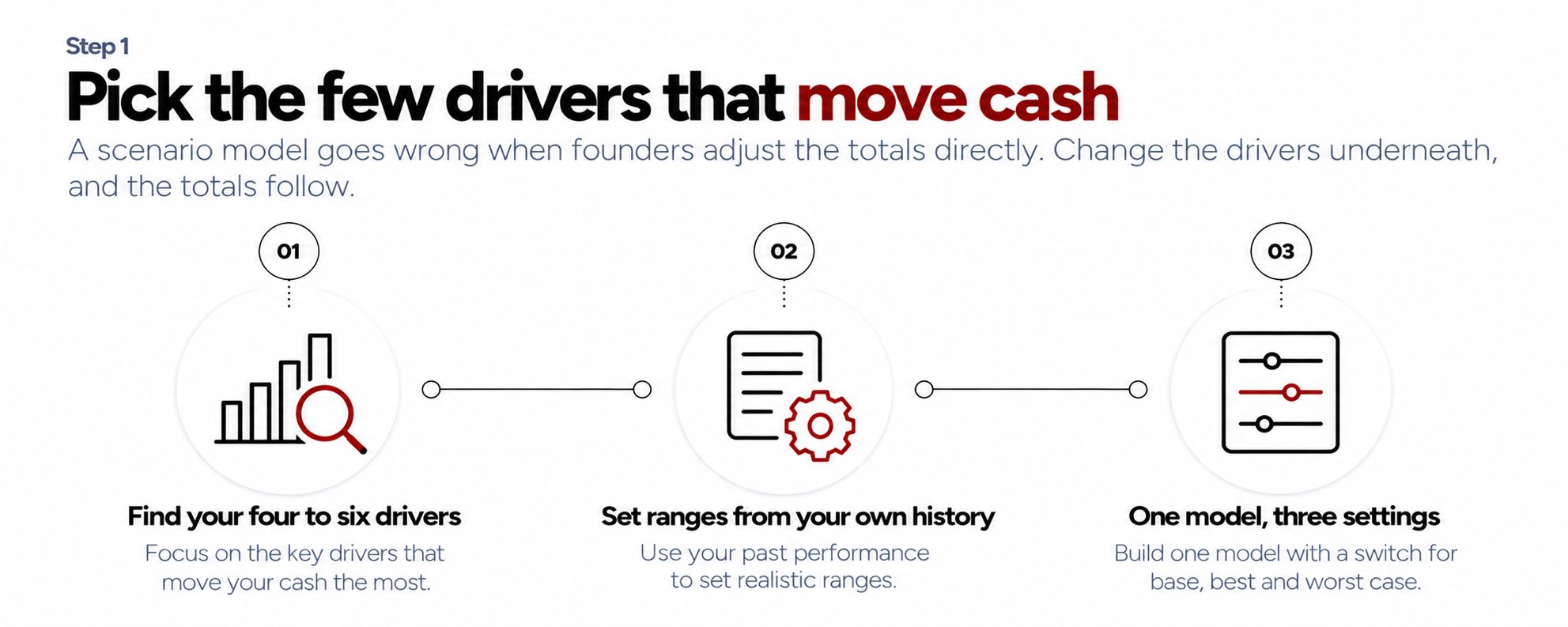
Pick the few drivers that move cash
A scenario model goes wrong when founders adjust the totals directly. Revenue up 20% or costs down 10% sounds tidy, but nobody can act on it. Change the drivers underneath, and the totals follow.
Find your four to six drivers
Most movement in startup cash comes down to a few drivers. New customers per month, average price, churn, days to collect, hiring dates and the next round’s closing date usually explain most of the movement. A trading business adds stock days and supplier terms. If you want a wider look at your finance setup first, JaZaa’s CFO checklist for founders covers more than 70 priorities.
Keep the ones that moved your bank balance most in the last year, and leave the rest fixed.
Set ranges from your own history
Your own history gives you realistic ranges. If your best quarter added 40 customers a month and your worst added 18, the base case probably sits near the middle. The worst case sits near 18, not at some round number you picked.
The same logic applies to collections. If large clients took 75 days to pay last year, assuming 30 days in the worst case is wishful thinking.
One model, three settings
Build one model with a switch at the top, so each case changes only the driver inputs. The formulas stay the same, which keeps the cases comparable and stops you ending up with three spreadsheets that slowly drift apart.
✅ Action to Take
List your drivers on one page, with a low, middle and high value for each, and note where each number came from. JaZaa’s startup financial planning team builds driver-based models with all three cases in a single file.
- Step 2
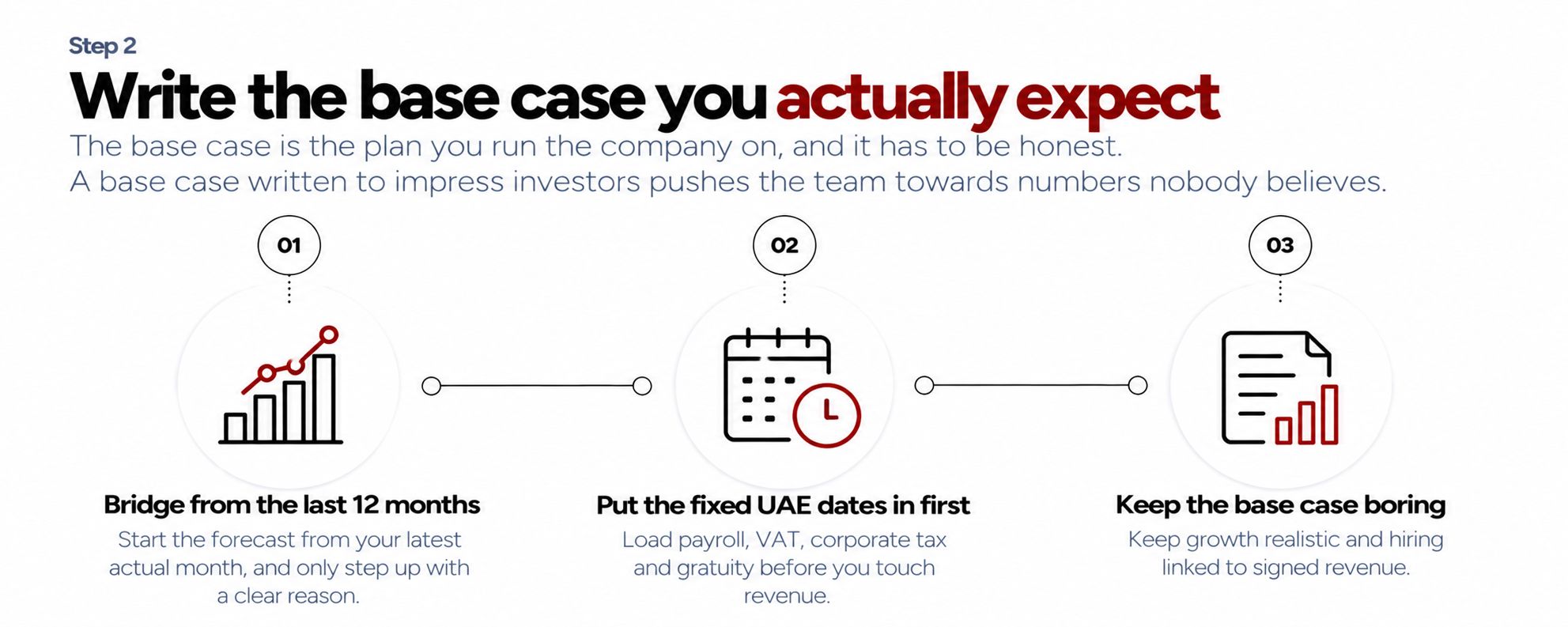
Write the base case you actually expect
The base case is the plan you run the company on, and because it sets budgets and targets, it has to be honest. A base case written to impress investors pushes the whole team towards numbers nobody believes.
Bridge from the last 12 months
Start the first forecast month from your latest actual month. If revenue was AED 400,000 last month, the base case should not open at AED 520,000. Any step up needs a named reason, such as a signed contract or a price change already live.
Put the fixed UAE dates in first
Some payments fall on fixed calendar dates in every case, so load them before you touch revenue.
- Payroll clears through the Wage Protection System by the 1st of each month.
- VAT returns and payment fall due within 28 days of each tax period end.
- Corporate tax is due within nine months of the year end.
- End of service gratuity builds up at 21 days of basic salary per year for the first five years, under Article 51 of the Labour Law.
Gratuity is easy to overlook because nobody pays it until an employee leaves. A team of 12 on an average basic salary of AED 15,000 builds up roughly AED 126,000 of gratuity a year. Treat that as a real cost in the base case.
Keep the base case boring
A good base case looks a little dull, with growth following the trend and hiring following signed revenue. If the base case shows a sudden jump, move that jump to the best case.
✅ Action to Take
Run your base case for the next 90 days in weekly steps. JaZaa’s free 90-day cash flow calculator for startups includes what-if settings and early warnings before cash runs low.
- Step 3
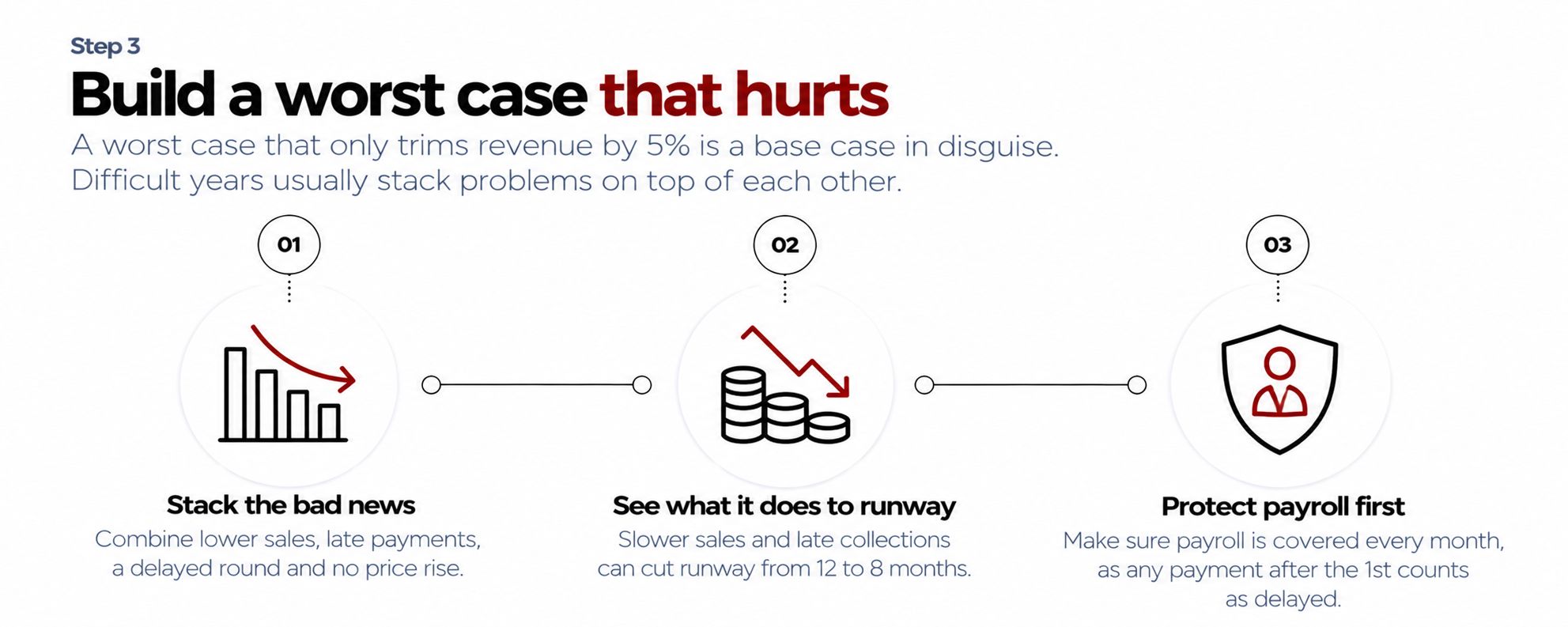
Build a worst case that hurts
A worst case that only trims revenue by 5% is a base case in disguise. Difficult years usually stack problems on top of each other. Slower sales, late customer payments and a delayed round often arrive in the same quarter.
Stack the bad news
Build the worst case from several drivers at once. A useful starting point for many UAE startups looks like this.
- New sales 30% below base.
- Large clients pay 30 days later than usual.
- The next round closes six months after plan.
- One planned price rise does not happen.
Your own history may point to a harsher or milder mix, and where it does, go with your history.
See what it does to runway
Take a startup with AED 3.6 million in the bank. In the base case, net burn is AED 300,000 a month, so runway is 12 months. In the worst case, slower sales and late collections push net burn to AED 450,000. Runway drops to 8 months.
Those four lost months are the whole point of the exercise. They show the founder how much time a bad year costs, and how early to act.
Protect payroll first
Under Ministerial Resolution 340 of 2026, any wage payment after the 1st counts as delayed. Enforcement steps begin within days, so the worst case must show payroll covered every month. If it does not, the model has found your first cut.
✅ Action to Take
Write down the cuts you would make if the worst case arrived, in order, with the cash each one saves. A fractional CFO who runs downside planning can test that list against the model before you need it.
- Step 4
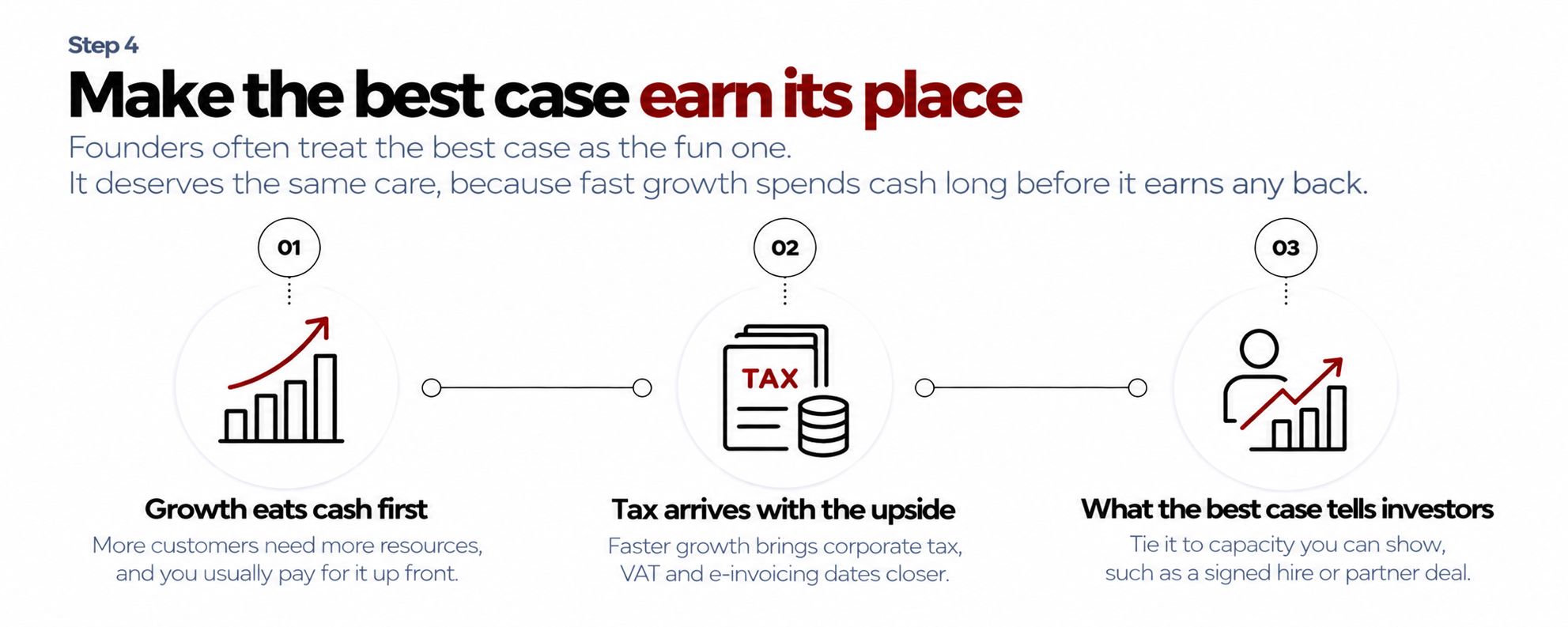
Make the best case earn its place
Founders often treat the best case as the fun one. It deserves the same care, because fast growth spends cash long before it earns any back.
Growth eats cash first
More customers need more staff, inventory or server capacity, and you usually pay for it up front. Receivables also grow. If customers pay in 60 days and sales double, the cash tied up in unpaid invoices roughly doubles too.
Run the best case and find the lowest cash point. A fast-growing startup can run out of cash sooner in its best case than in its base case.
Tax arrives with the upside
Corporate tax is 9% on taxable profit above AED 375,000. Small Business Relief now covers tax periods ending on or before 31 December 2029 under Ministerial Decision 131 of 2026. It applies only while revenue stays within AED 3 million. A best case that crosses that threshold should show the tax liability from that year.
Faster growth also brings compliance dates closer. VAT registration becomes mandatory once taxable supplies pass AED 375,000. Larger businesses faced an earlier e-invoicing deadline under Ministerial Decision 66 of 2026. Those with revenue of AED 50 million or more had to appoint an Accredited Service Provider by 30 October 2026. Smaller firms appoint by 31 March 2027 and go live on 1 July 2027.
What the best case tells investors
An investor reading your best case mainly wants to know whether the team can deliver it. Tie it to capacity you can show, such as a sales hire already signed or a partner deal in final terms.
✅ Action to Take
Find the lowest cash month in your best case and plan how to fund it. Our corporate tax consulting team for UAE startups can add the tax and VAT effects, so the upside holds no surprises at year end.
Not sure your model holds up under pressure?
A short call can show which case is weakest.
- Step 5
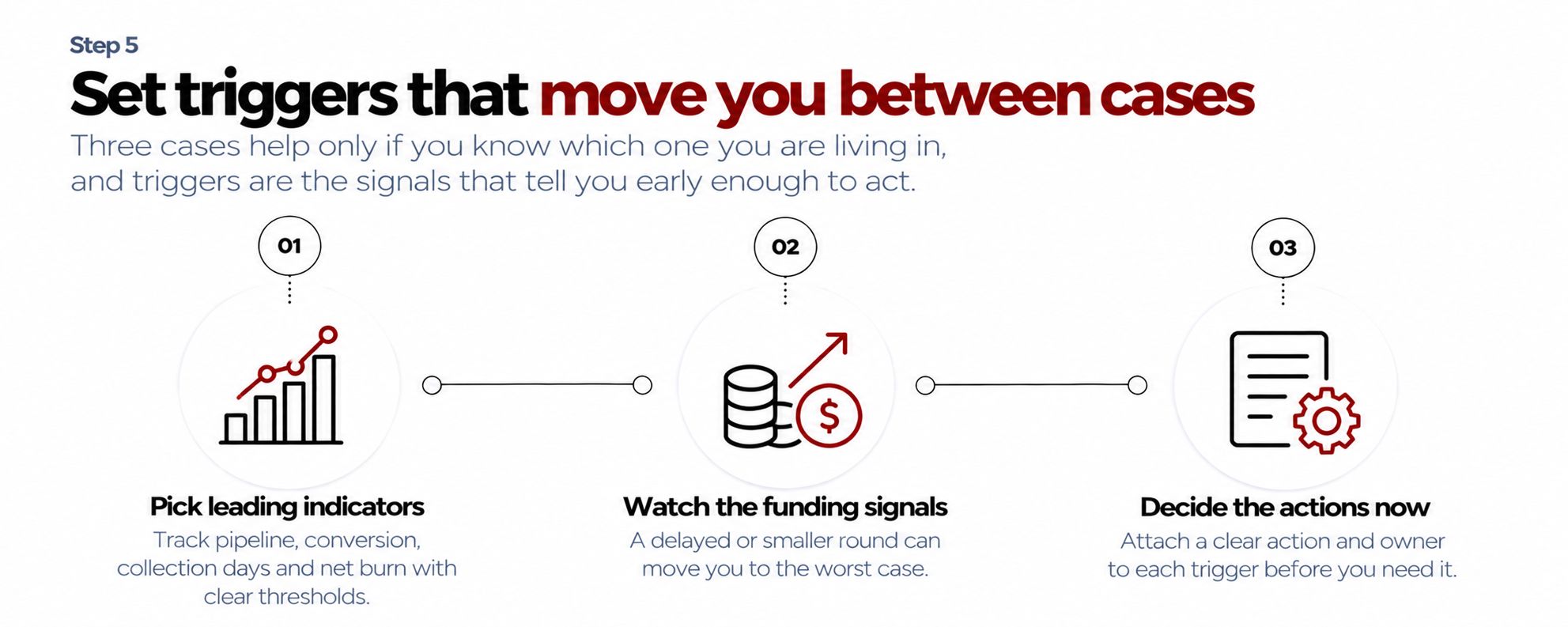
Set triggers that move you between cases
Three cases help only if you know which one you are living in, and triggers are the signals that tell you early enough to act.
Pick leading indicators
Revenue tells you about last month, while leading indicators tell you about the next one. Good ones include qualified pipeline, trial-to-paid conversion, days to collect and weekly net burn.
Set a numerical threshold for each indicator. For example, if collections slip past 60 days for two months in a row, you move to the worst-case plan.
Watch the funding signals
For many startups, the raise is the biggest single driver in the model. MAGNiTT’s H1 2026 review shows UAE funding up 53% to USD 895 million, while the number of UAE deals fell 37%. Investment is concentrating in fewer companies.
Regional investors also supplied about 81% of MENA capital in the period, by MAGNiTT’s count. The UAE chapter of the Chambers Venture Capital 2026 guide reports more bridge rounds and more capital released in tranches against agreed KPIs. A worst case should therefore assume a smaller first tranche, or a bridge before the full round.
Decide the actions now
A trigger with no action attached is just a worry. Next to each one, write what you will do and who is responsible. Decide now, while things are calm, because decisions made in the middle of a cash crunch are usually rushed.
✅ Action to Take
Put your triggers and actions in a one-page table and review it at every board meeting. JaZaa’s fundraising support team plans raise timing around these triggers so the round starts before runway gets short.
- Step 6
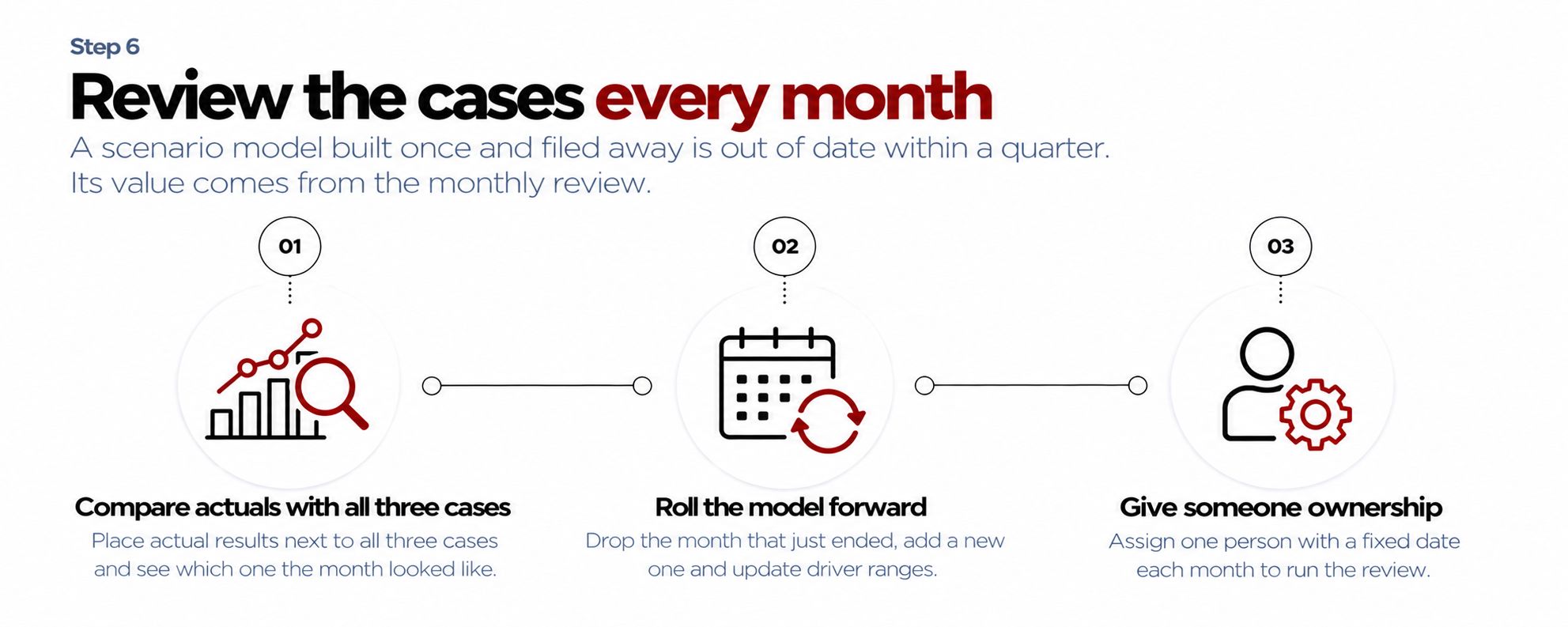
Review the cases every month
A scenario model built once and filed away is out of date within a quarter. Its value comes from the monthly review.
Compare actuals with all three cases
Each month, place actual results next to all three cases and ask which one the month looked most like, and why. Three months tracking closer to the worst case is a trigger in its own right.
Roll the model forward
Drop the month that just ended and add a new one at the far end. Update the driver ranges with what you have just learned. The model should always look 12 to 18 months ahead.
Give someone ownership
Founders often update the model before a raise and then ignore it. Give the review to one person with a fixed date each month. JaZaa’s published fractional CFO retainers in Dubai run from AED 15,000 to AED 35,000 a month. That range suits startups that need this discipline without a full-time hire.
✅ Action to Take
Book a recurring 60-minute review in the first week of each month. A part-time CFO with set days each month can own that review and bring the updated cases to the board.
Common Questions
Short answers to what UAE founders ask most about scenario planning.
It is building best, base and worst cases in one model, using drivers such as sales, collections and funding dates. Each case shows cash, runway and the UAE dates you must meet.
Three is enough for most early-stage companies. Add a separate stress test only if one risk, such as losing a major client, could break the business alone.
Twelve to 18 months by month for the plan. Keep the next 13 weeks of cash by week, because payroll and VAT dates fall inside that window.
Bad enough to hurt. Stack slower sales, later collections and a delayed raise in the same period, and use your own weakest quarter as a guide.
It should at least include a raise that closes six months late or arrives in tranches. Chambers' 2026 UAE chapter reports more tranche-based deals.
Payroll on the 1st of each month, and VAT within 28 days of each period end. Add corporate tax within nine months of year end, plus gratuity for every employee.
Yes. It applies to tax periods ending by 31 December 2029, but only while revenue stays within AED 3 million. A best case above that line should show the tax.
Every month, once the books close, and update the driver ranges as well as the numbers.
Many do, because a worst case with a clear action list shows the team has thought about risk. That builds trust in the base case.
Yes. Replace revenue drivers with launch date, conversion assumptions and the funding date, then show how long cash lasts if each one slips.
One person with a fixed monthly review date. Many startups give it to a virtual CFO who updates the cases each month and reports to the founder.
MAGNiTT’s third-quarter numbers will show whether the 2020 pattern repeats. Either way, the next year brings fixed dates for UAE startups, from the monthly payroll deadline to e-invoicing for smaller firms in July 2027. A startup that already knows its trigger points can move to the right plan in a week. One that has a single forecast will spend that week building a model while the cash runs down.
JaZaa CFO Advisory Team
JaZaa is a Dubai-based management consultancy that gives startups and SMEs senior finance support through fractional, virtual, part-time and interim CFO services. The team works with founders on forecasting, cash planning, tax readiness and fundraising across the UAE.
Legal disclaimer
This article provides general information about scenario planning and financial forecasting for startups and SMEs in the UAE. It does not constitute professional financial, tax, accounting, or legal advice specific to your business. JaZaa provides professional business services including accounting, bookkeeping support, and management consulting. We are not a registered audit firm, tax agent, CPA, or Chartered Accounting firm. Worked examples are illustrations only, and tax, payroll and gratuity rules cited reflect UAE law as of October 2026. Reading this article does not create an advisor-client relationship with JaZaa. For advice specific to your situation, arrange a consultation.