


🔔 What changed in 2026
Q: What is different for UAE founders this year?
Federal Decree-Law 20 of 2025 amended the Commercial Companies Law with effect from 1 January 2026. Mainland LLCs can now issue multiple share classes, including preference, convertible and non-voting shares. Drag-along and tag-along rights have a statutory basis. A priced round can now sit onshore instead of being pushed offshore, which puts more UAE valuations in front of a notary and a registry.
Q: Are investors paying more or less for the same company?
Both, depending on the company. MAGNiTT reported USD 1.35 billion raised across 214 deals in MENA in the first half of 2026, with funding down 22% and deal count down 41%. Mean deal size rose to USD 7.9 million while the median held at USD 2.0 million. Capital concentrated at the top, so a typical round did not get bigger.
| 📊 Valuation Methods at a Glance | |||
|---|---|---|---|
| METHOD | STAGE IT FITS | WHAT IT NEEDS | WHERE IT BREAKS |
| Berkus | Pre-revenue, idea to prototype | Five risk milestones scored in cash | Ceiling near AED 9 million |
| Scorecard | Pre-revenue to pre-seed | Average pre-money of funded regional peers | Thin comparable data in MENA |
| Risk factor summation | Pre-seed with uneven risk | A base value plus 12 risk ratings | Ratings stay subjective |
| VC method | Seed to Series A | Exit multiple, target return, dilution path | The exit assumption drives everything |
| Comparables | Series A onward | Revenue or ARR and traded multiples | Public multiples reprice fast |
| DCF | Series B onward | Three or more years of history | Terminal value swamps early models |
- Signal 1
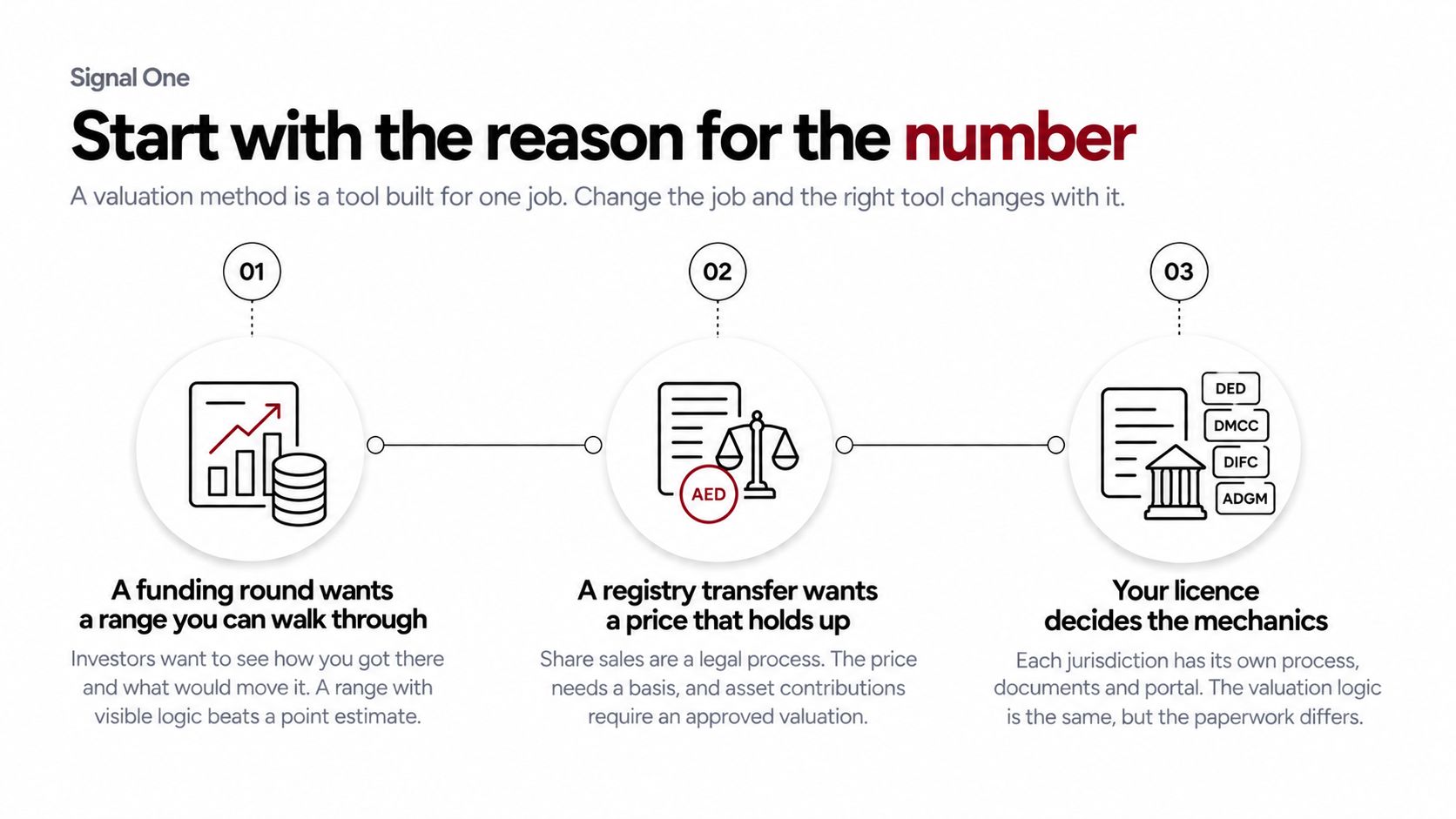
Start with the reason for the number
A valuation method is a tool built for one job. Change the job and the right tool changes with it.
A funding round wants a range you can walk through
Investors are not hunting for one true figure. They want to see how you got there and what would move it. A range with visible logic beats a point estimate, because it invites a conversation instead of a single counter-argument.
A registry transfer wants a price that holds up
Selling shares in a mainland LLC is a legal process, not a private negotiation. Existing shareholders hold pre-emption rights, so the price you offer a third party sets the price they can match. That price needs a basis. Where a partner contributes an asset rather than cash, the Commercial Companies Law requires an appraised value, and the Ministry of Economy sets the standards for approving valuers.
Your licence decides the mechanics
A mainland transfer runs through the Department of Economy and Tourism in Dubai, or the DED in the other emirates. It needs Arabic documentation, a notarised share transfer agreement and an amended memorandum of association. Commercial free zones such as DMCC and JAFZA each run their own portal and forms. DIFC and ADGM operate under English common law with digital filing. The valuation logic stays the same across all three. The paperwork it has to feed does not.
✅ Action to Take
Write the purpose in one line at the top of the model before you open a spreadsheet. Build both cases off one set of financials, starting from a structured business valuation that fits the stated purpose.
- Signal 2
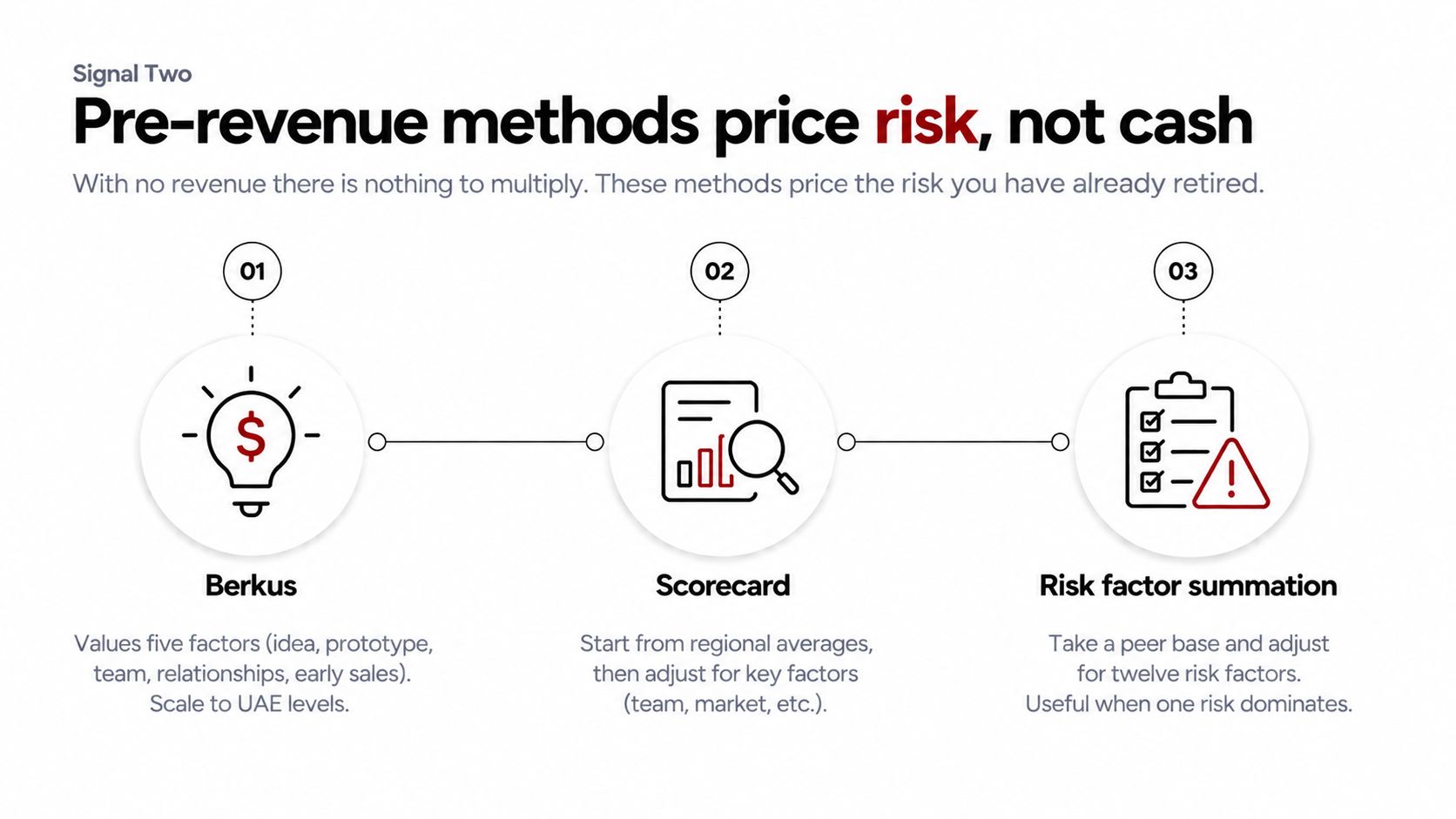
Pre-revenue methods price risk, not cash
With no revenue there is nothing to multiply. These methods price the risk you have already retired.
Berkus
Dave Berkus built this for angel deals. It assigns a fixed amount to each of five factors, capped at USD 500,000 apiece in the original US version. The factors are a sound idea, a working prototype, a quality management team, strategic relationships, and early sales.
The dollar amounts do not travel. UAE angel cheques sit below Bay Area norms, so scale the per-factor cap to what local angels pay. The ceiling is the second flaw. A Dubai team with a live pilot and a signed enterprise LOI often prices above the cap in a real round.
Scorecard
Bill Payne’s method starts from the average pre-money valuation of recently funded startups in your region and sector. It then adjusts that average across weighted factors. Management team usually carries the heaviest weight at around 30%, with market size next at around 25%.
Regional data is the constraint here. MENA saw 214 deals in the first half of 2026, and disclosed pre-money figures are rarer. Widen the set to the GCC, use a median, and state the sample in the model.
Risk factor summation
This method takes a base valuation from peer rounds. It then moves that base up or down across twelve risk categories, covering management, stage, regulation, technology and exit prospects. It suits UAE deals where one risk dominates, such as a fintech waiting on a Central Bank or DFSA permission that gates the whole revenue plan.
✅ Action to Take
Run at least two pre-revenue methods and record the gap between them. Early-stage teams preparing a first institutional round get further with startup CFO support that turns those numbers into a story investors follow.
- Signal 3
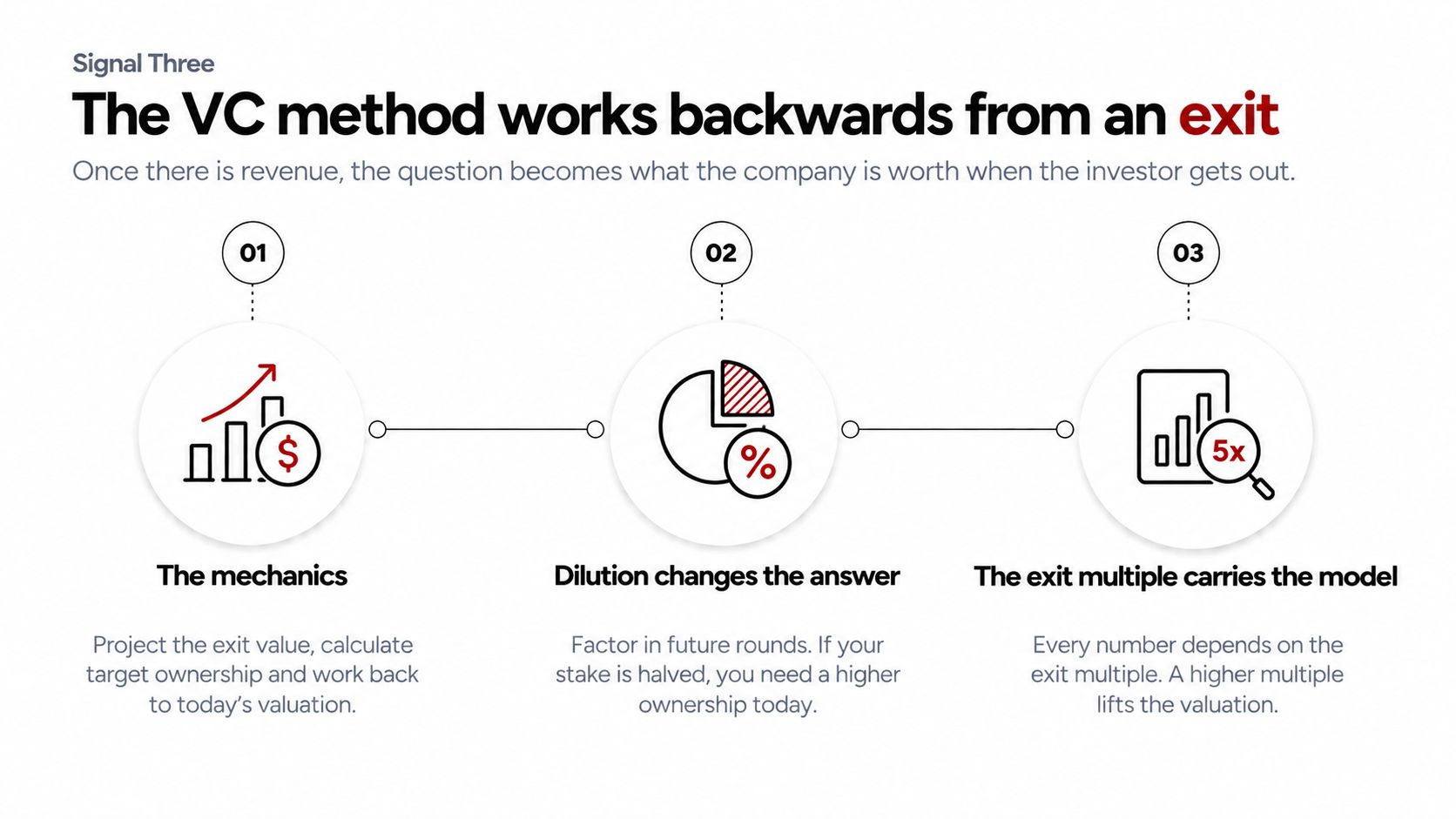
The VC method works backwards from an exit
Once there is revenue, the question becomes what the company is worth when the investor gets out.
The mechanics
Start at the exit. Say the plan puts you at AED 60 million of ARR in year five. Comparable businesses trade near 5x revenue, so that is an AED 300 million exit.
An investor writing AED 5 million and targeting 15x needs AED 75 million back. That is 25% of the exit. Divide the cheque by the ownership and today’s post-money is AED 20 million. Pre-money is AED 15 million.
Dilution changes the answer
Now add the rounds that come after. If the investor expects their stake to be halved, they need 50% today to hold 25% at exit. Post-money drops to AED 10 million. Founders who model the exit but skip dilution walk in with double the investor’s number.
The exit multiple carries the model
Every figure above hangs on that 5x. Aventis Advisors put the median EV to revenue multiple for public SaaS at 4.6x in August 2026, after a low of 3.2x in June. Move your assumed multiple from 5x to 8x and the valuation moves 60% with it. UAE founders at least do not have to model currency risk on the way out. The dirham has been pegged at 3.6725 to the US dollar since 1997.
✅ Action to Take
Build the VC method with three exit multiples rather than one, and show the spread on the same page. Founders running this alongside a live raise keep it inside monthly reporting with virtual CFO support so the range updates as traction lands.
- Signal 4
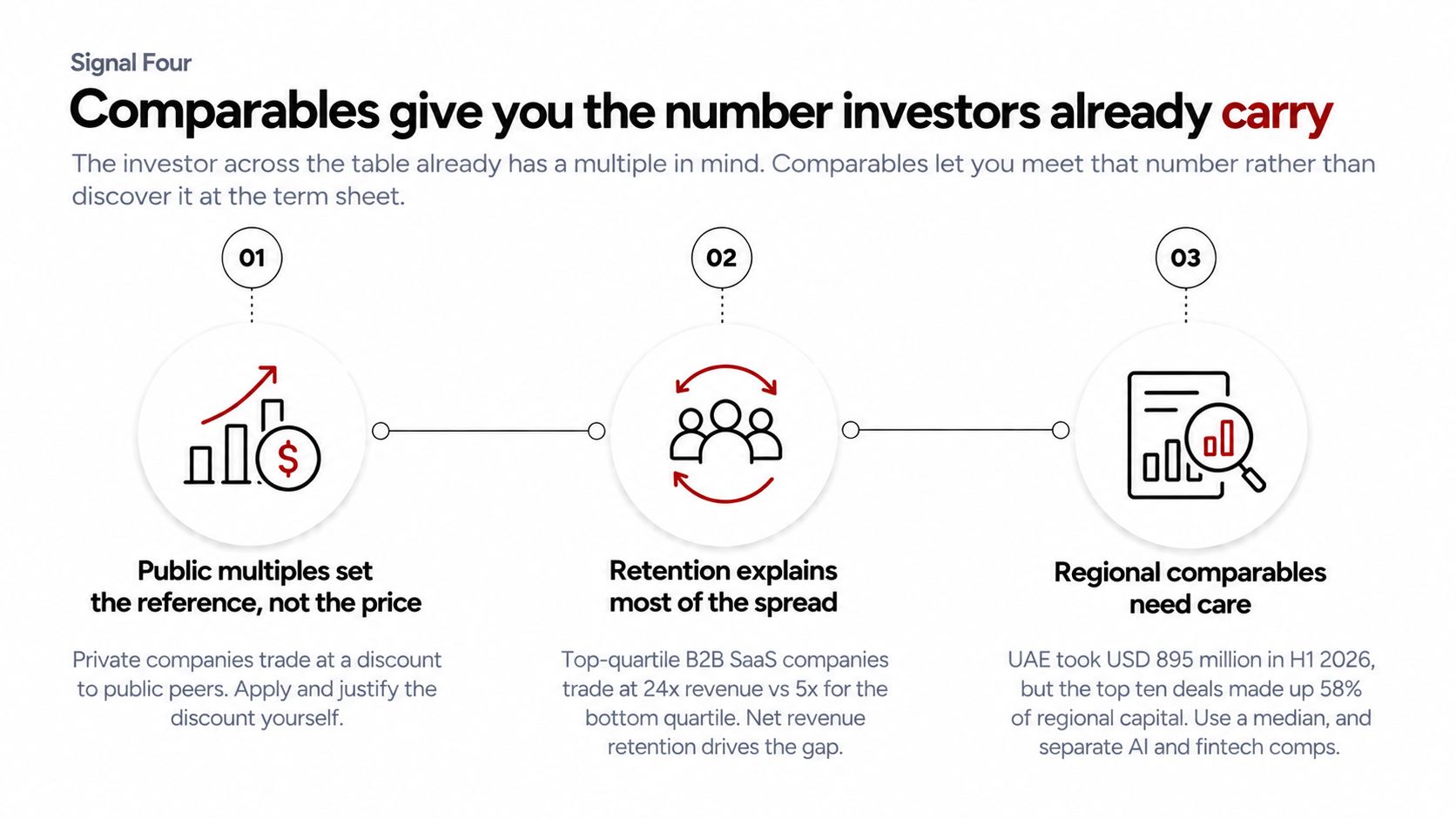
Comparables give you the number investors already carry
The investor across the table already has a multiple in mind. Comparables let you meet that number rather than discover it at the term sheet.
Public multiples set the reference, not the price
Private companies trade at a discount to public peers. The discount widens when growth is slower or the buyer pool is thin, which describes most UAE sectors outside fintech and AI. Quoting a public multiple straight is the fastest way to lose the room. Apply and justify the discount yourself.
Retention explains most of the spread
McKinsey’s work across more than 100 B2B SaaS companies found top-quartile businesses trading at a median 24 times revenue. The bottom quartile traded at 5 times, measured from early 2019 to the end of 2024. Net revenue retention was the metric most closely tied to that gap. If your retention is strong, lead with it.
Regional comparables need care
MAGNiTT’s H1 2026 figures show the UAE took USD 895 million, or 66% of all MENA venture funding, on a deal count that fell 37%. The ten largest transactions accounted for 58% of regional capital. Averages built on that distribution flatter everyone outside the top ten. Use a median, and separate the AI and fintech comps before you draw a line.
✅ Action to Take
Pull five comparable transactions with disclosed terms. Note revenue, growth and retention for each. Teams that keep this set current alongside fractional CFO support walk into pricing conversations with evidence instead of adjectives.
- Signal 5
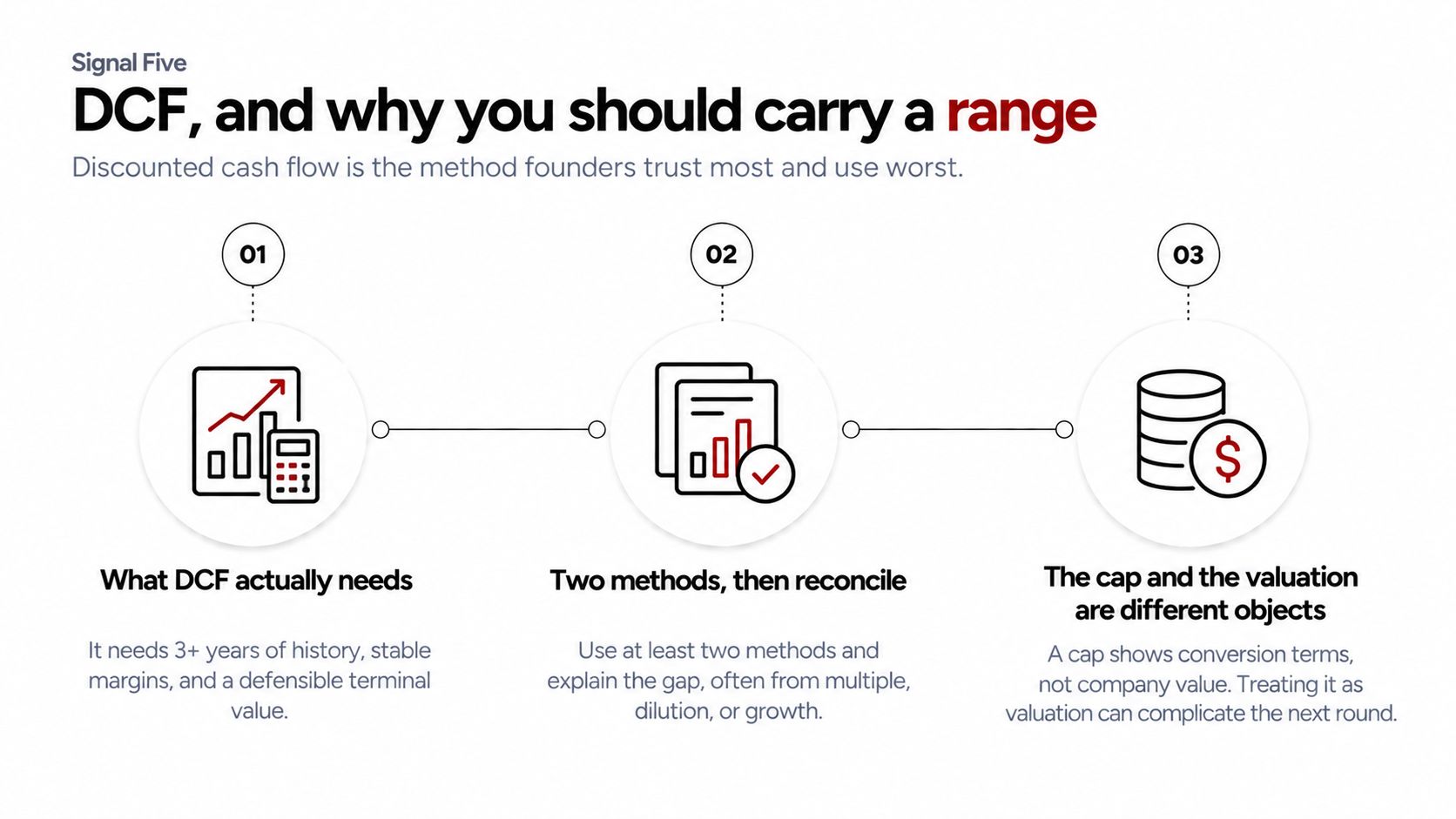
DCF, and why you should carry a range
Discounted cash flow is the method founders trust most and use worst.
What DCF actually needs
It needs three or more years of history, margins stable enough to project, and a terminal value you can defend. Early-stage models fail the last test. When 80% or more of the value sits in the terminal year, the model is really a statement about the discount rate. DCF earns its place from Series B onward, and for the profitable UAE SME weighing a partner buyout rather than a raise.
Two methods, then reconcile
The number that survives scrutiny is the one produced twice by different logic. If comparables give AED 30 million and the VC method gives AED 18 million, the useful work is explaining the gap. Usually it points at an exit multiple, a dilution assumption or a growth rate.
The cap and the valuation are different objects
Post-money SAFEs now dominate early rounds. Carta’s Q2 2026 data shows they made up 93% of pre-priced rounds. A cap tells you what conversion economics the market accepted, not what the company is worth. Treat it as a valuation and the priced round gets hard.
✅ Action to Take
Keep a live valuation file with two methods, the reconciliation, and the date of the last refresh. Companies without a finance lead get this built once and maintained through scheduled part-time CFO time rather than rebuilt under deadline every raise.
Not sure which method your round actually calls for?
A short conversation about stage, traction and licence type narrows it fast.
- Signal 6
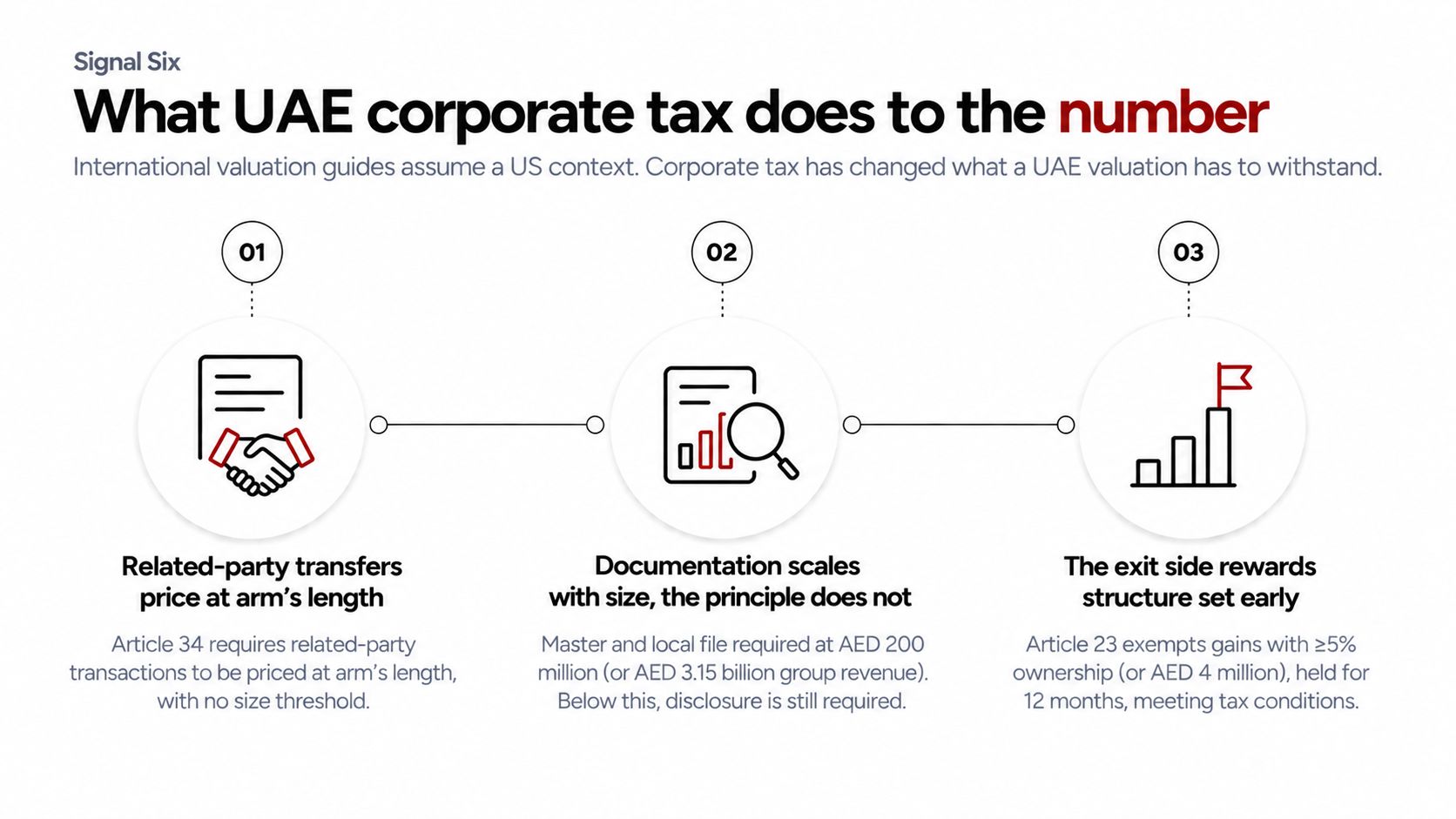
What UAE corporate tax does to the number
International valuation guides assume a US context. Corporate tax has changed what a UAE valuation has to withstand.
Related-party transfers price at arm’s length
Article 34 of Federal Decree-Law 47 of 2022 requires related-party transactions to be priced as independent parties would price them. There is no size threshold on the principle. It applies to purely domestic transactions, including a mainland company dealing with its own free zone affiliate. Moving shares to a founder holding company at book value is exactly what the Federal Tax Authority can adjust.
Documentation scales with size, the principle does not
Ministerial Decision 97 of 2023 requires a master file and a local file at AED 200 million of own revenue. The same applies at AED 3.15 billion of consolidated group revenue. Read the full decision if your structure sits near either line. Below both, the two-file set is not required. The related-party disclosure on the return still is, and every controlled transaction needs pricing you could evidence.
The exit side rewards structure set early
Article 23 exempts gains on a qualifying shareholding. The holder needs at least 5% ownership, or an acquisition cost of at least AED 4 million. The interest must be held for an uninterrupted twelve months and meet the subject-to-tax condition. FTA guidance treats a participating interest in a Qualifying Free Zone Person as meeting that condition. That matters for UAE groups under a DMCC or ADGM entity. You can check the detail against the FTA guide before relying on it. A structure assembled the month before a sale rarely clears the twelve-month clock.
✅ Action to Take
Check the holding period and ownership percentage on every entity now, not at term sheet. Founders with layered or cross-border structures pair the valuation with corporate tax advice before any share moves.
Common Questions
Short answers to what UAE founders ask most when pricing a round.
Berkus and Scorecard together, with risk factor summation when one risk dominates. A pending regulatory permission is usually that risk here. Run two and present the range.
The structure travels, the dollar amounts do not. The USD 500,000 per factor reflects US angel pricing. Scale it to what UAE and GCC angels pay, and say so in the model.
Mostly by anchoring on recent comparable rounds at the same stage and sector, then adjusting for team, traction and retention. Bring your own comparable set.
Not always, though it needs a defensible price. Pre-emption rights mean existing shareholders can match your offer, and an in-kind contribution requires an appraised value under the Commercial Companies Law. A report settles both without a dispute.
For the method, no. For everything around it, yes. Mainland transfers need Arabic documents, notarisation and DET or DED registration. DIFC and ADGM run on English common law with digital filing, which is why most institutional rounds still hold their cap table there.
No. A price above what the next round can support forces a flat round, a down round, or costly terms. Carta recorded down rounds at 11.4% of new rounds in Q1 2026, against a 2023 peak of 22%.
Build in the currency your books run in, then present in the one your investor thinks in. The peg means the conversion carries no FX assumption.
Start from the public comparable set, discount for private illiquidity and growth, then cross-check against disclosed regional rounds. Aventis Advisors put the public SaaS median at 4.6x revenue in August 2026, a reference point rather than a price.
It depends on who holds them and for how long. Gains on a qualifying shareholding held by a UAE company can be exempt under Article 23 where the ownership and twelve-month tests are met. Individuals holding shares personally, outside a licensed business, sit outside corporate tax altogether.
Annually as a baseline, and before any event that prices equity. Founders heading toward a sale start earlier, alongside exit planning that gives the number time to improve.
The method you choose in week one sets the ceiling on how well you argue in week six. Pick it from the purpose. Run a second method against it. Write down why the two disagree. That file is what you reach for when an investor pushes, when a co-founder exercises pre-emption, or when the Federal Tax Authority asks how a share moved.
JaZaa CFO Advisory Team
The JaZaa CFO Advisory Team works with startups and SMEs across the UAE on valuation, fundraising preparation and management reporting. It sits alongside founders through raises, share transfers and exits. Members hold US CMA, MBA and capital market qualifications, with backgrounds in financial modelling, M&A support and capital structuring.
This article provides general information about business valuation methods for startups and SMEs in the UAE. It does not constitute professional financial, tax, or accounting advice specific to your business. JaZaa provides professional business services including accounting, bookkeeping support, and management consulting. We are not a registered audit firm, tax agent, CPA, or Chartered Accounting firm. Valuation outputs depend on assumptions that change with market conditions. No method described here produces a figure that a buyer, an investor or a regulator is bound to accept. Reading this article does not create an advisor-client relationship with JaZaa. For advice specific to your situation, arrange a consultation.