


🔔 Why this matters now
The path from seed to Series A has narrowed in 2026. MAGNiTT’s Q3 2026 update, as reported by EnterpriseAM, shows MENA deal count down 33% for the first nine months and early-stage deals down 45%. Excluding mega-rounds, funding fell 32%.
Q: Is good accounting not enough after a seed round?
Accounting records what happened and keeps the company compliant. After seed, investors also want to know what happens next, and someone has to own that answer.
Q: Do I need a full-time CFO after seed?
Rarely at this stage. A fractional CFO usually covers the work for a share of the cost. JaZaa’s published retainers in Dubai run from AED 15,000 to AED 35,000 a month.
| 📊 Accounting and Finance Leadership at a Glance | ||
|---|---|---|
| BUSINESS AREA | WHAT ACCOUNTING COVERS | WHAT FINANCE LEADERSHIP ADDS |
| Board reporting | Monthly statements | Commentary, decisions needed, KPIs |
| Hiring | Payroll processing | Runway impact of each hire |
| Investor milestones | Historical results | KPI definitions and tracking |
| Pricing | Revenue recorded | Margin and payback analysis |
| Compliance | Filings and records | Planning ahead of thresholds |
| Series A | Clean books | Model, valuation and data room |
- Gap 1
Your board expects a monthly pack
If your seed round gave an investor a board seat or information rights, they now expect regular, structured updates on how their money is being used.
What accounting gives you
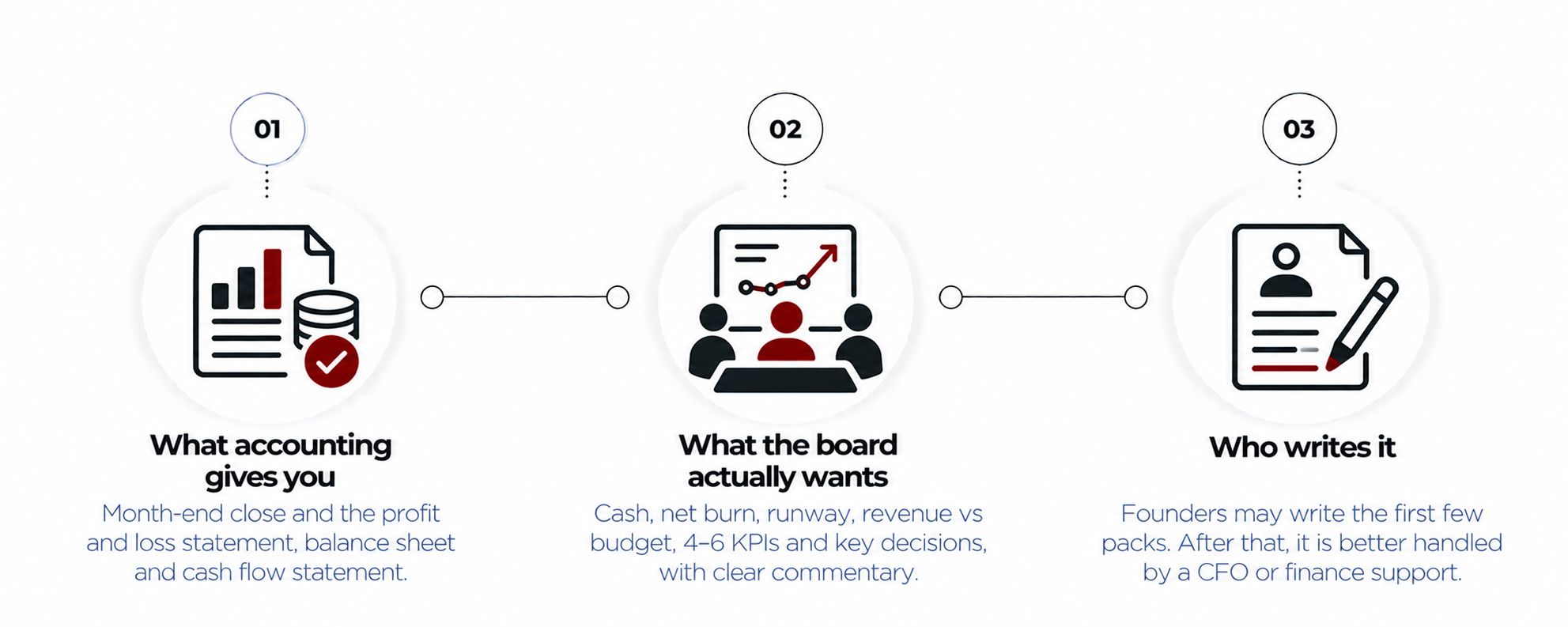
A good accountant closes the month and produces the profit and loss statement, balance sheet and cash flow statement. That is the foundation. It is not yet a board pack.
What the board actually wants
A useful board pack answers questions the statements alone cannot. Investors typically want to see:
- Cash, net burn and months of runway, compared with last month and with plan
- Revenue and gross margin against budget, with a short reason for any gap
- Four to six KPIs that match the business model
- Decisions the board needs to make this month
Send the pack on the same date every month, including the bad months. A short note that explains a weak month early keeps far more trust than a surprise at the next board meeting.
The commentary matters as much as the numbers. “Revenue fell 8% because one client delayed a renewal to November” is far more useful than a table with no words.
Who writes it
Founders often write the first few board packs themselves, late at night. That works for a quarter. After that, it pulls the founder away from sales and product just as the company needs them most.
✅ Action to Take
Agree a one-page board summary format with your lead investor, and set a fixed date each month to send it. JaZaa’s accounting services close the books on a set timetable so the pack starts from reconciled numbers.
- Gap 2
Hiring decisions need a runway view
Seed money usually goes into people. Each hire looks affordable on its own, but several hires together can cut runway faster than founders expect.
A worked example
Say a startup has AED 5.4 million in the bank and net burn of AED 300,000 a month. Runway is 18 months.
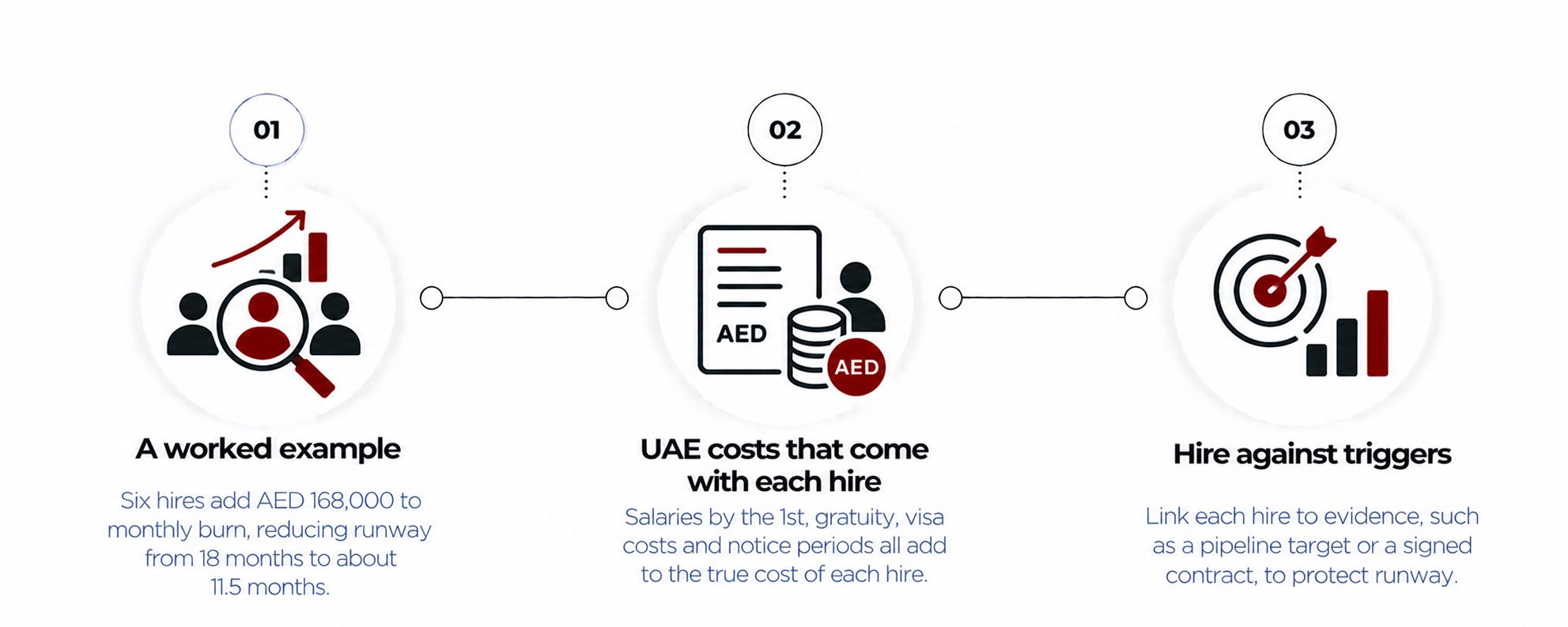
The founders plan six hires at an average basic salary of AED 20,000, with allowances and visa costs adding about AED 8,000 each. That adds AED 168,000 to monthly burn. Net burn rises to AED 468,000, and runway falls to about 11.5 months.
Nothing in the accounts flags that drop in advance. It only shows up after the hires start.
UAE costs that come with each hire
Each new employee brings fixed UAE obligations that belong in the plan from day one.
- Salaries must reach staff by the 1st of each month under Ministerial Resolution 340 of 2026, with no grace period.
- End of service gratuity builds up at 21 days of basic salary per year for the first five years, under Article 51 of the Labour Law.
- Notice periods run from 30 to 90 days under Article 43, so a change of plan takes time to show up in costs.
Hire against triggers
A finance lead links hiring to evidence. A second sales hire starts when the first reaches a pipeline target. An engineer starts when a signed contract needs the work done.
✅ Action to Take
Put every planned hire into a monthly runway model with its start date and full cost. JaZaa’s startup financial planning team builds hiring plans tied to runway and updates them as results come in.
- Gap 3
Investors release money against milestones
Seed and bridge rounds in the UAE are often paid in stages. That changes what the finance function has to track.
Tranches tied to KPIs
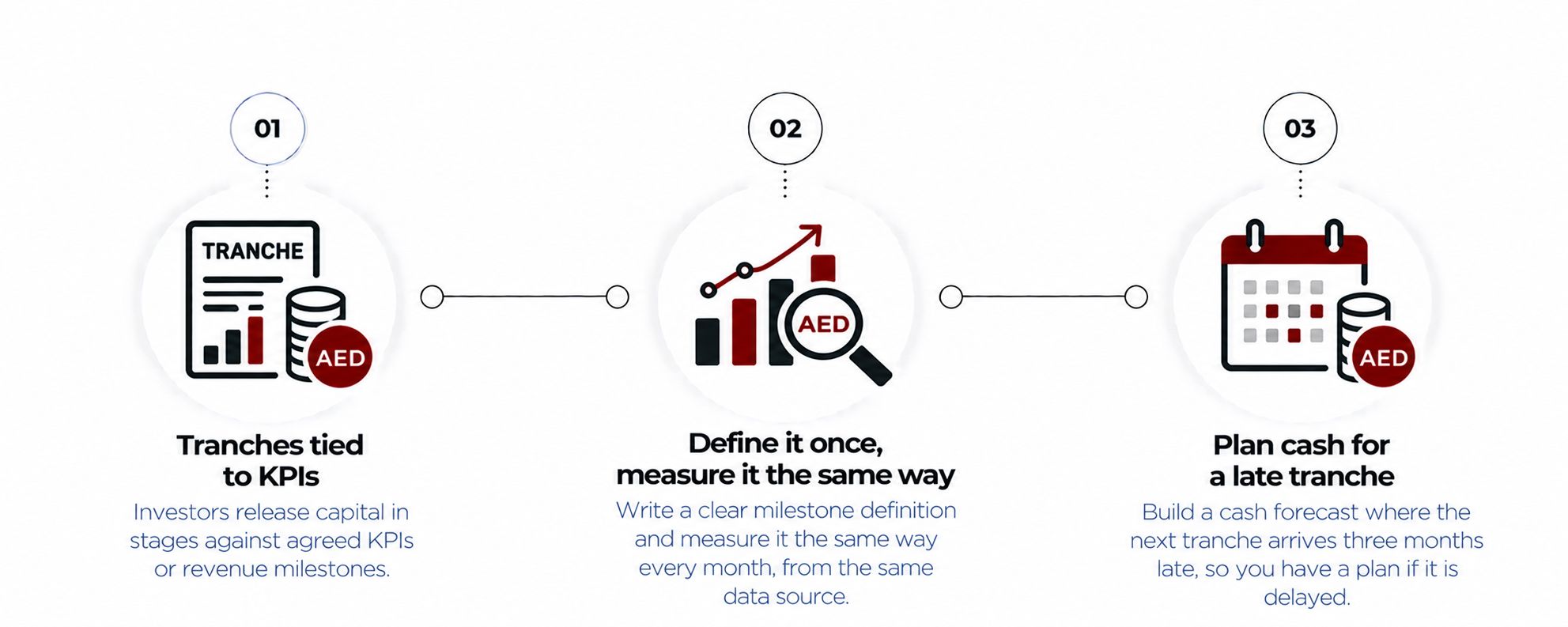
The UAE chapter of the Chambers Venture Capital 2026 guide reports more bridge rounds and convertible instruments. It also reports investors releasing capital in tranches against agreed KPIs or revenue milestones.
If your next tranche depends on reaching AED 150,000 of monthly recurring revenue, someone has to define that number precisely. Does it include one-off setup fees? Annual contracts paid upfront? A customer on a free trial?
Define it once, measure it the same way
Here is how a loose definition causes trouble. Say a AED 3 million round is split into two tranches of AED 1.5 million, with the second due when monthly recurring revenue reaches AED 150,000. The startup counts setup fees and hits the number in month eight. The investor’s reading puts it at month eleven, so the company has planned for cash three months before it arrives.
Write each milestone definition into a short schedule that both sides sign off. Then measure it the same way every month, from the same source data.
Disputes over tranches usually start with definitions. Settling them early protects the founder’s cash and the relationship with the investor.
Plan cash for a late tranche
Build a version of the cash forecast where the next tranche arrives three months late. If payroll is not covered in that version, the plan needs a cut list ready before you need it.
✅ Action to Take
List every milestone in your investment agreement and write one clear definition for each. A fractional CFO working set days each month can track those milestones and report them in the format investors agreed to.
- Gap 4
Pricing and unit economics need an owner
After seed, investors start asking whether each customer is worth what it costs to win. Accounting holds the raw data. Somebody still has to turn it into answers.
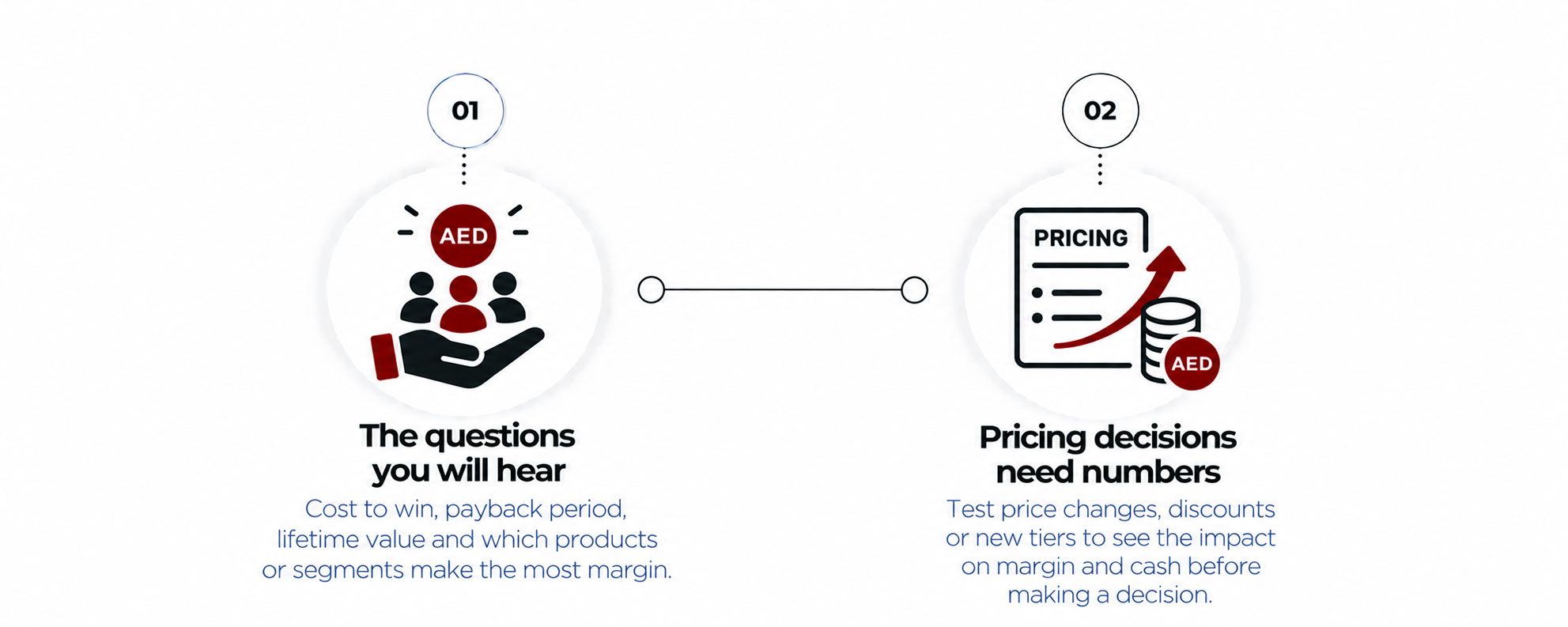
The questions you will hear
- How much does it cost to win a customer, by channel?
- How many months until that cost is earned back in gross margin?
- How much does a customer earn over its lifetime?
- Which product or customer segment makes the most margin?
David Skok writes the For Entrepreneurs blog on SaaS metrics. He uses a lifetime value to acquisition cost ratio of about 3 to 1 as a working target. He also suggests a payback period of 5 to 12 months, with lifetime value calculated on gross margin.
Pricing decisions need numbers
A price change, a discount for annual payment or a new tier all change margin and cash. Without a model, founders tend to pick the number that feels safe and hope it works.
A finance lead tests each option first. A 10% discount for paying a year upfront costs margin but pulls cash forward by up to eleven months. When runway is short, that cash can matter more.
✅ Action to Take
Build a simple cohort view of customers by start month, with acquisition cost and gross margin for each group. A startup CFO who builds early-stage models can set this up from your existing accounting data.
Not sure where your finance setup falls short?
A short call can show which of these gaps matters most for your startup.
- Gap 5
Compliance grows with the company
A seed-stage startup in the UAE can cross several tax and reporting lines within a year or two. Each one needs planning before the company reaches it.
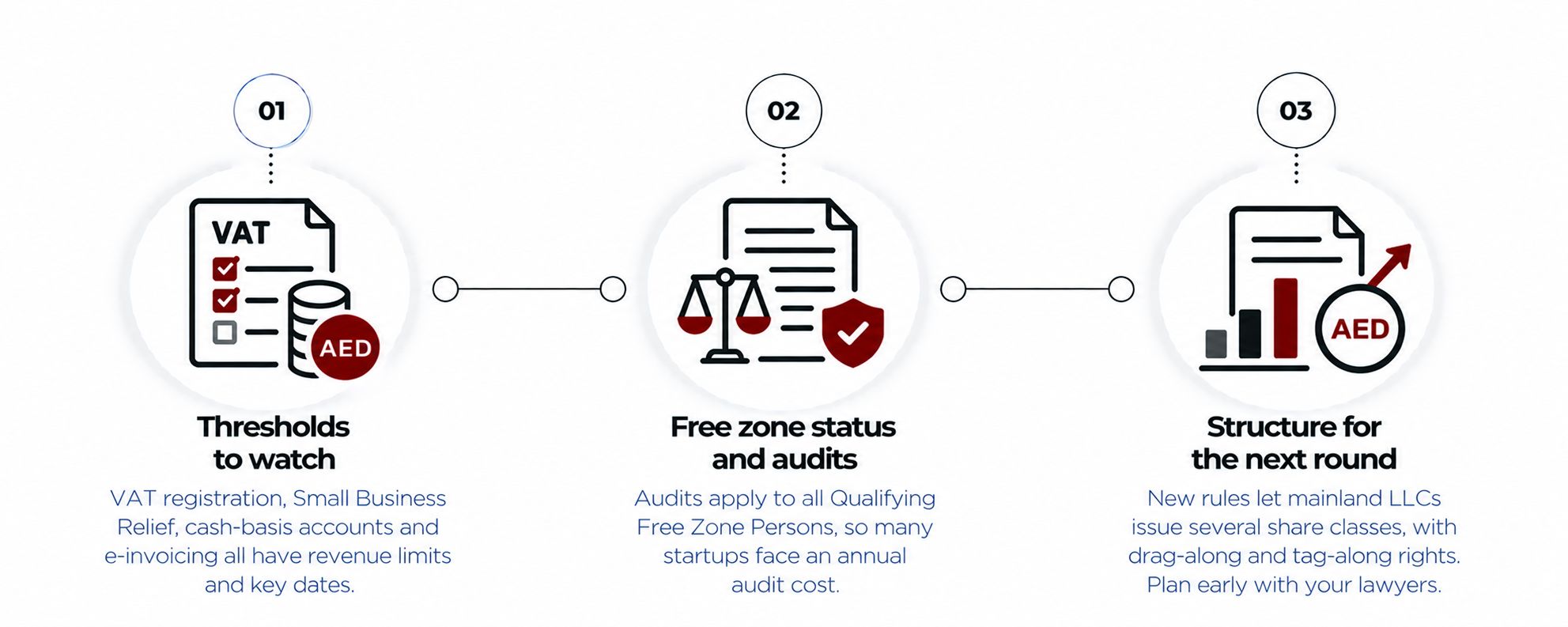
Thresholds to watch
- VAT registration becomes mandatory once taxable supplies pass AED 375,000.
- Small Business Relief now covers tax periods ending on or before 31 December 2029 under Ministerial Decision 131 of 2026, but only while revenue stays within AED 3 million.
- Cash-basis accounts are allowed only up to AED 3 million of revenue under Ministerial Decision 114 of 2023.
- Firms below AED 50 million in revenue must appoint an e-invoicing Accredited Service Provider by 31 March 2027 and go live on 1 July 2027.
Free zone status and audits
Ministerial Decision 84 of 2025 requires audited financial statements for every Qualifying Free Zone Person, whatever its revenue. Many startups set up in a free zone for that status, so the audit becomes an annual fixed cost.
Structure for the next round
Federal Decree-Law 20 of 2025 now lets mainland LLCs issue several share classes and include drag-along and tag-along rights in their constitutional documents. Gowling WLG notes that rollout depends on further Cabinet decisions and updates to the commercial register. A finance lead works with your lawyers so the cap table and the model stay in step.
✅ Action to Take
Map your revenue against each threshold for the next 24 months and note the date you expect to cross each one. Our corporate tax consulting team for UAE startups can plan the registrations and elections ahead of time.
- Gap 6
Series A diligence starts early
Series A investors look back over your full history. The work to pass their checks starts months before the round, often straight after seed.
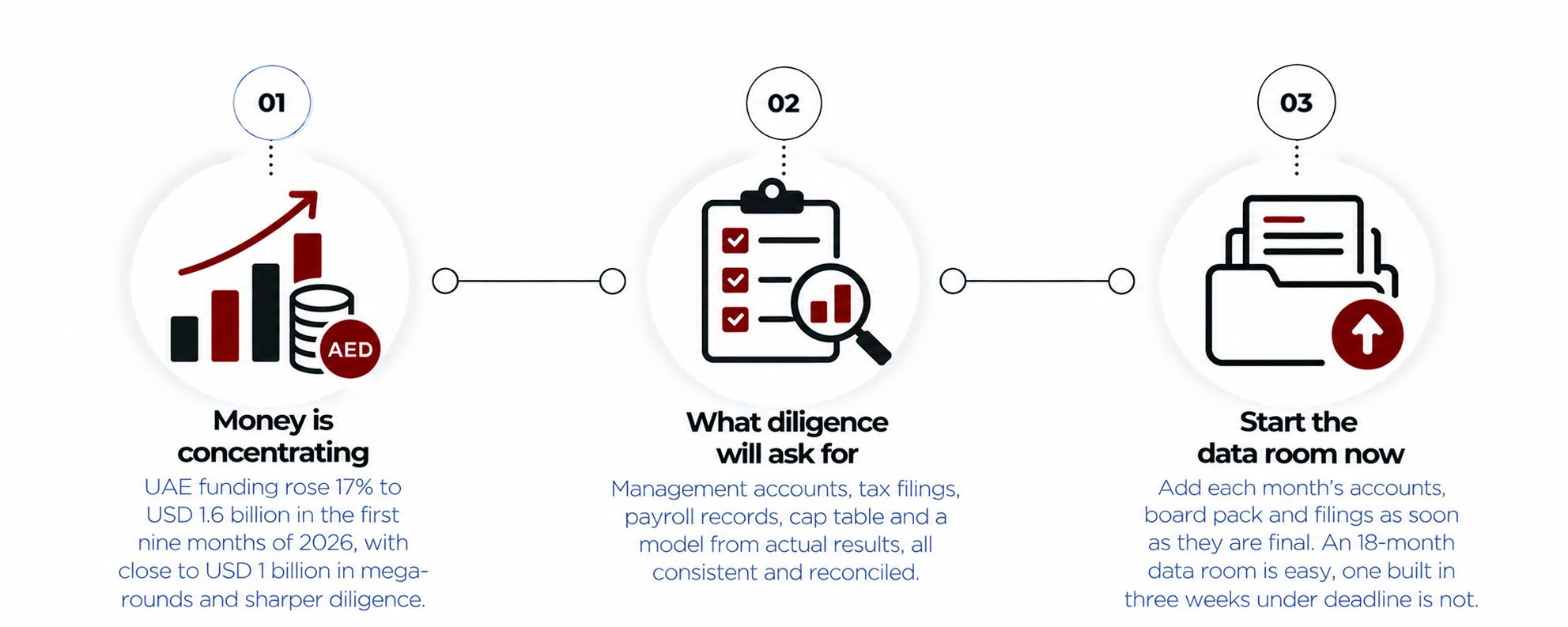
Money is concentrating
EnterpriseAM’s reading of MAGNiTT data shows UAE funding up 17% to USD 1.6 billion in the first nine months of 2026. Close to USD 1 billion of that came from mega-rounds. The rest of the market competed for a smaller share, which means sharper diligence for everyone else.
What diligence will ask for
- Monthly management accounts since launch, reconciled to bank statements
- VAT returns and corporate tax filings that match the accounts
- Payroll and Wage Protection System records
- A cap table that matches the share register and every investment document
- A financial model that starts from actual results
Diligence also compares the deck with the accounts. A revenue figure that differs between the two can cost you the investor’s trust in the first meeting.
Under the Corporate Tax Law, businesses must keep records for seven years. Gaps in older records slow diligence down and give investors reasons to lower the price.
Start the data room now
A data room built over 18 months is easy. One built in three weeks under deadline pressure is not. Add each month’s accounts, board pack and filings as soon as they are final.
✅ Action to Take
Run your records against an investor checklist this quarter. JaZaa’s free due diligence checklist for UAE startups covers 105 items across five areas.
Common Questions
Short answers to what UAE founders ask about finance leadership after seed.
Usually once investors expect monthly reporting, hiring starts to cut runway, or the next tranche depends on measured milestones. In the UAE, nearing the AED 3 million revenue line is another common trigger.
An accountant records and reports what happened. A finance leader plans ahead, models decisions, tracks milestones and prepares the company for its next round.
No. The accountant keeps the books accurate. Finance leadership sits on top of those books.
JaZaa's published retainers run from AED 15,000 to AED 35,000 a month, depending on scope and days.
Cash, net burn and runway, revenue against budget, a short list of KPIs, and the decisions the board needs to make.
An interim CFO who steps in within days can cover the gap and hand over to a permanent hire. JaZaa onboards interim engagements in 5 to 7 business days.
Investors release part of the round when agreed KPIs are met. Define each KPI in writing and measure it the same way every month.
Yes. It builds up for every employee from day one and is paid when they leave, so it belongs in the runway model.
Straight after seed. Keep monthly accounts, filings and board packs in a data room as you go.
No. Ministerial Decision 84 of 2025 requires every Qualifying Free Zone Person to keep audited financial statements.
One named person with a fixed monthly review. Many startups give it to a part-time CFO with set days each month who updates it from actual results.
The next year brings a tighter funding market and more fixed UAE dates, from e-invoicing for smaller firms in July 2027 to the monthly payroll deadline. Investors writing post-seed cheques want founders who can show where the money goes and what it delivers each month. Startups that add finance leadership early will reach their Series A with the answers already in the data room.
JaZaa CFO Advisory Team
JaZaa is a Dubai-based management consultancy that gives startups and SMEs senior finance support through fractional, virtual, part-time and interim CFO services. The team works with founders on board reporting, planning, tax readiness and fundraising across the UAE.
Legal disclaimer
This article provides general information about finance leadership and reporting for startups and SMEs in the UAE. It does not constitute professional financial, tax, accounting, or legal advice specific to your business. JaZaa provides professional business services including accounting, bookkeeping support, and management consulting. We are not a registered audit firm, tax agent, CPA, or Chartered Accounting firm. Share class and investment agreement questions need a UAE-licensed lawyer, and rules cited reflect UAE law as of October 2026. Reading this article does not create an advisor-client relationship with JaZaa. For advice specific to your situation, arrange a consultation.