

🔔 Why this matters now
Exits in the region are getting harder to come by. MAGNiTT’s Q3 2026 data, as reported by EnterpriseAM, shows 31 M&A deals in MENA in the first nine months. That is down 26% on a year earlier. Early-stage funding deals fell 45% over the same period, so more founders are weighing a sale to a larger company.
Q: What is an acquihire?
It is a deal where the buyer mainly wants the team. The buyer may purchase the company’s shares, buy selected assets, or hire the staff directly and pay for the intellectual property.
Q: If the buyer wants the people, why do the finances matter?
In a share purchase, the buyer takes on the company’s liabilities. In an asset or hiring deal, the founders usually have to settle those liabilities before staff move. Either way, they come off the price or out of the founders’ pockets.
| 📊 Acquihire Checks at a Glance | ||
|---|---|---|
| WHAT ACQUIRERS CHECK | WHAT THEY ASK FOR | RED FLAG |
| People costs | Gratuity schedule, leave balances, contracts | Gratuity not provided for in the accounts |
| Payroll history | Wage Protection System records | Salaries paid after the 1st |
| Tax position | VAT returns, corporate tax registration and filings | Late or missing returns, unpaid tax |
| Investor instruments | Cap table, notes, investment agreements | Notes or promises missing from the cap table |
| Liabilities and contracts | Loans, customer contracts, deferred revenue | Change of control clauses, prepaid services |
| Quality of books | Monthly accounts, reconciliations | Accounts that do not match the bank |
- Check 1
What you owe your people
In an acquihire, the team is the asset. So the buyer looks first at what the company owes those people, because the bill usually falls due when they move.
Gratuity adds up
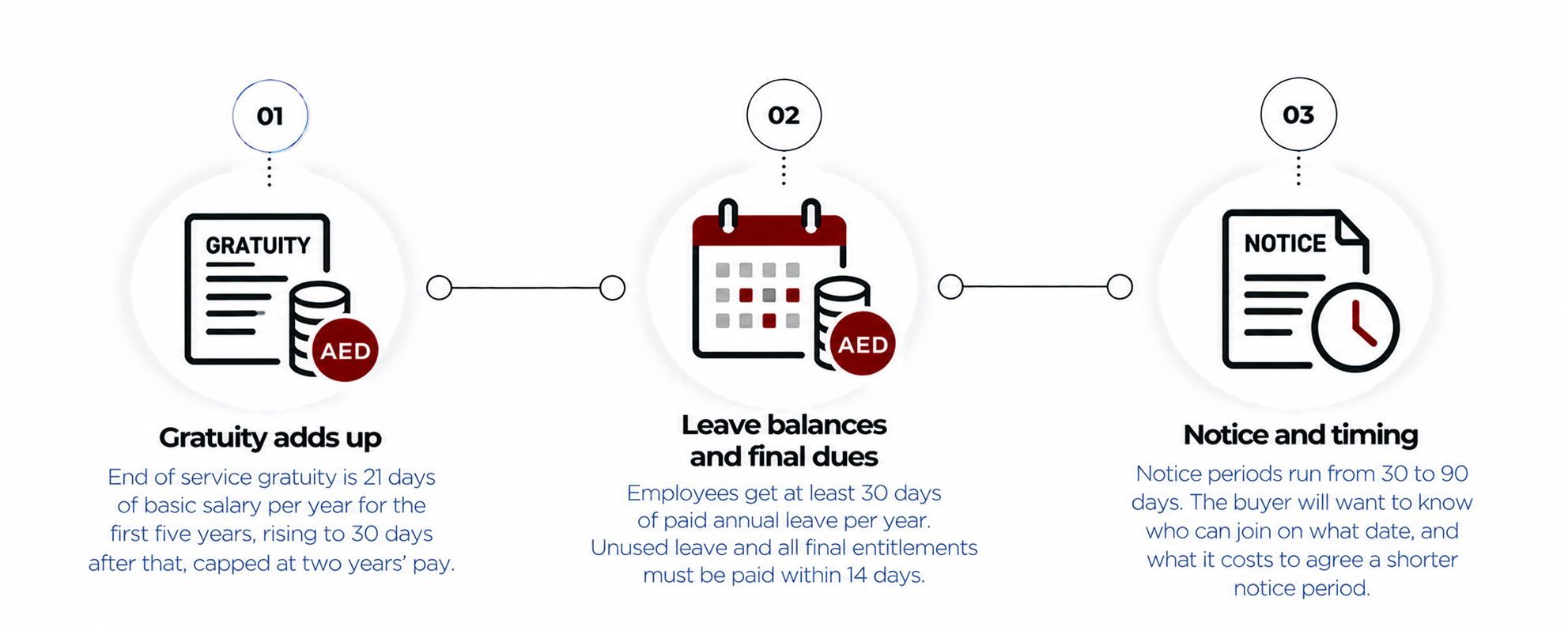
Under Article 51 of the Labour Law, end of service gratuity is 21 days of basic salary for each of the first five years of service. It rises to 30 days a year after that, capped at two years’ pay, and only basic salary counts.
Here is how it adds up. Take eight engineers on an average basic salary of AED 18,000, each with three years of service. Each one has built up about AED 37,800 of gratuity. Across the team, that is about AED 302,400.
If the accounts do not show that liability, the buyer will find it in diligence and take it off the price.
Leave balances and final dues
Article 29 gives employees at least 30 days of paid annual leave for each year of service. Unused leave has to be paid out when employment ends. Article 53 then requires all final entitlements to be paid within 14 days of the contract ending.
If staff resign from your company to join the buyer, those payments land in one short window. The company needs the cash ready on that date.
For the eight engineers above, gratuity alone is about AED 302,400. Add unused leave and the last month’s salaries, and the cash needed within two weeks of the team moving can pass AED 450,000.
Notice and timing
Notice periods run from 30 to 90 days under Article 43. The buyer will want to know who can join on what date, and what it costs to agree a shorter notice period.
✅ Action to Take
Build a schedule of every employee with basic salary, start date, accrued gratuity and unused leave. JaZaa’s accounting services keep these liabilities in the monthly accounts so the figure never surprises a buyer.
- Check 2
Your payroll history
A buyer taking on your staff wants to know they have been paid properly. Wage Protection System records give a clear, dated trail.
The 1st-of-month rule
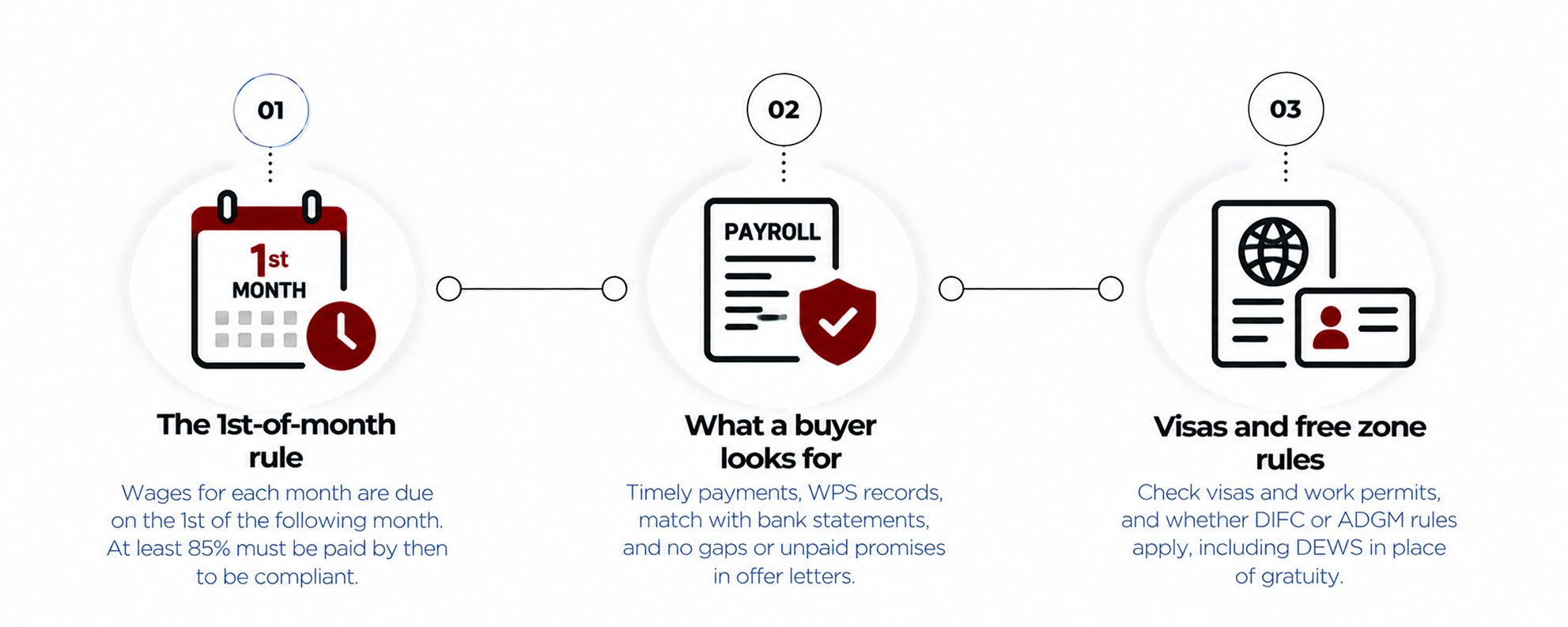
Ministerial Resolution 340 of 2026 took effect on 1 June 2026. Wages for each month are now due on the 1st of the following Gregorian month. Any payment after that date counts as delayed.
Baker McKenzie reads the resolution as treating a firm as compliant if at least 85% of total wages reach staff by the 1st. Enforcement then escalates for repeated delays.
What a buyer looks for
- Months where salaries cleared after the 1st
- Staff paid outside the Wage Protection System
- Gaps between payroll records and the bank statements
- Salary promises in offer letters that differ from what was paid
Each of these suggests cash strain or weak controls, and neither helps the price.
A buyer will also check visas and work permits. Each engineer joining the buyer usually needs a new work permit under the buyer’s establishment. The timing of cancellations and new permits affects the start date.
Free zone differences
DIFC and ADGM run their own employment regimes. DIFC uses the DEWS savings plan in place of accrued gratuity. A buyer will check which rules apply to each employee.
✅ Action to Take
Pull the last 12 months of payroll and match each run against the bank and the Wage Protection System records. A fractional CFO who prepares companies for sale can run this check and explain any gaps before the buyer asks.
- Check 3
Tax filings and open exposure
Tax is where small mistakes turn into large deductions from the price. In a share deal, the buyer inherits every unpaid tax bill and penalty.
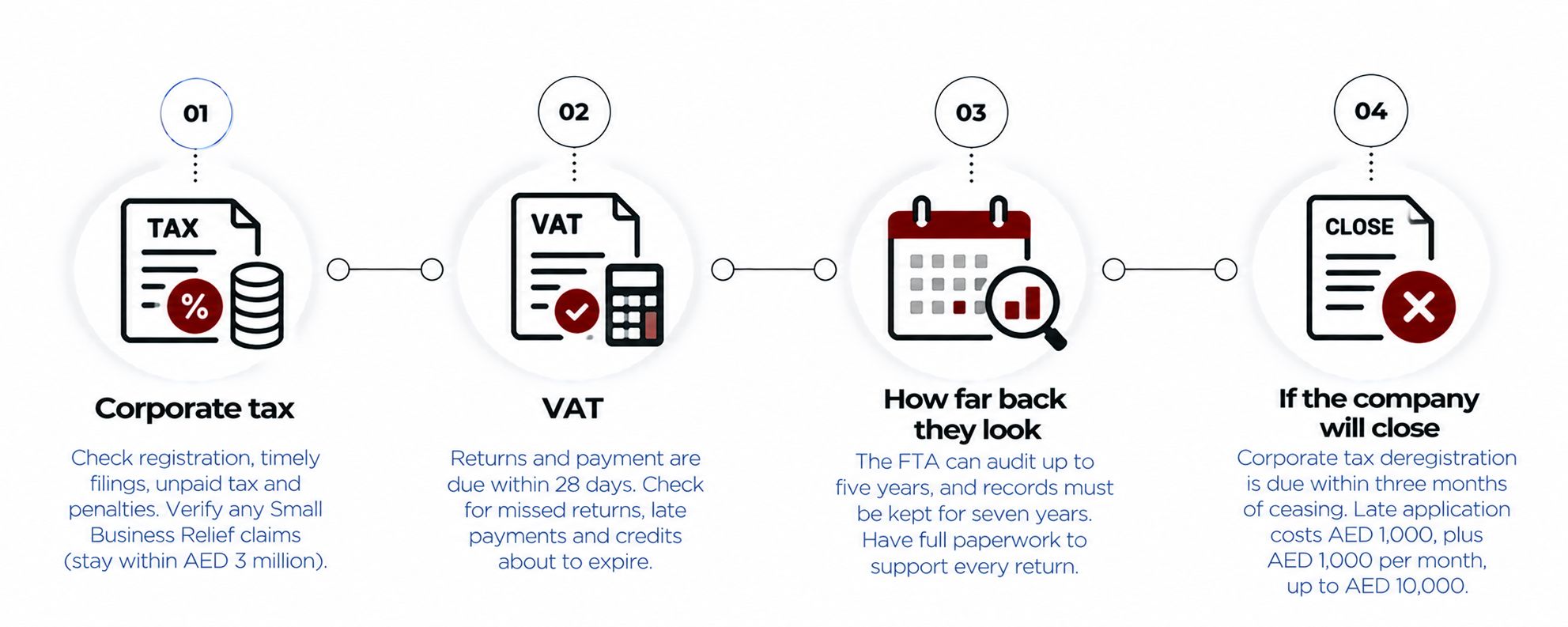
Corporate tax
The buyer will check that the company registered for corporate tax on time and filed each return within nine months of the year end. A late registration carries a flat AED 10,000 penalty. Unpaid tax accrues a late payment penalty of 14% a year, calculated monthly.
If the company claimed Small Business Relief, the buyer will check that revenue stayed within AED 3 million in each year it was elected. The relief now covers tax periods ending on or before 31 December 2029 under Ministerial Decision 131 of 2026.
VAT
VAT returns and payment fall due within 28 days of each tax period end. A buyer will match the VAT returns to the sales ledger. They will look for missed returns, late payments and credits that are about to expire.
Under Federal Decree-Law 16 of 2025, excess input VAT must be used or reclaimed within five years of the period it arose in. Older balances can still be claimed in a transition window that closes on 31 December 2026.
How far back they look
The Federal Tax Authority can generally audit up to five years back. The Corporate Tax Law also requires businesses to keep records for seven years. A buyer will want the paperwork to support every return in that window.
If the company will close
Many acquihires leave an empty company behind. Corporate tax deregistration is due within three months of the business ceasing. A late application costs AED 1,000, plus AED 1,000 for each further month, up to AED 10,000.
✅ Action to Take
List every tax registration, return and payment since the company started, and fix gaps before diligence begins. Our corporate tax consulting team for UAE startups can review the filings and plan the deregistration if the company will close.
- Check 4
Investor instruments and the cap table
The purchase price has to be split between everyone with a claim on the company. Surprises here can stop a deal outright.
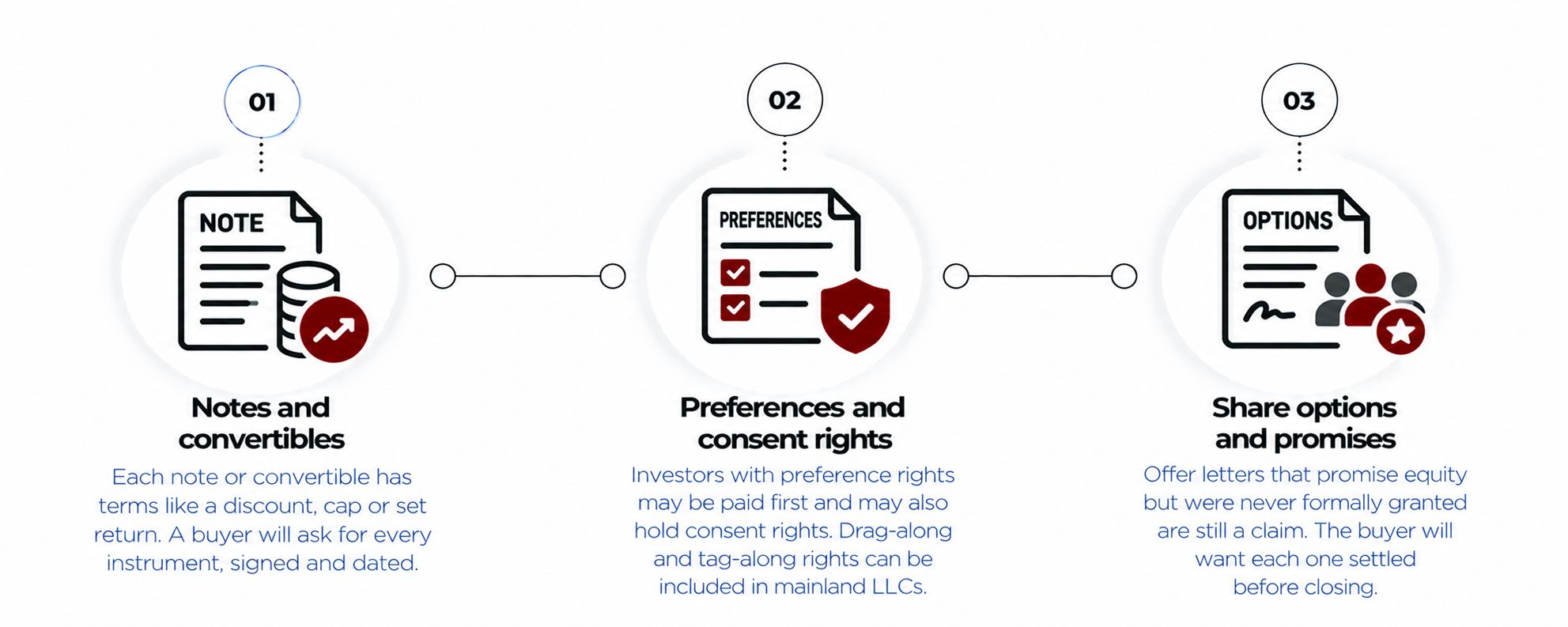
Notes and convertibles
The UAE chapter of the Chambers Venture Capital 2026 guide reports more bridge rounds and convertible instruments. Each note or convertible carries terms that decide what its holder receives in a sale. Those terms can include a discount, a cap or a set return.
A buyer will ask for every instrument, signed and dated. A note that sits in an email thread but not on the cap table is a classic red flag.
Preferences and consent rights
Investors with preference rights may be paid first from the sale proceeds. Some also hold consent rights that let them block a sale.
Federal Decree-Law 20 of 2025 lets mainland LLCs include drag-along and tag-along rights in their constitutional documents. If your documents include a drag-along, it can help force a sale that most shareholders support.
Share options and promises
Offer letters sometimes promise equity that was never formally granted. Each one is a claim the buyer will want settled before closing.
✅ Action to Take
Reconcile your cap table against the share register, every investment document and every offer letter. JaZaa’s mergers and acquisitions team prepares the deal model that shows who receives what at a given price.
Not sure how your startup would look in diligence?
A short call can show where the biggest red flags sit.
- Check 5
Debts, prepaid customers and contracts
Liabilities beyond tax and payroll come next. Some sit on the balance sheet. Others hide in contracts.
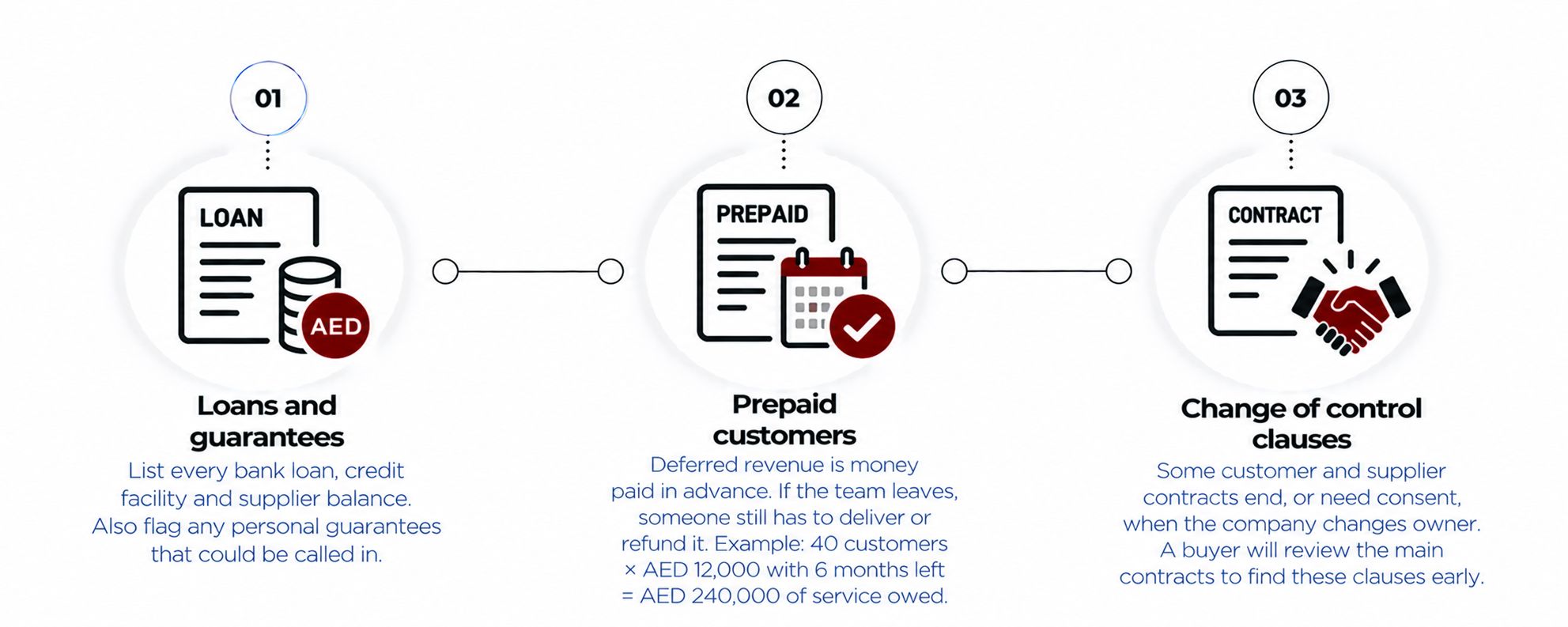
Loans and guarantees
The buyer will list every bank loan, credit card facility and supplier balance. Founders should also flag any personal guarantees, because a lender may call them in when the company changes hands or closes.
Prepaid customers
Deferred revenue is money customers paid in advance for a service you have not yet delivered. If the team leaves to join the buyer, someone still has to deliver that service or refund the money.
Say 40 customers have each paid AED 12,000 upfront for a year and have six months left. That is AED 240,000 of service owed. The buyer will either deduct it from the price or ask the founders to settle it.
Change of control clauses
Some customer and supplier contracts end, or need consent, when the company changes owner. A buyer will read the main contracts to find these clauses early.
✅ Action to Take
List every loan, guarantee, prepaid contract and change of control clause in one schedule. JaZaa’s exit planning team prepares this schedule as part of sale readiness and cleans up the data room before buyers arrive.
- Check 6
Books that reconcile
Every check above depends on the books. If the accounts do not match the bank, the buyer cannot trust any other number.
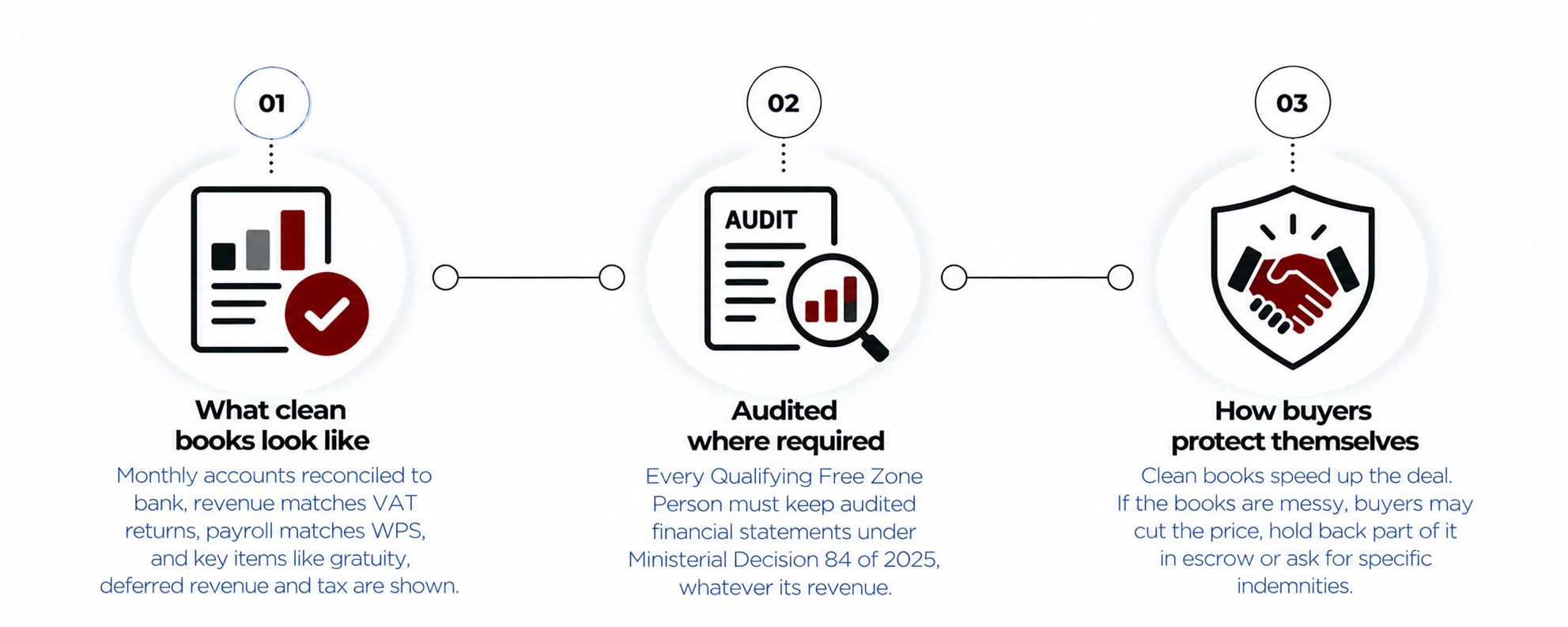
What clean books look like
- Monthly accounts closed and reconciled to every bank account
- Revenue that matches the VAT returns
- Payroll that matches the Wage Protection System records
- A balance sheet that shows gratuity, deferred revenue and tax owed
Audited where required
Every Qualifying Free Zone Person must keep audited financial statements under Ministerial Decision 84 of 2025, whatever its revenue. If your startup holds that status, the buyer will expect to see them.
How buyers protect themselves
Clean books also speed up the deal. A buyer who can test your numbers in a week moves faster, and the founders spend less time answering questions.
When the books are messy, buyers protect themselves in the deal terms. They may cut the price, hold back part of it in escrow for a period, or ask the founders for specific indemnities. Clean books leave less room for any of these.
✅ Action to Take
Close and reconcile the last 24 months before you start talks, and run the records against a buyer checklist. JaZaa’s free due diligence checklist for UAE startups covers 105 items across five areas.
Common Questions
Short answers to what UAE founders ask about acquihire diligence.
The common ones are gratuity missing from the accounts, late salaries and missing tax returns. Buyers also look for notes left off the cap table, prepaid services nobody will deliver, and books that do not match the bank.
In a share purchase, yes. In an asset or hiring deal, the company usually pays final dues, including gratuity, within 14 days of employment ending.
21 days of basic salary per year for the first five years, then 30 days per year, capped at two years' pay.
Against a valuation built from your own numbers. A business valuation prepared before talks start gives founders a figure they can defend.
Yes. Employees are entitled to pay for unused annual leave when employment ends.
Usually as far back as the FTA can audit, which is generally five years. Records must be kept for seven years.
Often it closes. Corporate tax deregistration is due within three months of the business ceasing.
Some can, if their investment documents give them consent rights. Check every investment agreement early.
Bring them up to date before talks start. Messy books lead to lower prices, escrow and indemnities.
Every Qualifying Free Zone Person must keep audited financial statements under Ministerial Decision 84 of 2025.
Someone who has prepared companies for diligence before. Many founders bring in an interim CFO for the length of the deal. JaZaa onboards interim engagements in 5 to 7 business days.
MAGNiTT’s full-year figures will show whether regional M&A recovers in the last quarter of 2026. Either way, buyers have fewer deals to choose from and more time to check each one. Founders who keep gratuity, payroll, tax and the cap table clean every month can say yes to an offer quickly. Those who wait until a buyer appears will spend the deal fixing old records while the terms get worse.
JaZaa CFO Advisory Team
JaZaa is a Dubai-based management consultancy that gives startups and SMEs senior finance support through fractional, virtual, part-time and interim CFO services. The team works with founders on exit readiness, valuations, due diligence and deal modelling across the UAE.
Legal disclaimer
This article provides general information about financial due diligence for startup acquisitions and acquihires in the UAE. It does not constitute professional financial, tax, accounting, or legal advice specific to your business. JaZaa provides professional business services including accounting, bookkeeping support, and management consulting. We are not a registered audit firm, tax agent, CPA, or Chartered Accounting firm. Employment, share and deal structure questions need a UAE-licensed lawyer, and rules cited reflect UAE law as of October 2026. Reading this article does not create an advisor-client relationship with JaZaa. For advice specific to your situation, arrange a consultation.