

🔔 What changed in 2026
Why this matters now
Small Business Relief lets UAE resident companies with revenue under AED 3 million pay zero corporate tax. It was due to end after tax periods closing in 2026. The Ministry of Finance pushed that sunset out to tax periods ending on or before 31 December 2029. The change came through Ministerial Decision No. 131 of 2026. A founder who onboarded a CFO last year on the old timeline is now planning off outdated math. Catching this kind of shift early is exactly what a first 90 days should do.
Q: Does the extension change the revenue threshold?
No. The AED 3 million limit stands. It still applies on a cumulative basis. Cross it once, and Small Business Relief is gone for every period after, even if revenue drops back down later.
Q: Do I need to apply for the extension?
No application exists. You still elect Small Business Relief on your Corporate Tax return each year. You still have to meet every other condition, including registration and filing.
| 📋 Virtual CFO Onboarding at a Glance | |||
|---|---|---|---|
| PHASE | TIMEFRAME | MAIN FOCUS | WHAT YOU GET |
| Discovery | Days 1 to 15 | System access, data pull, financial health check | A written diagnostic of your current numbers |
| Foundation | Days 16 to 45 | Chart of accounts, monthly close, cash flow model | A working close process and a rolling forecast |
| Strategy | Days 46 to 75 | Board reporting, scenario planning, tax positioning | A board-ready pack and a ranked action list |
| Rhythm | Days 76 to 90 | Formal review, handover to ongoing retainer | A 90-day report and an agreed monthly cadence |
A virtual CFO engagement with JaZaa follows this shape for most UAE startups and SMEs. The pace shifts depending on how clean your books already are. It also shifts if a raise or a loan is already on the calendar.
- Signal 1
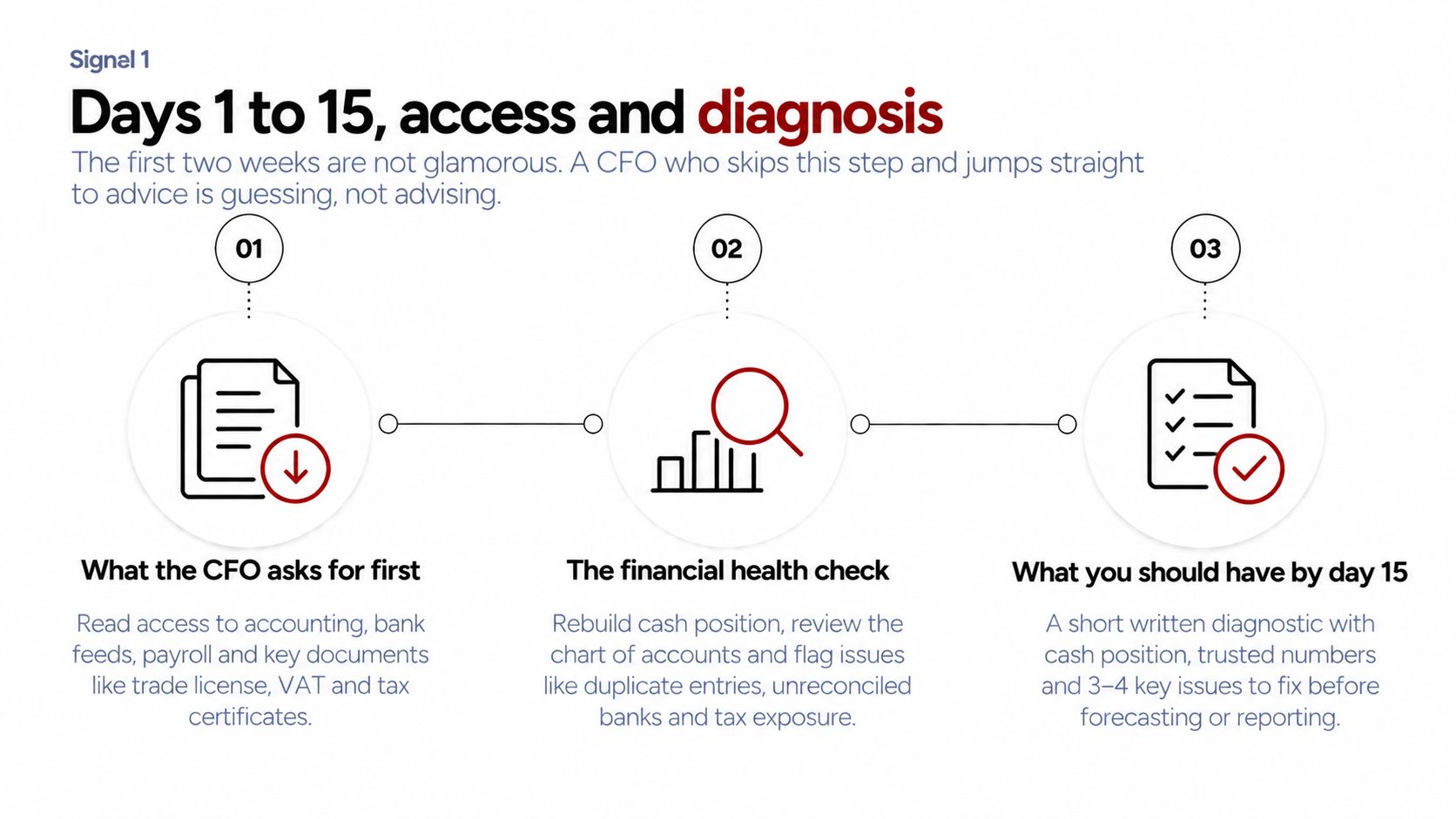
Days 1 to 15, access and diagnosis
The first two weeks are not glamorous. A CFO who skips this step and jumps straight to advice is guessing, not advising.
What the CFO asks for first
Expect a request for read access to your accounting software, bank feeds, and payroll system. Add any spreadsheets currently standing in for a financial model. Then add your trade license, MOA, and VAT and Corporate Tax registration certificates. Include the last 12 months of bank statements too. None of this is optional. A CFO who works off a founder’s verbal summary of the numbers ends up correcting course later. That costs more time than gathering the documents up front.
The financial health check
With access in hand, the CFO reconstructs a true cash position. Next comes a check of the chart of accounts against how the business actually operates. Duplicate vendor entries, unreconciled bank accounts, and VAT filings that do not tie to the ledger all get flagged here. This is also where Corporate Tax exposure gets tested. Is revenue tracking above or below the AED 375,000 profit threshold where the 9% rate kicks in? Does the business still qualify for Small Business Relief under the AED 3 million ceiling, now open through 2029?
What you should have by day 15
A short written diagnostic, not a slide deck. It states where cash actually stands. It says which numbers can be trusted today. It lists the three or four issues that need fixing before forecasting or reporting has any real value.
✅ Action to Take
Pull together your trade license, last 12 months of bank statements, and current accounting file before your first call. A virtual CFO can move through discovery in half the time when the paperwork is ready on day one.
- Signal 2
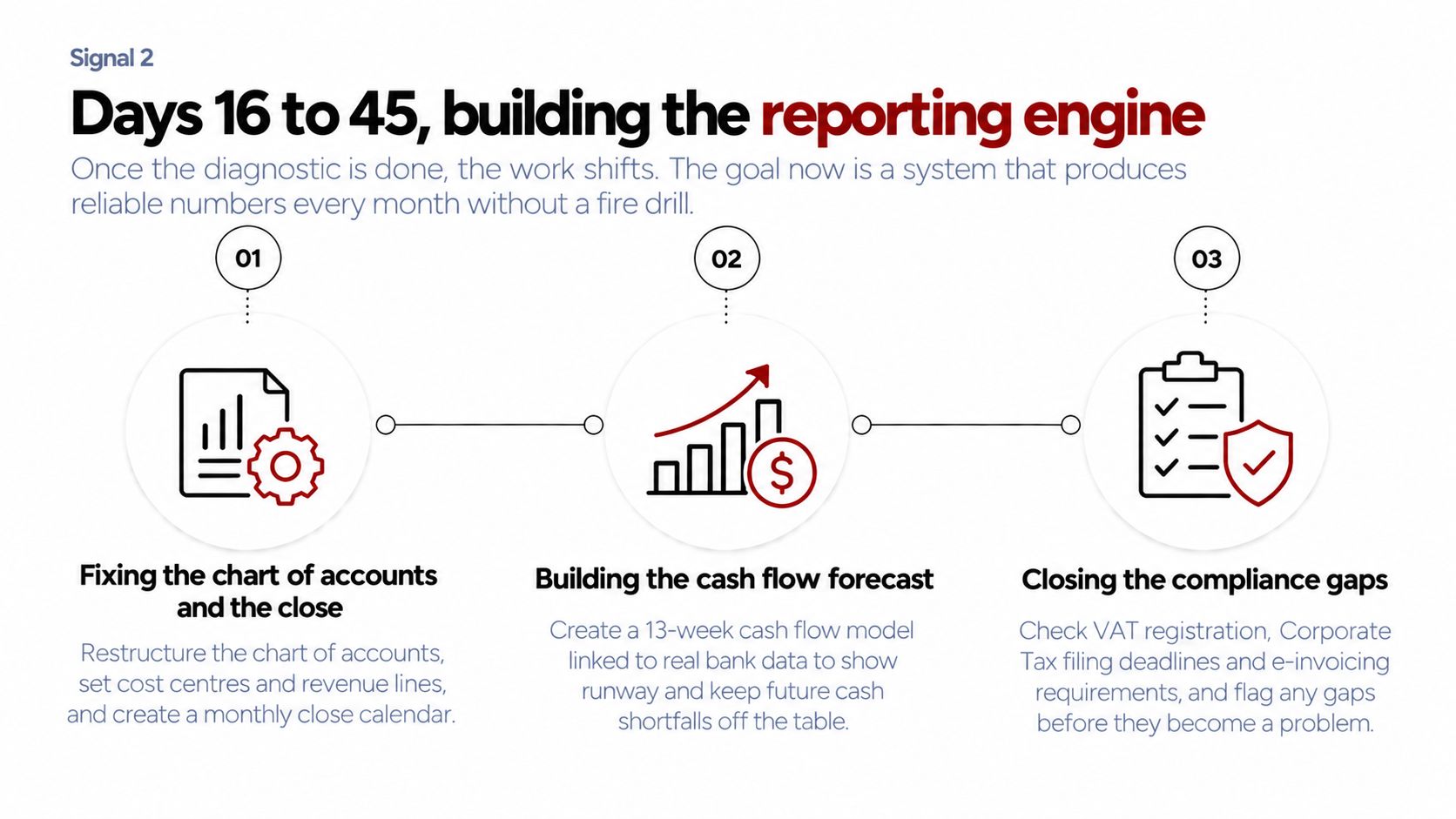
Days 16 to 45, building the reporting engine
Once the diagnostic is done, the work shifts. The goal now is a system that produces reliable numbers every month without a fire drill.
Fixing the chart of accounts and the close
Most early-stage UAE companies run a chart of accounts built by whoever set up the books first. It rarely reflects how the founder actually needs to read the business later. The CFO restructures it around real cost centres and revenue lines. A monthly close calendar comes next, a fixed sequence for reconciling accounts, reviewing accruals, and locking the books by a set date each month.
Building the cash flow forecast
This is usually the deliverable founders care about most. A rolling 13-week cash flow model, tied to actual bank data rather than guesswork, shows how many months of runway remain at the current burn rate. CB Insights reviewed 431 startup shutdowns since 2023. Running out of cash was the final cause in 70% of them. A forecast built in week three of an engagement exists to keep that statistic from ever applying to your business.
Closing the compliance gaps
Tax and VAT compliance get folded into the same build. That means confirming VAT registration status against the AED 375,000 mandatory and AED 187,500 voluntary thresholds. It means checking Corporate Tax filing is on track for the nine-month deadline after year end. It also means flagging whether the business needs an Accredited Service Provider ahead of the UAE’s e-invoicing rollout, mandatory from 1 January 2027 for companies with revenue at or above AED 50 million.
✅ Action to Take
Ask your CFO for a written close calendar by day 30. If you cannot say what day of the month your books close, the reporting numbers downstream cannot be trusted either. A JaZaa accounting review alongside this build catches VAT and Corporate Tax gaps before they turn into penalties.
- Signal 3
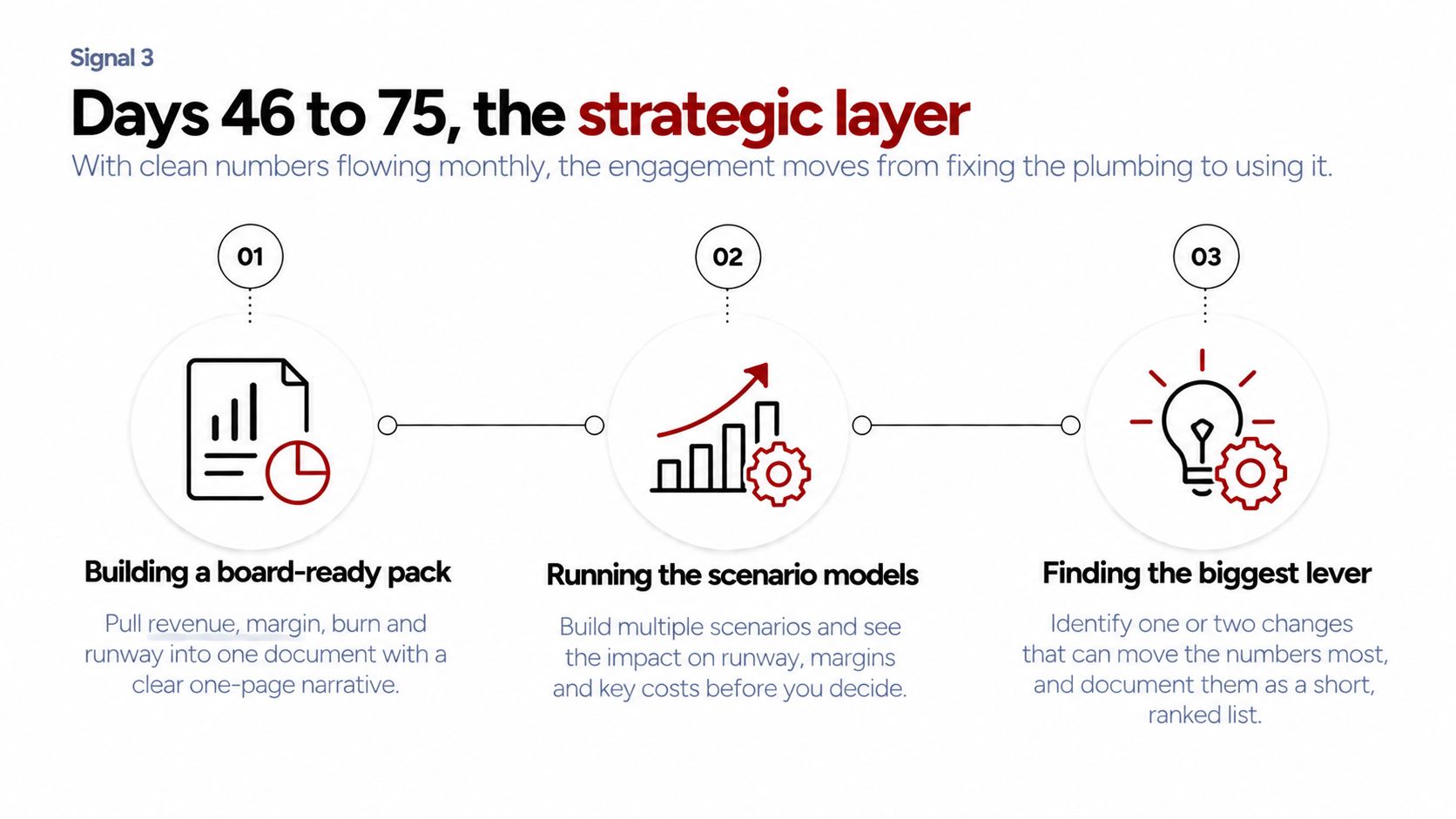
Days 46 to 75, the strategic layer
With clean numbers flowing monthly, the engagement moves from fixing the plumbing to using it.
Building a board-ready pack
Whether or not you have a formal board, this is where reporting starts to look presentable. Revenue by line, gross margin trend, burn multiple, and runway all get pulled into one document. A one-page narrative explains what moved and why. Founders running the business off a single spreadsheet often say this is the first time they have seen the full picture in one place.
Running the scenario models
A CFO worth the retainer builds more than one version of the future. What happens to runway if hiring slows by two roles? What happens to margin if a key supplier raises prices 10%? These are not academic exercises. They are the basis for decisions founders make every week. A model that is ready in advance turns a week of back-and-forth spreadsheet edits into a one-hour decision.
Finding the biggest lever
By this stage the CFO usually sees the one or two changes that would move the numbers most. That might be a pricing gap, a customer segment with weak margins, or a fixed cost that has outgrown what revenue supports. This gets written up as a short, ranked list. Nobody reads a long report.
✅ Action to Take
Review the scenario models with your CFO before any hiring or spending decision above your normal monthly threshold. Book a free consultation if you want a second opinion on a model before you commit to it.
Not sure if you're ready for this stage yet?
Some businesses need another month on the foundation work before strategy conversations pay off. Book a free consultation and we will tell you honestly where your numbers stand.
- Signal 4
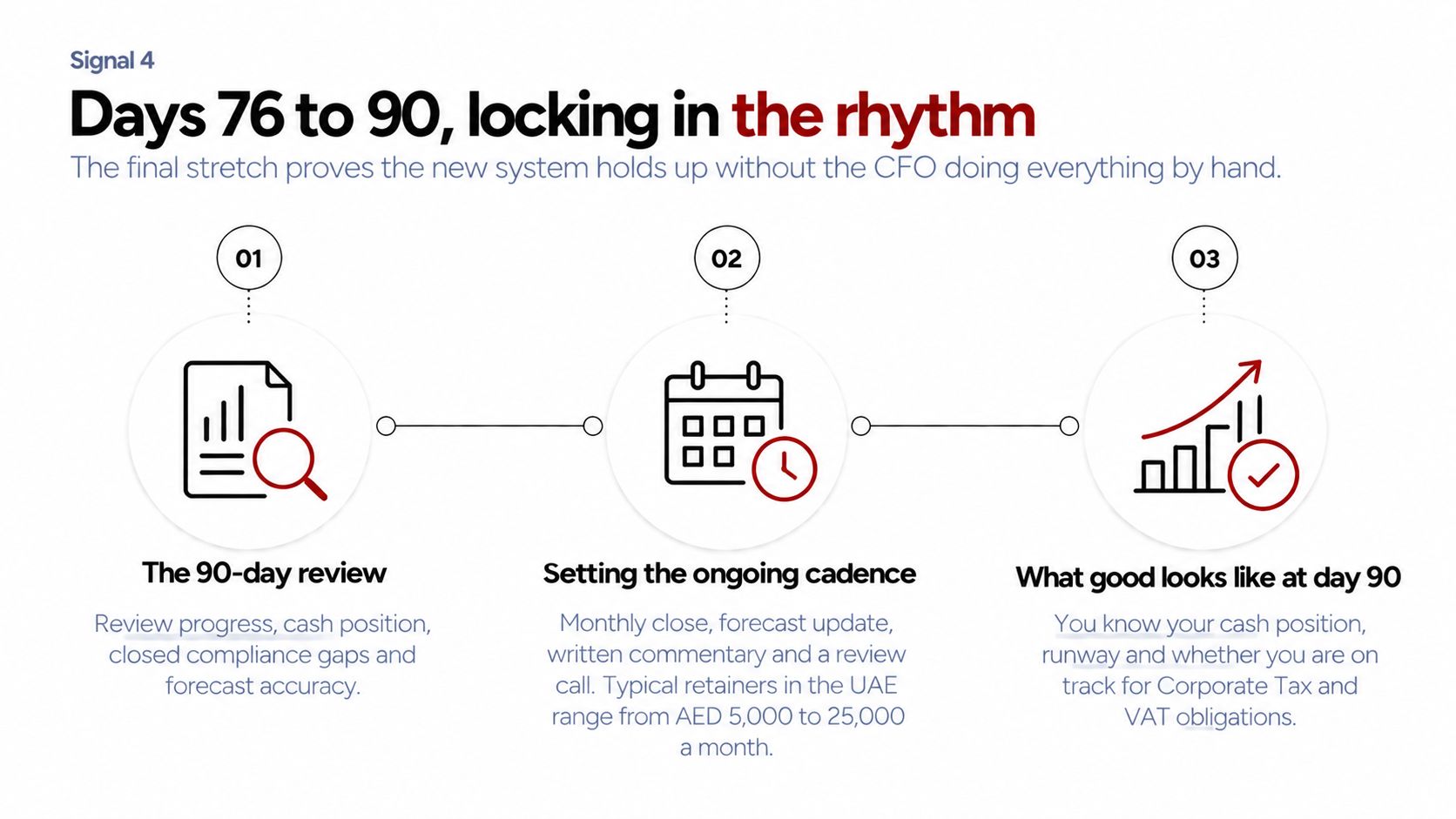
Days 76 to 90, locking in the rhythm
The final stretch proves the new system holds up without the CFO doing everything by hand.
The 90-day review
This is a formal sit-down between founder and CFO. It walks through what changed since day one, cash position then versus now, the compliance gaps that got closed, and how accurate the forecast has been so far. Good onboarding does not end with a claim that everything is fixed. It ends with a clear list of what is fixed and what is still in progress.
Setting the ongoing cadence
From here the relationship usually settles into a fixed monthly rhythm. That means a closed set of books by a set date, a forecast update, a short written commentary, and a call to walk through it. UAE pricing guides put a typical retainer for this kind of ongoing support at AED 5,000 to 25,000 a month, depending on company stage. A full-time CFO hire, once salary, visa, and benefits are added up, typically runs AED 40,000 to 70,000 a month. Most founders keep the retainer model well past the first year, since the cost stays well below a full-time seat even as reporting needs grow.
What good looks like at day 90
You can answer, without checking with anyone, what your cash position is this week. You know what your runway looks like. You know whether you are tracking toward or away from your Corporate Tax and VAT obligations. If you cannot answer those three questions confidently, the onboarding is not finished yet, whatever the calendar says.
✅ Action to Take
Set a recurring 90-day review on your calendar from the start of any virtual CFO engagement, not just the first one. Businesses change fast enough in the UAE that a fresh diagnostic every few quarters earns its hour.
Common Questions
Straight answers to what founders usually ask before and during onboarding.
Ninety days is the working shape for most engagements. A business with clean books already in place can move through discovery and foundation work faster. A business with years of messy records sometimes needs closer to four months before the strategic layer starts.
Trade license, MOA, VAT and Corporate Tax certificates, and the last 12 months of bank statements. Also access to whatever accounting software is currently in use, even if it is just a spreadsheet.
Retainers typically run AED 5,000 to 25,000 a month, depending on the stage of the business and how much reporting the role covers. A full-time hire, once salary and benefits are included, typically runs AED 40,000 to 70,000 a month.
The discovery phase takes longer. The CFO will usually flag a cleanup project before the forecasting and reporting work begins. This adds time but is not a reason to delay starting.
Expect a handful of calls and document requests in the first two weeks. After that, the touch gets lighter as the CFO works mostly with the data already gathered. Most founders call the disruption manageable.
Fundraising is one trigger, not the only one. Rapid growth is another. Cash flow that is hard to predict is another. Simply not knowing your runway on any given day is reason enough on its own.
The terms overlap heavily in the UAE market. Both describe part-time, retainer-based CFO support. Some firms use fractional to describe deeper, more embedded involvement, but the line is not consistent across providers.
Yes. Checking whether revenue sits under the AED 3 million threshold, now relevant through tax periods ending in 2029, is a standard part of the first financial health check.
Monthly is standard for most UAE SMEs. Businesses with tighter cash positions or faster growth sometimes move the cash flow forecast to a biweekly update.
A properly run onboarding includes a formal review at day 90 for exactly this reason. It gives you an answer backed by data rather than a feeling. If the numbers, the cadence, or the working relationship are not where they should be, raise it directly with your virtual CFO advisory team.
A virtual CFO works alongside existing staff rather than replacing them. Onboarding usually includes a short call with your finance manager or bookkeeper in the first two weeks, so reporting lines and handovers get agreed early instead of causing confusion later.
Mostly, yes. Free zone entities go through the same discovery and reporting build, though the diagnostic also checks Qualifying Free Zone Person status for Corporate Tax, since that status carries its own conditions and a 0% rate on qualifying income.
The first 90 days set the ceiling for everything that follows. A CFO who rushes discovery to get to strategy faster ends up building forecasts on shaky data. Those forecasts fail exactly when a founder needs to trust them most, during a raise, a loan application, or a hard call on headcount. The businesses that get the most from a virtual CFO treat the first quarter as infrastructure work, not overhead.
JaZaa CFO Advisory Team
JaZaa works with startups and SMEs across the UAE on virtual and fractional CFO engagements. The team’s scope runs from first-time onboarding to ongoing monthly reporting and fundraising support. The team has run this 90-day process with founders at very different stages, from pre-seed teams cleaning up their first set of books to growth-stage companies preparing for a Series A. Learn more about JaZaa
Legal disclaimer
This article provides general information about virtual CFO onboarding for startups and SMEs in the UAE. It does not constitute professional financial, tax, or accounting advice specific to your business. JaZaa provides professional business services including accounting, bookkeeping support, and management consulting. We are not a registered audit firm, tax agent, CPA, or Chartered Accounting firm. Corporate Tax and VAT positions referenced here, including Small Business Relief eligibility, depend on your specific facts and should be confirmed with a registered tax agent before you rely on them. Reading this article does not create an advisor-client relationship with JaZaa. For advice specific to your situation, arrange a consultation.