
🔔 Why this matters now
Q: Has the bridge round become normal or is it still a warning sign?
Normal here, and increasingly deliberate. The Chambers Venture Capital 2026 guide for the UAE reports growing use of bridge rounds and convertible instruments. Founders use them to extend runway and defer price discovery. Investors also release that capital in tranches against agreed KPIs. The pipeline explains the demand. MAGNiTT data shows only 7.3% of MENA startups have historically advanced from early stage to Series A.
Q: Who is actually funding bridges in the UAE right now?
Regional investors, more than before. UAE funding carried the region’s heaviest exposure to foreign capital, with international participation at 78% in 2025 against 29% in Saudi Arabia. MAGNiTT then reported international participation across MENA fell 48% in the first half of 2026. The count went from 181 investors to 95, while MENA numbers held near flat at 148. Regional deployment rose 23% to USD 940 million, an estimated 81% of all capital deployed. Your likely bridge investor sits in the Gulf, not London or San Francisco.
| 📊 What a CFO does in a bridge, at a glance | ||
|---|---|---|
| WORK | TIMING | OUTPUT |
| Rebuild runway on a cash basis | Week one | A dated month when cash reaches zero |
| Size the raise to a milestone | Week one to two | The amount and the proof it buys |
| Cost model with settlement and WPS | Week two | Net saving after gratuity and notice |
| Dilution model at two prices | Before terms | Founder position under cap and discount |
| Investor evidence pack | Ongoing | Monthly numbers investors can check |
| Compliance calendar | Ongoing | Filing dates mapped against cash |
- Signal 1
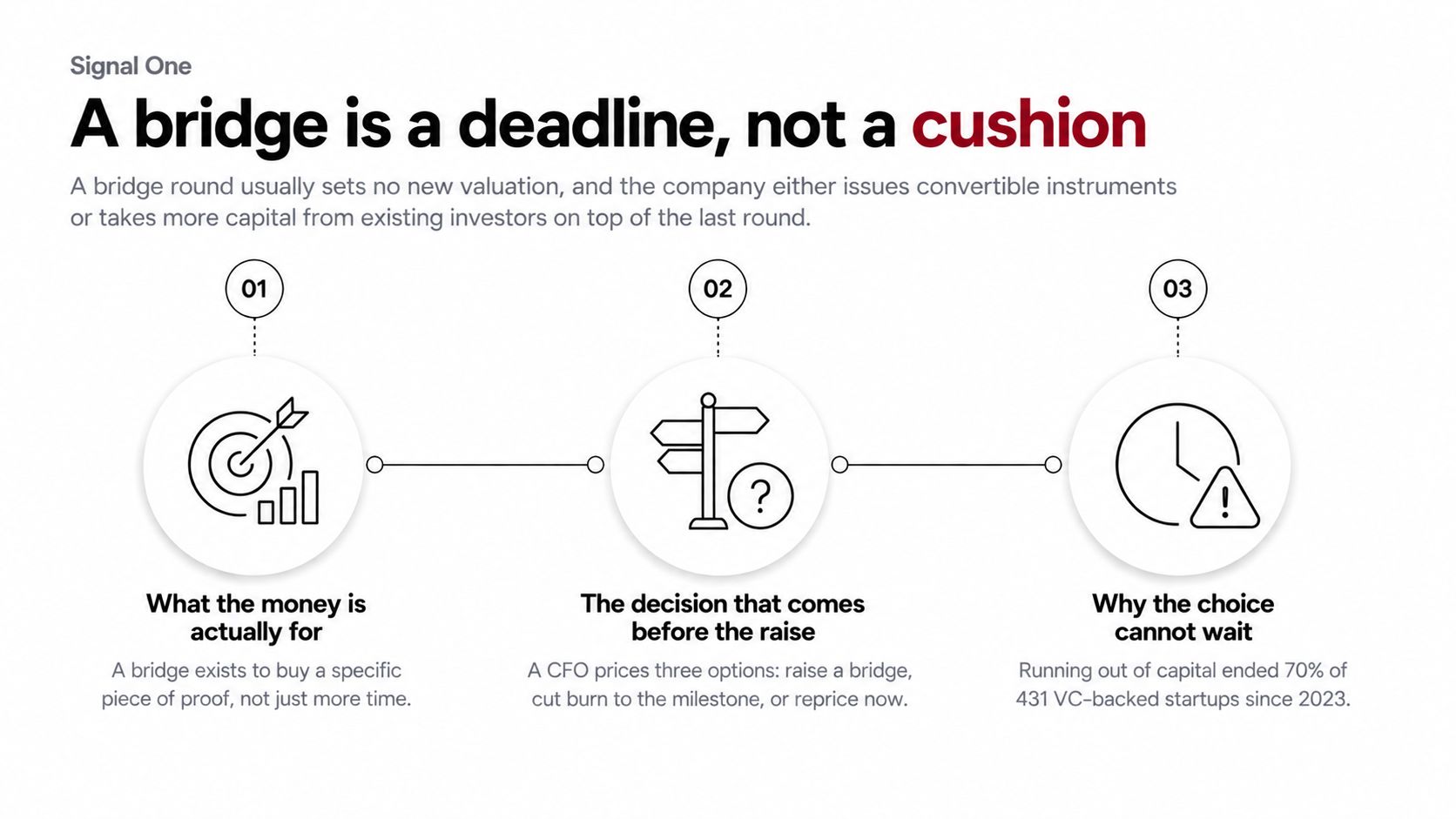
A bridge is a deadline, not a cushion
A bridge round usually sets no new valuation, and the company either issues convertible instruments or takes more capital from existing investors on top of the last round.
What the money is actually for
Founders describe a bridge as more time. Investors read it as unfinished evidence. The capital exists to buy a specific piece of proof, and a bridge with no named proof is a slower version of the same problem.
The decision that comes before the raise
There are three live options and a CFO prices all of them. Raise a bridge. Cut burn and reach the milestone on current cash. Reprice now and take a down round while terms are still negotiable. UAE investors increasingly release bridge capital in tranches against agreed KPIs, which makes the milestone question unavoidable from the first conversation.
Why the choice cannot wait
CB Insights reviewed 431 VC-backed shutdowns since 2023. Running out of capital was cited in 70%, almost always as the final cause rather than the root one. The weakest position at any table is the founder with eight weeks of cash and a licence coming up for renewal.
✅ Action to Take
Price all three options in the same model before you call an investor. Founders without a finance lead run this with startup CFO support so the comparison sits on one set of numbers.
- Signal 2
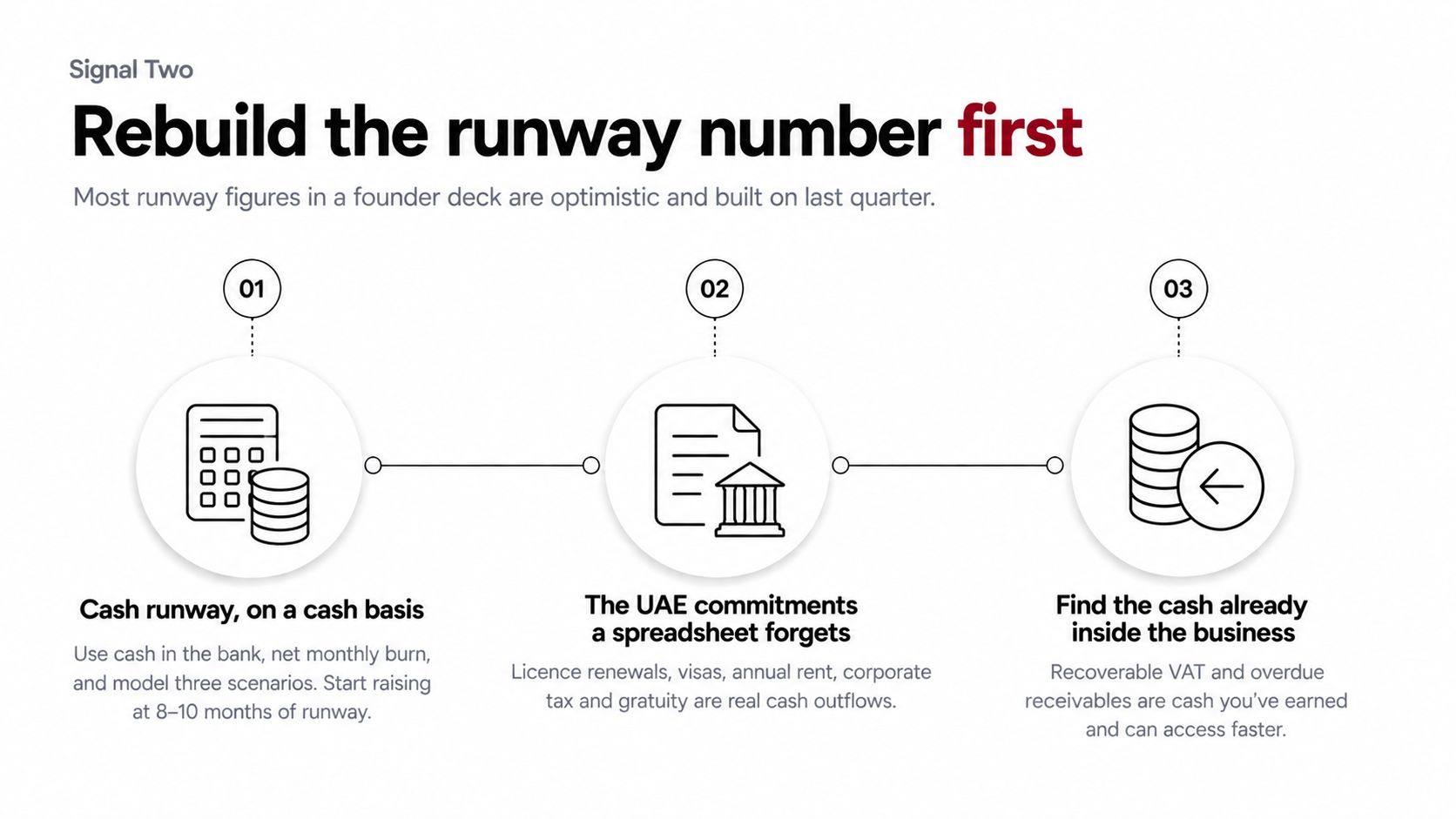
Rebuild the runway number first
Most runway figures in a founder deck are wrong in the same direction. They are optimistic and built on last quarter.
Cash runway, on a cash basis
Runway is cash divided by net monthly burn. Use cash actually in the bank, not accrued revenue. Use net burn, not gross. Then rebuild it three ways. Plan as filed. Collections 30 days late. Two largest customers renewing at reduced value.
The conventional trigger is to start raising at eight to ten months of runway. In a bridge you are usually below that.
The UAE commitments a spreadsheet forgets
Cost bases here carry lumps that monthly averages hide. Trade licence, establishment card and immigration card renewals fall annually, and an expired licence blocks visa processing and banking until it is fixed. Employee visas and medicals arrive per hire. Office rent in most free zones is paid annually or in a few cheques rather than monthly.
Corporate tax is due within nine months of the tax period end. A December year end means a September payment. Accrued end of service gratuity is a real obligation, not a provision you can defer.
Find the cash already inside the business
Recoverable input VAT and overdue receivables are cash you have already earned. Both move faster than a funding round and dilute nobody.
✅ Action to Take
Rebuild runway weekly during a bridge, not monthly. Teams keeping a rolling thirteen week cash view with virtual CFO support spot the shortfall while there is still time to act.
- Signal 3
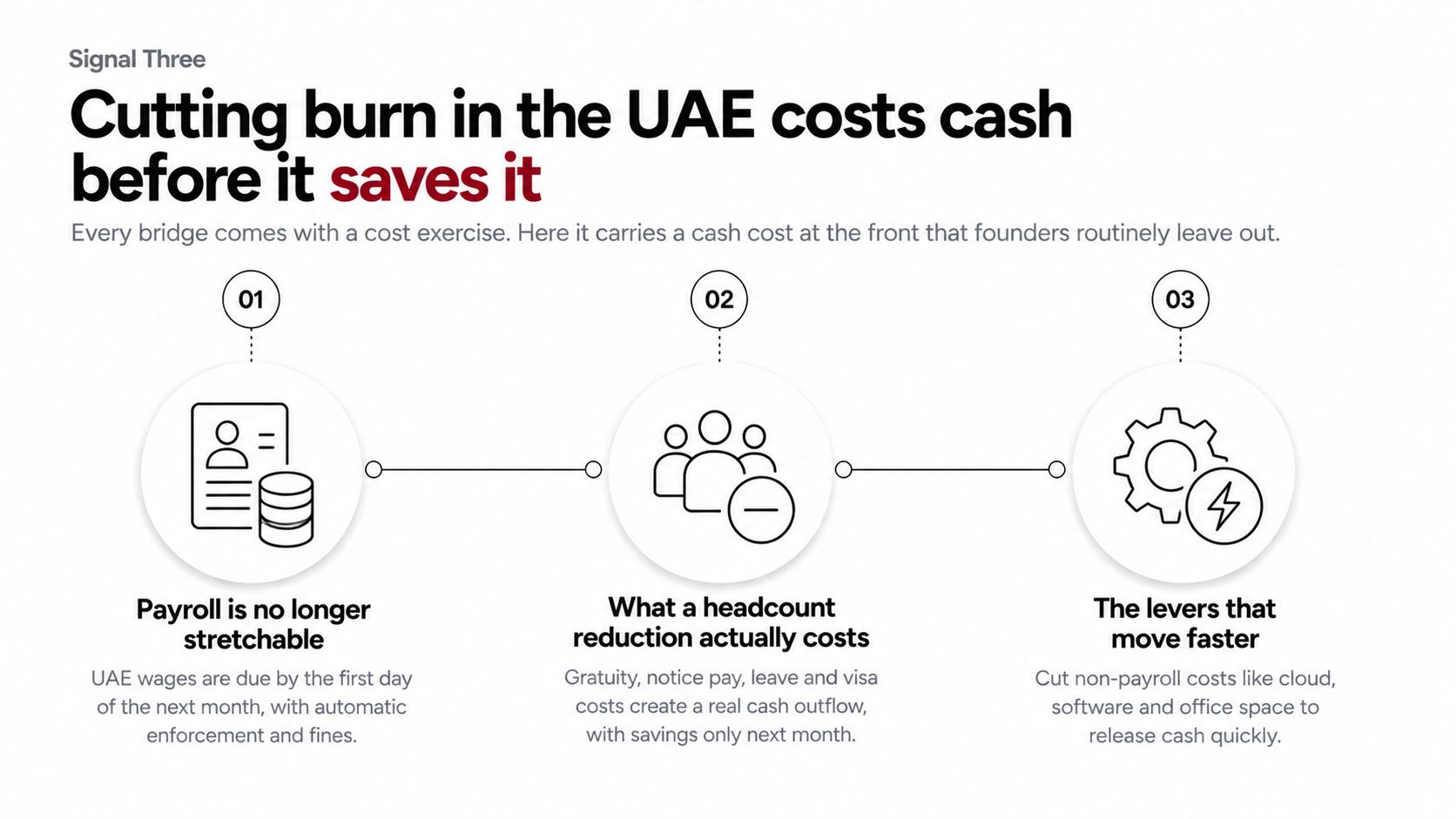
Cutting burn in the UAE costs cash before it saves it
Every bridge comes with a cost exercise. Here it carries a cash cost at the front that founders routinely leave out.
Payroll is no longer stretchable
Ministerial Resolution 340 of 2026 took effect on 1 June 2026 and removed the 15-day grace period. Wages for the previous month are now due on or before the first day of the following month, monitored electronically through the Wage Protection System.
Enforcement is automatic and quick. Electronic monitoring starts on the due date, warnings follow from day two, and MOHRE may suspend new work permits from day five. Administrative fines and reclassification into the third category can follow from day eleven for repeat violations. Delaying payroll to buy a fortnight of runway is not a lever in this market. DIFC and ADGM run separate regimes worth confirming for your entity.
What a headcount reduction actually costs
End of service gratuity accrues at 21 days of basic wage per year for the first five years. Each year beyond five earns 30 days. The total is capped at two years of wage and calculated on basic salary only, so housing and transport allowances are excluded. Under Federal Decree-Law 33 of 2021 the final settlement is due within 14 days of the last working day. Notice pay, accrued leave and visa cancellation costs land in the same window.
A team of ten averaging three years of service is a meaningful outflow in the month you cut. The saving starts the month after.
The levers that move faster
Non-payroll costs release cash without a settlement bill. Renegotiate cloud commitments. Move annual software prepayments to monthly. Sublet unused space or downgrade to a flexi-desk package at renewal.
✅ Action to Take
Model the settlement cost and the monthly saving on the same timeline before any decision is announced. Clean payroll and WPS records through structured accounting services make that model accurate.
- Signal 4
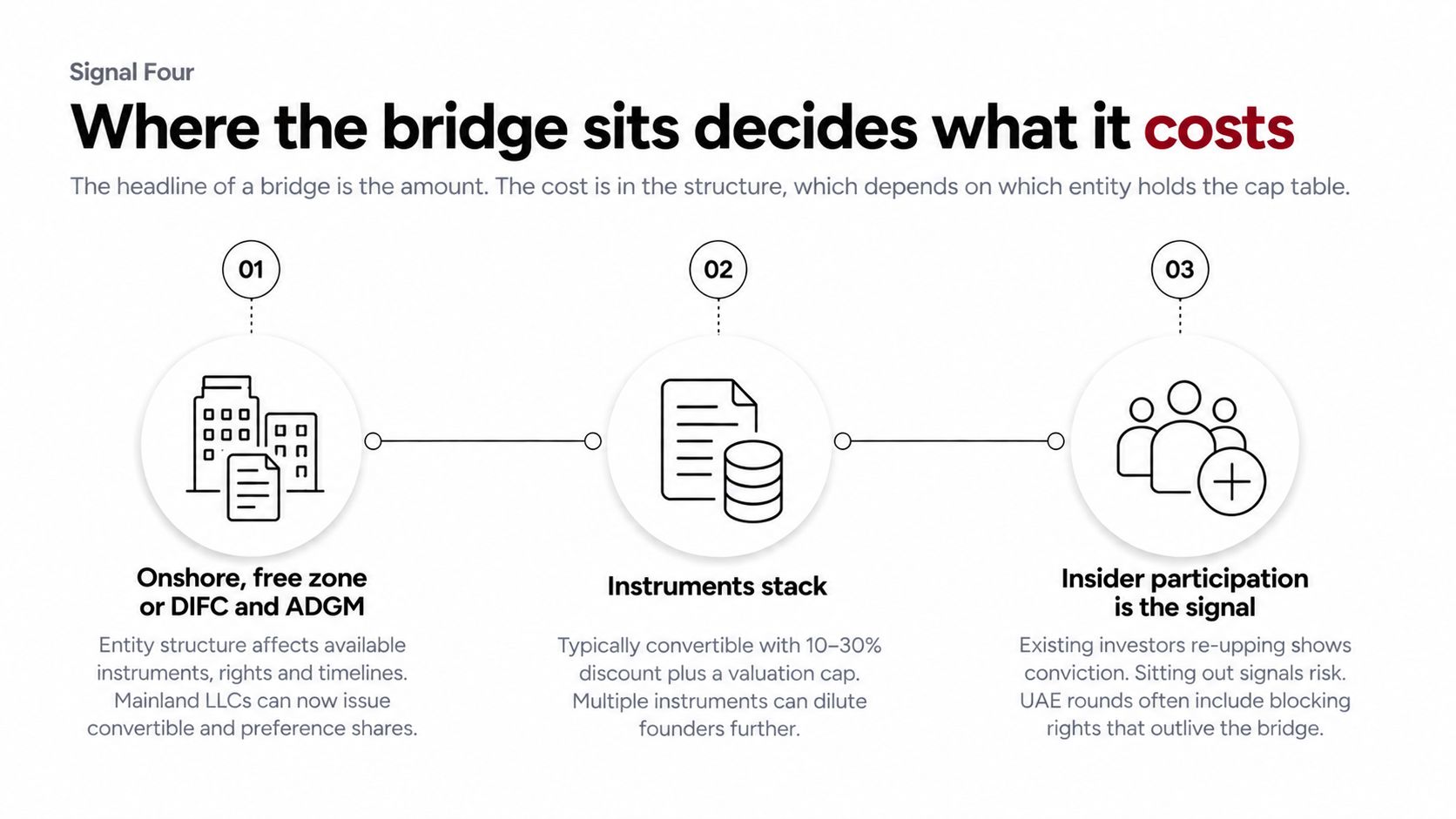
Where the bridge sits decides what it costs
The headline of a bridge is the amount. The cost is in the structure, which depends on which entity holds the cap table.
Onshore, free zone or DIFC and ADGM
Most institutional cap tables sit in DIFC, ADGM or an offshore holdco, because convertible instruments and option pools were awkward onshore. Federal Decree-Law 20 of 2025 changed that from 1 January 2026. Mainland LLCs can now issue preference, convertible and non-voting shares, and drag-along and tag-along rights have a statutory basis.
A conversion into a mainland LLC still meets pre-emption, notarisation and registry updates. Existing shareholders get first refusal, the memorandum of association is amended, and the ultimate beneficial owner register is updated. Build that timeline into the raise rather than discovering it at closing.
Instruments stack
Bridges are usually convertible. Notes written in this market typically carry a discount of 10% to 30% on the next round’s share price, plus a valuation cap. Both apply at conversion, and stacked instruments convert together. Two or three layered on a seed can quietly cost several points of founder ownership. Model the cap table at conversion, not at signing.
Insider participation is the signal
The most watched variable is whether existing investors re-up. When the people closest to the company put in more money, the next investor reads conviction. When they sit out and a new party sets a low price, the same investor reads adverse selection. Structure travels further than price. UAE rounds increasingly grant blocking rights to one core investor or a small group, and those rights outlive the bridge.
✅ Action to Take
Run the dilution model at two prices before you negotiate, one flat and one down. Grounding both in a defensible business valuation turns the conversation from opinion into arithmetic.
- Signal 5
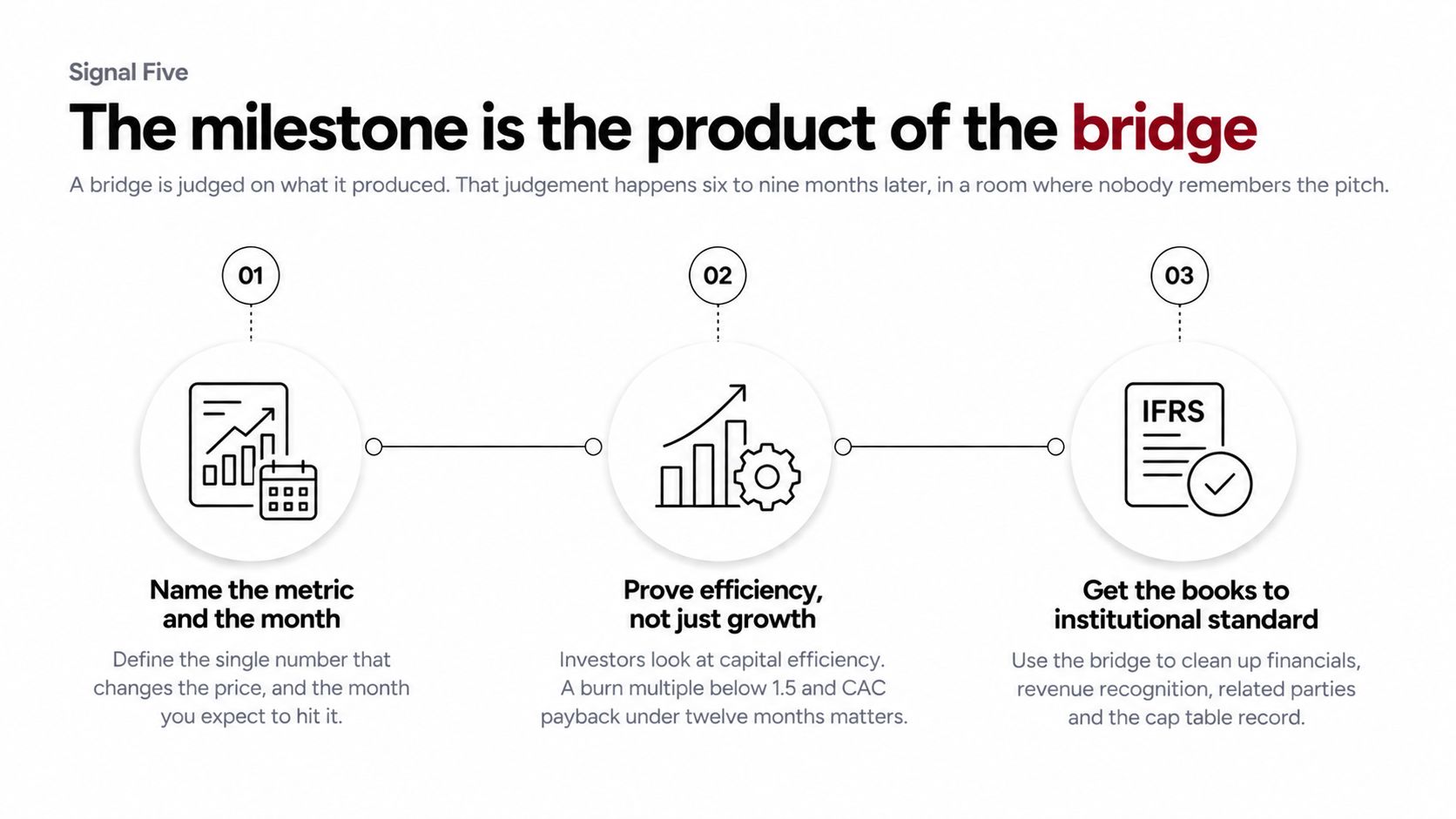
The milestone is the product of the bridge
A bridge is judged on what it produced. That judgement happens six to nine months later, in a room where nobody remembers the pitch.
Name the metric and the month
Write down the single number that changes the price, and the month you expect to hit it. Revenue at a stated level. A signed enterprise or government contract. Vague milestones convert into a second bridge.
Prove efficiency, not just growth
Investors underwriting a post-bridge round look at how much capital each unit of growth consumed. Burn multiple is net burn divided by net new ARR, and David Sacks’ published scale rates anything below 1.5 as great or better. Payback on customer acquisition under twelve months carries similar weight.
Get the books to institutional standard
Regional funds and family offices here run real diligence, and Series A usually expects IFRS-based financials with audit support behind them. A bridge is the window to clean up revenue recognition, related-party balances and the cap table record. Arriving at the next round with messy books costs weeks you have already borrowed.
✅ Action to Take
Publish a monthly investor update from the day the bridge closes. Founders setting this rhythm with a fractional CFO reach the next raise with nine months of evidence, not a new deck.
Not sure whether to bridge, cut or reprice?
One conversation about cash position and milestone narrows it faster than another model.
- Signal 6
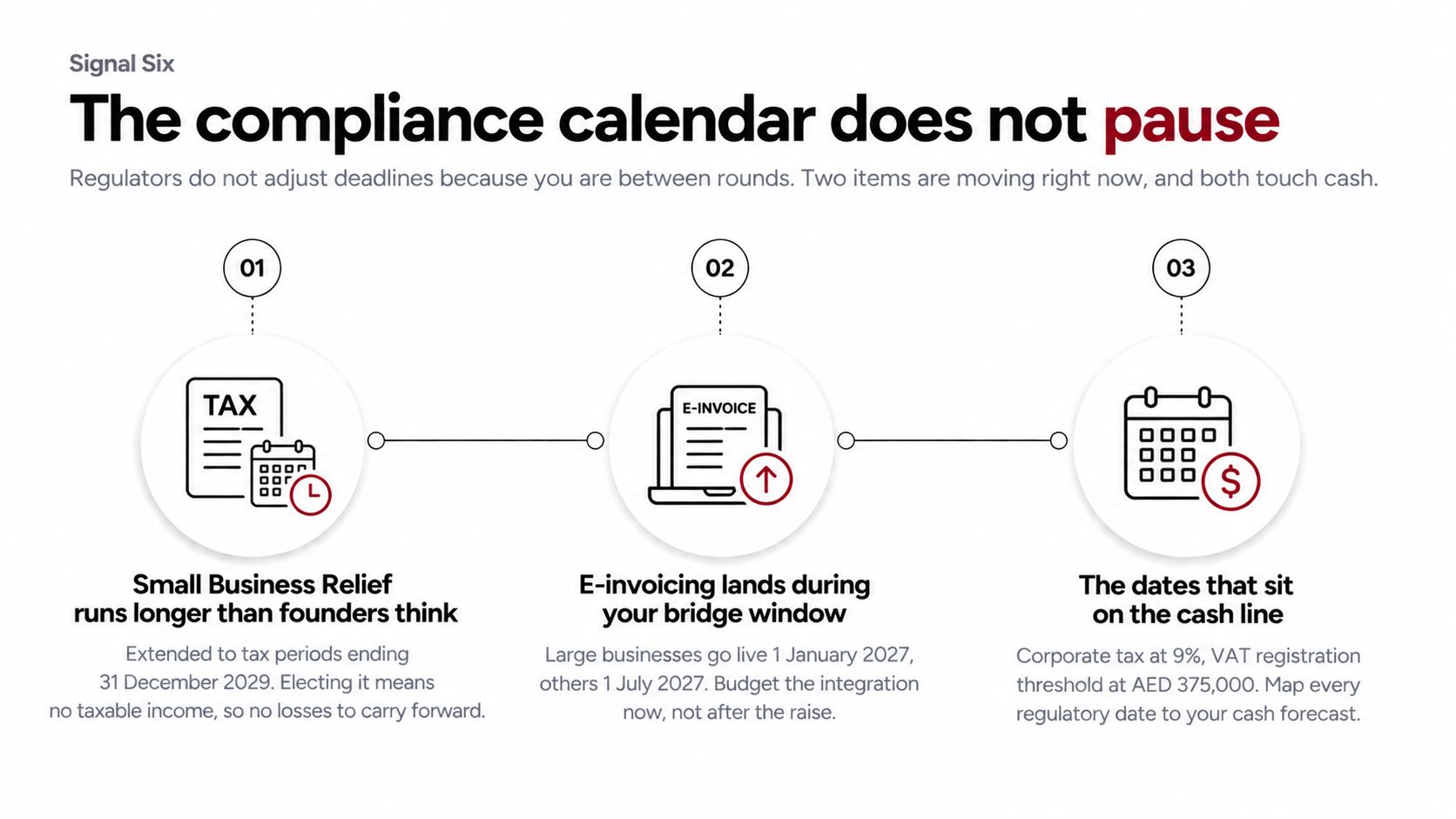
The compliance calendar does not pause
Regulators do not adjust deadlines because you are between rounds. Two items are moving right now, and both touch cash.
Small Business Relief runs longer than founders think
Ministerial Decision 131 of 2026 extended Small Business Relief to tax periods ending on or before 31 December 2029. The AED 3 million revenue threshold is unchanged, Qualifying Free Zone Persons remain excluded, and the relief has to be elected in each return. There is a trap for a loss-making year. Elect the relief and you are treated as having no taxable income, so no tax loss arises to carry forward. Those losses may be worth more later than the filing simplicity.
E-invoicing lands during your bridge window
The pilot went live on 1 July 2026. Businesses with revenue of AED 50 million or more appoint an Accredited Service Provider by 30 October 2026 and go live on 1 January 2027. Everyone else appoints by 31 March 2027 and goes live on 1 July 2027. Check the Ministry of Finance portal for current guidance, then budget the integration inside the bridge rather than after it.
The dates that sit on the cash line
Corporate tax is 9% on profit above AED 375,000, filed and paid within nine months of the tax period end. VAT registration is mandatory once taxable supplies pass AED 375,000. You can confirm the mechanics against the FTA corporate tax guide before you set the payment date. Map every date onto the cash forecast so no payment lands in a month you planned to run thin.
✅ Action to Take
Put every filing, renewal and visa date on the same calendar as the cash forecast. Founders with group or free zone structures keep this current with corporate tax advice rather than checking at year end.
Common Questions
Short answers to what UAE founders ask when a bridge starts to look likely.
Interim financing between priced rounds. It usually sets no new valuation and comes as convertible instruments or an add-on from existing investors. It funds a milestone, not general survival.
Enough to reach the named milestone, plus the months the next raise takes. Sizing to the gap invites a second bridge. Sizing to proof gives the investor something to price.
No. Ministerial Resolution 340 of 2026 removed the 15-day grace period from 1 June 2026. Wages are due by the first of the following month and monitored electronically. MOHRE may suspend new work permits from day five, with fines and reclassification following for repeat violations.
It brings the cost forward. Gratuity accrues at 21 days of basic wage per year for the first five years, then 30 days after that. The settlement is due within 14 days of the last working day, so model the outflow and the saving on the same timeline.
Yes. DIFC uses the DEWS savings plan instead of accrued gratuity, ADGM offers a savings alternative, and both sit outside the federal wage protection regime. The obligations exist either way, but the cash profile differs.
More easily than before. Federal Decree-Law 20 of 2025 lets mainland LLCs issue convertible and preference shares from 1 January 2026. Conversion still runs through pre-emption rights, notarisation and a registry update, so allow time for the process.
Only when a specific milestone will lift the price. Without one, a bridge defers the reset and adds dilution on top. The mechanics differ here too, since repricing a mainland LLC runs through pre-emption and registry updates while a convertible bridge does not.
Long enough to hit the milestone and raise afterwards. MENA deal count fell 41% to 214 in the first half of 2026, the fewest in five years, and UAE deal count fell 37%. Plan against a slower ladder than the one you raised into.
Not automatically. The relief runs to tax periods ending on or before 31 December 2029. Electing it means no tax loss arises for that period to carry forward, so run the comparison before filing.
Usually yes. The work is concentrated over a defined period. Most companies cover it with scheduled part-time CFO time instead of a permanent hire.
The next investor will ask one question about this period. What did the money buy. Everything a CFO does inside a bridge makes that answer specific, dated and checkable. Set the milestone before the raise. Model the cost of every option, including the one you dislike. Keep payroll, filings and renewals on the same calendar as the cash. Those dates decide how much room you actually have.
JaZaa CFO Advisory Team
The JaZaa CFO Advisory Team works with startups and SMEs across the UAE on cash planning, fundraising preparation and management reporting. Members hold US CMA, MBA and capital market qualifications, with backgrounds in financial modelling and capital structuring.
This article provides general information about bridge round financing and cash management for startups and SMEs in the UAE. It does not constitute professional financial, tax, accounting, or legal advice specific to your business. JaZaa provides professional business services including accounting, bookkeeping support, and management consulting. We are not a registered audit firm, tax agent, CPA, or Chartered Accounting firm. Employment settlement obligations, wage protection rules and tax deadlines depend on your entity type, jurisdiction and contracts. Confirm them for your specific situation. Reading this article does not create an advisor-client relationship with JaZaa. For advice specific to your situation, arrange a consultation.